Get Full Government Meeting Transcripts, Videos, & Alerts Forever!
Get email alerts on the Medical Discovery Teams topic
No spam. Unsubscribe anytime.
University highlights medical discovery teams, rural and Native American dementia research and residency programs
Summary
University witnesses described four medical discovery teams funded by a prior state investment, cited NIH grant successes, and detailed statewide clinical training programs including RPAP and a mobile dental clinic supported by health-focused state specials.
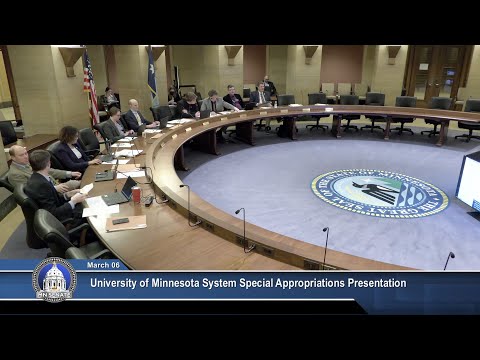
Christine Kiel, interim director for government and community relations, and Beth Nunley, the university’s academic clinical affairs CFO, presented state funding tied to health sciences and medical discovery teams and explained how the funds were used to rebuild faculty capacity and statewide clinical training.
Kiel told the committee that the University of Minnesota Medical School — the state’s only public medical school — trains roughly 70 percent of Minnesota’s physicians and that a 2015 Blue Ribbon Commission recommendation led to targeted state investments to rebuild faculty and research capacity. The state investment (described by presenters as $30 million, delivered as $15 million per year in that biennium) supported creation of four Medical Discovery Teams (MDTs): Addiction; Biology of Aging; Optical Imaging and Brain Science; and Rural and Native American Health Disparities (Memory Keepers MDT).
MDT directors described results and federal leverage. Dr. Mark Thomas (Addiction MDT) said the team has hired 16 new faculty in neuroscience and psychiatry and has initiated clinical trials and statewide outreach to reduce stigma and expand treatment approaches. Dr. Lauren Niedernhofer and Paul Robbins (Biology of Aging MDT) described translational progress that led to a new class of drugs and more than 20 clinical trials; Robbins said the team recently was ranked to receive an NIH center‑level award (a P30) and expects that award to support multiple cores and faculty. Dr. Kamil Ugurbil (Optical Imaging/Brain Science MDT) recounted the university’s historic role developing human brain imaging and the team’s work to combine optical and MRI methods; he said the imaging programs brought “millions” in NIH funding and helped attract top researchers.
Dr. Kristen Jacklin, director of the Memory Keepers Medical Discovery Team in Duluth, described a community‑based participatory research model that engages 11 tribal communities and rural advisory groups, hires community‑based researchers, and has attracted NIH funding (about $18 million since 2020). Jacklin said the team is preparing a $37 million program project grant pre‑approved for submission in May 2025 and has pursued other multiyear NIH applications.
Kiel and Nunley also described state funds that support clinical training: the Rural Physician Associate Program (RPAP), founded in 1971, which places third‑year medical students in nine‑month clinical rotations across rural clinics and hospitals; the Health Training Restoration appropriation (part of the 2015 investments) that supports faculty at eight residency sites, a mobile dental clinic serving Medicaid and Medicare patients, and geriatrics education; and a $9.2 million annual health sciences state special that funds residencies (for example, a St. Cloud residency line of $346,000), the Institute for Engineering and Medicine, partnerships with community clinics, regenerative medicine awards, and the university veterinary diagnostic laboratory.
Presenters emphasized outcomes: MDT hires and grant leverage, increased rural clinical training capacity, and community partnerships that aim to improve screening, earlier diagnosis and culturally appropriate assessments for underrepresented populations. Committee members asked technical and funding questions; presenters said some NIH awards are under review or contingent on federal agency decisions.