Get Full Government Meeting Transcripts, Videos, & Alerts Forever!
Get email alerts on the Reproductive Health topic
No spam. Unsubscribe anytime.
Senate committee backs bill to require insurers to cover vasectomies
Summary
Senate File 1054, which would require insurance coverage for vasectomies, was recommended to pass to HHS after advocates and physicians testified the procedure is safe, cost-saving and promotes reproductive equity.
The Senate Commerce and Consumer Protection Committee voted March 6 to recommend Senate File 1054 to the Health and Human Services Committee. The bill would require insurers to cover vasectomies, typically a brief outpatient procedure, arguing it reduces morbidity compared with surgical alternatives and lowers downstream costs.
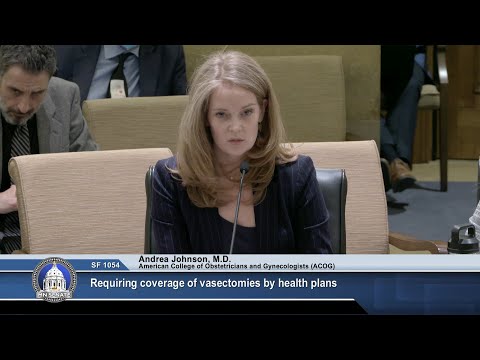
Advocates and clinicians testified in support. Sarah Gangelhoff of the Women’s Foundation of Minnesota said mandating vasectomy coverage would relieve women of disproportionate contraceptive burdens and produce long-term savings: “Requiring vasectomies to be covered at no cost is not just about expanding access to a medical procedure. It’s about closing a glaring gap in our health care system,” she told the committee. Dr. Andrea Johnson, an obstetrician-gynecologist affiliated with the University of Minnesota and speaking for the Minnesota section of the American College of Obstetricians and Gynecologists, said vasectomy is usually an office-based procedure performed with local anesthesia and carries lower risk than tubal sterilization.
Testimony included cost comparisons: witnesses said vasectomies typically range from about $350 to $1,000, while tubal sterilization and associated surgical approaches can cost several thousand dollars (testimony cited figures up to roughly $6,000). The committee reviewed a 62J analysis that estimated a nominal small per-member-per-month impact to plans.
The committee adopted an author’s A1 amendment and approved a motion by Senator Wicklund to recommend the bill to Health and Human Services. The motion passed by voice vote.