Get Full Government Meeting Transcripts, Videos, & Alerts Forever!
Get email alerts on the Agriculture Extension topic
No spam. Unsubscribe anytime.
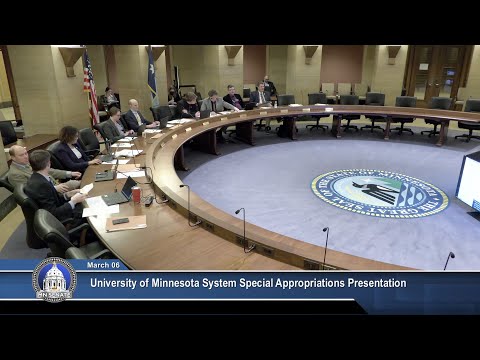
University officials describe how $42.9 million Ag state special funds support Extension, CFANS and 4‑H
Summary
University witnesses told the committee the agriculture state special ($42.9 million) supports the College of Food, Agricultural and Natural Resource Sciences (CFANS), University of Minnesota Extension and other colleges; Extension uses funds for faculty, county offices, 4‑H and nutrient management outreach.
Bev Durgin, dean of University of Minnesota Extension, told the committee the agricultural state special appropriation totals $42,900,000 and is distributed across multiple colleges. She said the College of Food, Agricultural and Natural Resource Sciences (CFANS) receives roughly 50.8 percent of the special, while University of Minnesota Extension receives about 37 percent of the special.
Durgin described Extension’s statewide footprint: offices in all 87 counties, 15 regional offices and about 67 percent of state faculty, educators and staff located throughout Minnesota. She said Extension relies heavily on people (salaries and fringe) rather than facilities, supports more than 30,000 volunteers (Master Naturalist, Master Gardener and 4‑H programs) and that Extension’s website receives about 14 million hits per year.
Durgin said roughly 38 percent of Extension’s $32,000,000 in state funding comes from the state (including the Ag State Special and O&M appropriation), about 23 percent comes from county partners (which provide office space and local funding via three‑year MOAs), and about 27 percent comes from grants, gifts and program income. She said Extension uses state funds to support nutrient management programming, emergency responses such as avian influenza outreach, and the 4‑H youth development program (which currently enrolls about 50,000 youth; Extension reported nearly 10,000 new youth last year, two‑thirds of them from first‑generation families).
Jolene Hadrich, associate dean for Research and Outreach Centers and the Minnesota Agricultural Experiment Station, said CFANS’ total budget is roughly $180,000,000 and that the Ag State Special comprises about 12 percent of the college’s total. She told the committee CFANS used state funds to stabilize research staffing and to leverage external funding; CFANS faculty and research staff brought in about $75,000,000 in external research funding in fiscal year 2024, Hadrich said.
Both witnesses emphasized that many state special and O&M appropriations have been level‑funded for years and that inflation has eroded purchasing power. They said when appropriations decline, units within a special are reduced proportionally to preserve original legislative intent reflected in historic work papers.