Get Full Government Meeting Transcripts, Videos, & Alerts Forever!
Get email alerts on the State Budget topic
No spam. Unsubscribe anytime.
Minnesota GOP leaders call for spending cuts after forecast shows $6 billion shortfall
Summary
House and Senate Republican leaders said a recent state budget forecast shows a roughly $6 billion shortfall and urged spending reductions, fraud prevention and agency savings while pledging no tax increases as they work toward a May 19 budget deadline.
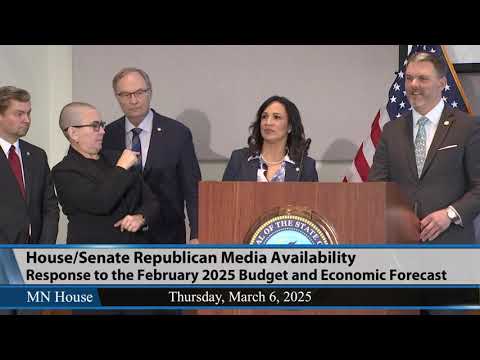
At a press conference in St. Paul, Speaker Damoth, a House Republican leader, said Minnesota faces roughly a $6 billion budget shortfall and urged immediate spending reductions while ruling out tax increases.
The forecast “We are now at looking at a $6,000,000,000 deficit,” Speaker Damoth said, adding that Republicans plan to pursue “tax saving cuts and absolutely no tax increases.” He also said, “We have 6,000 new FTEs that were created in the state of Minnesota just over the last 2 years,” and cited “over $600,000,000 in known fraud” as reasons to seek savings.
Republican leaders framed the shortfall as the result of two years of Democratic control, saying an $18 billion surplus two years ago and $10 billion in subsequent tax and fee increases left the state exposed when costs rose. “Just in 2 years, 2 years ago, we had an $18,000,000,000 surplus and then hit family budgets even harder with raising taxes and fees by another $10,000,000,000,” Speaker Damoth said. He added that the November forecast showed a $5.1 billion deficit and that “as you can see today, that has gotten even worse.”
Senate Republican leader Mark Johnson said the long-term forecast shows structural imbalance and repeated that GOP concerns about spending and fraud. “Simply put, Democrats have put us in an unsustainable spending path and that will hurt every Minnesotan,” Johnson said, adding that Minnesota’s private economy is being “stifled by the massive increases in government spending, government taxes, and government regulation.”
Paul Torkelson, chair of the House Ways and Means Committee, said the caucus will not pursue straight across-the-board cuts. “We have no intention of doing straight across the board cuts,” Torkelson said. He said the committee will attempt to “find first, unspent funds that we can claw back, identify where fraud has happened, and cut state agencies where we can.” Torkelson also said some agencies were not reduced after parts of them were moved into new units, and that the caucus intends to reduce government “complement of employees” where appropriate.
Leaders repeatedly stressed a target to finish budget work by May 19. Speaker Damoth said he had requested standing meetings with the governor two months earlier and was still awaiting them; he said he looked forward to meeting with Democratic leaders and the governor.
Republican leaders also referenced possible federal budget changes and tariff negotiations in Washington, D.C., but said Minnesota’s immediate work is to address the state forecast. “We have to focus on what we are doing here in the state of Minnesota,” Speaker Damoth said, while acknowledging the uncertainty federal actions could create because a third of the state budget is federal funds.
The leaders identified several numerical items they said justified their approach: an $18 billion surplus two years ago, $10 billion in taxes and fees raised since then, a November forecast showing a $5.1 billion deficit and a current $6 billion shortfall, about 6,000 new FTE positions added in the last two years, roughly $1 billion in grants to nonprofits, and $600 million described as known fraud.
The leaders said they will seek joint targets with Democrats and continue negotiations, and signaled committees will examine agency budgets, recover unspent funds, and pursue fraud prevention. They did not provide a detailed, itemized savings plan at the press conference.
May 19 remains the date leaders cited for completing budget work; they said some decisions could be influenced by pending federal actions but that the state will prioritize its own budgeting work.