Get Full Government Meeting Transcripts, Videos, & Alerts Forever!
Get email alerts on the Government Oversight topic
No spam. Unsubscribe anytime.
Senate concurs in amendment to restore GOAC subpoena power without Executive Board ratification
Summary
The Senate concurred in House amendments to Senate Bill 176, restoring independent subpoena authority to the Government Operations and Audit Committee (GOAC) and removing a prior need for Executive Board ratification.
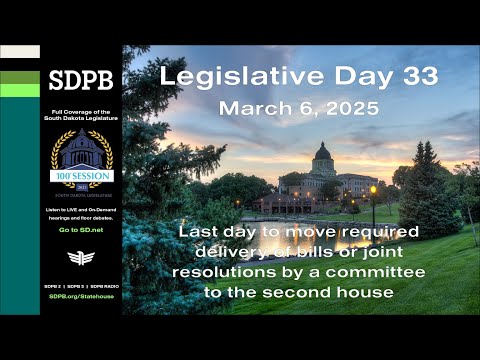
The South Dakota Senate on March 6 concurred in House amendments to Senate Bill 176, a measure that clarifies and restores subpoena authority to the Legislature's Government Operations and Audit Committee (GOAC).
Senator Wheeler explained that the amendment removed a requirement that GOAC subpoenas be ratified by the Executive Board; under the change, GOAC would be able to issue subpoenas without further ratification. "GOAC, if this bill passes, would thereafter be able to issue a subpoena without further ratification," Wheeler said on the floor, adding he supported the change.
Senator Carr, among others, defended the committee's role and described GOAC as a key legislative oversight body that seeks efficiencies and accountability in state government. "This restores GOAC with the powers that originally [were] intended for and gives them the additional tools of investigative powers," Carr said.
The motion to concur was approved by roll call. The Senate recorded 33 ayes and zero nays with two excused members and the president declared the motion carried.
The amendment's effect is to allow GOAC — a statutorily created oversight committee — to exercise investigatory subpoenas on its own authority, rather than requiring subsequent approval by the Legislature's Executive Board. Proponents said GOAC has demonstrated responsibility in exercising oversight; opponents were not prominent on the floor during the recorded discussion.
The concurrence allows the bill, as amended, to move forward in the legislative process.