Get Full Government Meeting Transcripts, Videos, & Alerts Forever!
Get email alerts on the Energy Nuclear topic
No spam. Unsubscribe anytime.
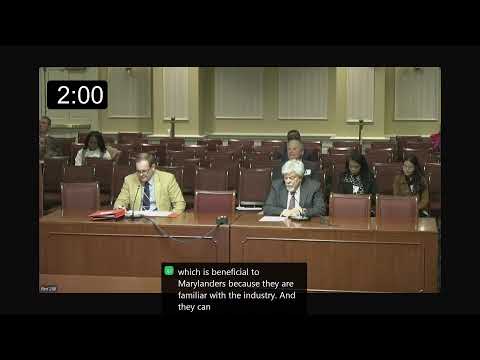
Senate committee hears bill to add nuclear to Maryland's renewable portfolio and create NREC market
Summary
Senator Christopher Brooks introduced Senate Bill 716 to make new nuclear generation a Tier 1 resource in Maryland's Renewable Portfolio Standard and to create tradable nuclear renewable energy credits, arguing the move would attract private investment and improve grid reliability.
Senator Christopher Brooks introduced Senate Bill 716, the Decarbonation Infrastructure Solution Act of 2025, asking the Senate Education, Energy, and the Environment Committee to add new nuclear generation to Maryland's Tier 1 Renewable Portfolio Standard and to create a market of nuclear renewable energy credits (NRECs) that utilities could buy.
The bill would make nuclear plants built after October 2025 eligible for Tier 1 status and would phase in a minimum share of nuclear-derived energy, starting at 4% in 2026 and rising toward 50% by 2040, according to Brooks' written presentation. Brooks called the measure "a blueprint for Maryland's clean energy future," saying nuclear provides high capacity factors and zero greenhouse-gas emissions.
Proponents said the measure aims to attract private capital while protecting consumers. Ray Baker, Maryland director for the Baltimore-DC Building Trades Council, told the committee his members "stand ready, excited, willing, capable, and eager to deliver" work tied to the projects and praised labor standards and local hiring language in the bill. Roger Manno, speaking for a consortium of trades and contractors, said the bill creates a market-driven NREC approach that avoids direct subsidies while giving the Public Service Commission (PSC) oversight to protect ratepayers.
Brooks and witnesses described the bill as different from the governor's and other bills heard this session because it explicitly places nuclear into the RPS as a Tier 1 resource and establishes minimum procurement percentages for nuclear energy to meet RPS requirements. The sponsor said the bill would let the PSC set compliance values for NRECs annually and include guardrails such as labor protections, ratepayer benefit requirements, and cost caps.
Committee members asked a few technical questions; no formal votes occurred during the hearing. Witnesses emphasized the bill would not prevent continued investments in wind, solar, or geothermal. Manno and others said the NREC approach lets nuclear compete on equal footing with other Tier 1 resources while providing private-sector incentives to finance plants without direct state procurement.
Supporters noted existing market and grid context: Maryland currently relies on a mix of generation that includes nuclear, and witnesses argued adding new in-state nuclear or small modular reactors would increase reliability and capacity at high utilization rates. The bill includes PSC review steps for project feasibility and a requirement that PSC set compliance values not to fall below a floor designed to ensure competitiveness.
Opponents were not on the record at this hearing; committee staff and PSC representatives indicated technical amendments and cross-agency coordination may follow as the bill advances.