Get Full Government Meeting Transcripts, Videos, & Alerts Forever!
Get email alerts on the Committee Voting Session topic
No spam. Unsubscribe anytime.
House Judiciary Committee advances range of bills including DNA database changes, ‘‘Buddy’s Law’’ and medical parole amendments
Summary
The House Judiciary Committee on March 6 advanced a slate of bills, adopting amendments on several and moving others forward for further consideration.
The House Judiciary Committee on March 6 advanced a slate of bills, adopting amendments on several and moving others forward for further consideration.
The committee voted to adopt an amendment to a Department of State Police-sponsored bill on the statewide DNA database, approved legislation increasing the maximum civil recovery for serious injury or death of a pet (commonly referred to in committee as "Buddy's Law"), and moved amendments into House Bill 11-23 that add medical-parole details and a funding provision to expand case review capacity.
Why it matters: the actions change how the state collects and manages DNA samples, raise the civil cap for pet-injury claims from $10,000 to $25,000, and adjust the medical- and geriatric-parole process — including removing the governor from the medical-parole decision pathway and directing $1 million from the Justice Reinvestment Fund to add case examiners. Several items also include procedural changes that affect day-to-day interactions between state government and residents, such as jury excusal rules for nursing/breastfeeding parents and requirements for notification when someone dies in a correctional facility.
DNA database bill (House Bill 259) Claire, a committee staffer, described an amendment "that basically reflects what the Senate did." She said the change "creates an exception for citizen initiated charges and reduces the maximum fine from $10,000 to $1,000." Claire also described the underlying bill as a departmental, housekeeping measure requested by the Department of State Police that "alters the circumstances in which a DNA sample must be collected and stored in the statewide DNA database system, alters the individuals required to collect the DNA samples, and alters the process for collecting the samples, clarifies when a DNA sample may be tested, placed in the database system or destroyed and expunged." The committee adopted the amendment and then moved the bill favorably.
"So this is, basically this is a departmental bill requested by the Department of State Police," Claire said. "...there are 13,000 DNA samples that are in limbo and this will clear it up." The committee voted to advance the bill as amended.
"Buddy’s Law" (House Bill 438) The committee debated an amendment to change the bill title to include the name "Buddy's Law" and whether the civil-damages cap should be $20,000 or $25,000. The sponsor and other members clarified this is a civil remedy, not a criminal penalty: a member explained, "This is not a criminal bill, this is a civil bill. ...you can be awarded up to $25,000." Committee members voted to add the title and to move the bill favorably as amended.
Assisted outpatient treatment (House Bill 592) Delegate Phillips reminded the panel that assisted outpatient treatment — a mechanism to require outpatient psychiatric care for some individuals — passed a House committee in 2024 and will not be fully implemented until 2026, with a pilot already underway. She said the psychiatric association requested placement of certain individuals on a prohibited-persons registry; the committee moved the bill favorably.
Probate publication and register-of-wills change (House Bill 623) Members debated an amendment proposed by Delegate Moon that narrows a move from mandatory newspaper publication to an incremental approach using the register-of-wills website for known heirs. The adopted amendment requires publication on the register-of-wills site for certain known parties (spouse, registered domestic partner, lineal ancestors or descendants) while retaining newspaper publication where heirs are not known. The committee also directed drafting of a possible reporting amendment to ask county registers to report how many people are identified via the website process.
Notification when an incarcerated person dies (House Bill 775) The committee advanced a bill that would require correctional facilities to notify state delegates and senators for the legislative district where a facility is located, and the county chief executive (mayor or county executive) when someone dies in a Department of Corrections facility. Members said situational awareness and constituent inquiries motivated support; several delegates described correctional staffing and safety concerns in their districts. The committee voted to move the bill favorably.
Other actions and amendments - Amendments to House Bill 1060 clarified terminology (substituting "uniformed services" for "armed forces" and restoring the phrase "honorable discharge") and were adopted; the bill moved favorably as amended. - House Bill 1140 (jury service and lactation) was amended to lower the age threshold for an automatic consideration from a child younger than 4 to younger than 3 for those who need continuous care. The amendment also clarifies that a jury judge or jury commissioner may excuse a breastfeeding person or caregiver but is not required to do so; the committee moved the bill as amended. - House Bill 11-23 (medical and elder parole): the committee added language from House Bill 190 to clarify medical-parole criteria and remove the governor from medical-parole consideration. The amended bill also directs $1,000,000 from the Justice Reinvestment Fund to hire two additional case examiners to focus on people 60 or older with at least 20 years of incarceration to help clear a backlog of cases for review. Committee members noted the Senate may be considering different, broader approaches to geriatric parole; the House bill as amended will continue through the process.
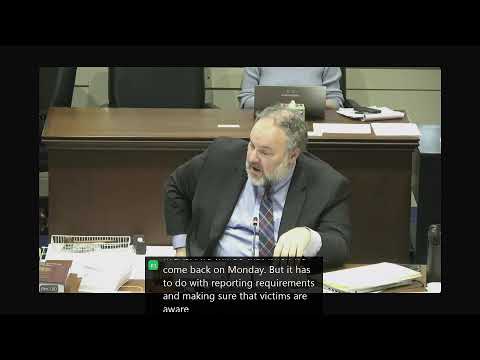
Votes at a glance - HB 259 (DNA database) — Amendment adopted; bill moved favorably. - HB 438 (Buddy's Law — increased pet-damage civil cap to $25,000) — Title amendment ("Buddy's Law") adopted; bill moved favorably as amended. - HB 592 (Assisted outpatient treatment) — Moved favorably (motion adopted). - HB 623 (Register-of-wills publication changes) — Moon amendment adopted; bill moved as amended; committee asked for a reporting amendment to be drafted. - HB 775 (Notification on deaths in correctional facilities) — Moved favorably. - HB 1060 (Uniformed services wording / discharge language) — Amendments adopted; bill moved as amended. - HB 1140 (Jury excusal and lactation) — Amendments adopted; bill moved as amended. - HB 11-23 (Medical and elder parole) — Amendment adopting medical-parole provisions from HB 190 adopted; funding provision to add case examiners included; bill held for further victim-notice amendment discussion on Monday. - Several other bills were withdrawn by motion (list provided to committee) and several items were held for later consideration.
What's next Committee members said they will reconvene for a voting session Monday at 2 p.m.; subcommittee hearings are scheduled Monday at 10 a.m., 11 a.m., noon and 1 p.m., with floor sessions anticipated Tuesday. Members noted time constraints and plans to return to outstanding amendments and a victim-notice amendment to the parole bill on Monday.
Ending note Chair and vice-chair procedural remarks closed the panel with reminders about scheduling; no final enactments occur in committee — bills advanced here will continue through the legislative process.