Get Full Government Meeting Transcripts, Videos, & Alerts Forever!
Get email alerts on the Eminent Domain Property Rights topic
No spam. Unsubscribe anytime.
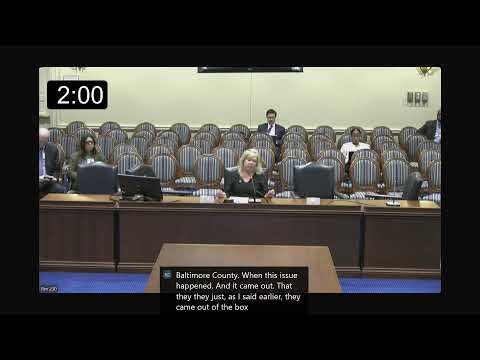
Committee hears multiple bills on eminent domain, conservation easements and compensation for landowners
Summary
The Economic Matters Committee heard several related bills proposing limits on eminent domain for conserved land, expanded compensation for landowners and reimbursement for legal costs in condemnation proceedings.
Lawmakers, farm groups and conservation organizations urged the Economic Matters Committee on Thursday to strengthen protections for landowners facing condemnation, and to ensure fair compensation where eminent domain is used.
Delegate Michelle Guyton opened testimony on House Bill 631, which would bar condemnation of privately held land subject to a conservation easement. "I am asking you to prohibit the government or any instrumentality of it from using eminent domain to take land that is already subject to an existing conservation easement," Guyton said. Supporters told the committee the change would protect investments in long-standing preservation programs.
Representatives of agricultural groups and land trusts testified in favor. Tyler Huff of the Maryland Farm Bureau said the organization opposes using eminent domain against preserved farmland because it undermines trust in conservation programs. Lindsey Thompson of the Maryland Grain Producers Association explained that overhead transmission through preserved parcels can prevent use of essential farm equipment: she cited easement language that restricts operations that would let large sprayers or combines pass under lines, which would "be extremely disruptive for future agricultural production." Michael Sonnenfeld of Land Preservation Trust said Maryland has invested more than $1.3 billion in land preservation and urged protection of those investments.
Related bills brought additional protections for landowners whose property is condemned. Delegate Doug Mangione presented House Bill 1337, which would expand damages to include lost profits for small businesses and farms that will be destroyed by eminent domain. "If we're going to allow these large out-of-state utility companies to use eminent domain to destroy our small businesses, then fairness requires that we make them provide for lost profits," Mangione said.
A companion measure, House Bill 1362, would require the condemning authority to reimburse landowners for reasonable legal, appraisal and expert expenses if the owner obtains a judgment above the initial offer. Delegate Mangione testified that the change would level an otherwise asymmetric process where utilities bring teams of experts and landowners must hire counsel to protect their interests. He cited U.S. Supreme Court precedent noting that reimbursement for such costs is a matter of legislative discretion.
Supporters argued the bills respond to recent transmission proposals, such as the Piedmont Reliability Project, and to community concern about transparency and negotiation tactics. Opponents were not prominent in the transcript for these items, though committee members asked about the interactions between existing easement language and proposed statutory changes. Witnesses acknowledged that some easement templates already contain narrow clauses allowing taking for transmission where the project benefits Marylanders or where legislative approval is given; HB 631 would create a statewide bar regardless of preexisting easement clauses.
Committee members asked technical questions about retroactivity, interaction with MALPF (the Maryland Agricultural Land Preservation Foundation) easement language, and whether exceptions should be carved out for public-safety infrastructure such as runway extensions. Witnesses from farm bureaus and land trusts said they would work with sponsors on narrow amendments to address public-safety carve-outs while preserving the broader protection against condemnation of easement-held land.
No formal committee votes were taken at the hearing.