Get Full Government Meeting Transcripts, Videos, & Alerts Forever!
Get email alerts on the Solar On Ag Land topic
No spam. Unsubscribe anytime.
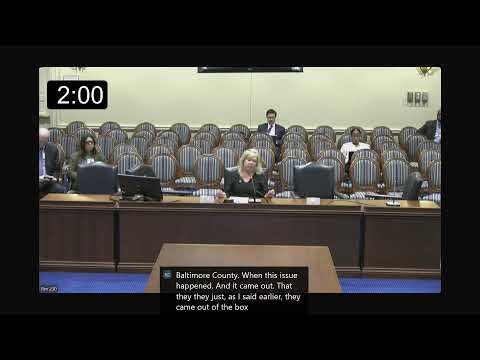
Eastern Shore speakers urge local control and bar eminent domain for utility-scale solar
Summary
Residents and local officials from Maryland's Eastern Shore urged the Economic Matters Committee to protect agricultural land from utility-scale solar development, emphasizing local control and a prohibition on eminent domain in testimony on House Bills 739 and 742.
A group of Eastern Shore residents and local officials told the Economic Matters Committee on Thursday that state solar siting policies should not be pursued at the expense of large-scale agriculture and private property rights.
The witnesses pressed two main points: they want stronger local control over where utility-scale solar can be built and want to prohibit the use of eminent domain to acquire farmland for solar projects. "Property rights are very important to the folks that we serve," one Eastern Shore testifier said, adding that while local delegates and counties are not opposed to solar, they want to "make sure that we trust the work that they've already done" at the county and planning levels.
The testimony came during hearings on House Bill 739 and related measures. Commenters described agriculture on Maryland's Eastern Shore as a multibillion-dollar industry that supports thousands of jobs. One testifier said the regional agricultural economy is an "$8,250,000,000 industry" that employs "over 300,000 people," and argued that long-term soil loss and the disruption of integrated supply chains could be irreversible if prime farmland is converted to solar.
Residents and county officials described rapid outreach from solar developers to landowners. "They're getting letters it seems like weekly," Matthew Jones, a resident who testified, said of landowner solicitations. Several testifiers described lease offers that they said ranged from about $1,500 to $3,000 per acre per year and sometimes an upfront signing bonus of about $15,000, figures they said were tempting to older landowners but raised community concern about losing generational farms.
Speakers urged the committee to preserve local caps and local review processes already adopted in some counties. Caroline County staff and officials were cited repeatedly as an example: one testifier said the county had a local cap of about 2,000 acres and that it has already put about 1,000 to 2,000 acres into early construction, with silt fence visible along many roads. Witnesses warned that a single statewide percentage cap could produce widely divergent results by county and cited Worcester County as an example where a simple percentage could translate into thousands of acres.
The Maryland Energy Administration's (MEA) position also drew repeated comment. Witnesses said a recent MEA letter indicated the administration wants to retain eminent domain as a potential tool to meet state renewable-energy targets; testifiers opposed that stance. One Eastern Shore testifier said, "Under no circumstances should we ever use eminent domain for utility scale solar because we have so many other options," and asked the panel to consider statutory language that would explicitly bar eminent domain for solar facilities.
Committee members asked multiple questions about the tradeoffs between meeting state renewable targets and protecting farmland. Witnesses said they support renewable energy generally, but that rooftop, parking-lot, and brownfield options should be prioritized over taking highly productive cropland. Several county officials invited committee members to visit local farms and review county ordinances that set setbacks, fencing standards and modest acreage caps.
Less technical topics also came up: witnesses described chain-link or barbed-wire security fencing installed around some arrays, concern about cumulative fragmentation of farmland, and uncertainty about how long land taken out of production would take to return to high-yield agriculture if it were ever restored.
The hearing concluded with residents asking the committee to pass legislation that preserves local decisionmaking and removes eminent domain from the solar siting toolbox. No formal committee votes were recorded during the hearing.
The committee moved on to other bills after the testimony concluded.