Get Full Government Meeting Transcripts, Videos, & Alerts Forever!
Get email alerts on the Supplemental Budget topic
No spam. Unsubscribe anytime.
Appropriations Committee hears analysis of supplemental budget; BRE write-down puts state budget out of balance
Summary
Legislative analysts told the Appropriations Committee that the governor's supplemental budget would leave a roughly $100 million cash balance before a Board of Revenue Estimates (BRE) downward revision; applying the BRE write-down would create an estimated $247 million deficit by the end of fiscal 2026, leaving lawmakers to identify fixes.
The Appropriations Committee heard a presentation on Supplemental Budget No. 1 showing a roughly $100 million projected general fund balance under the governor's plan — before a Board of Revenue Estimates adjustment announced the same day that cuts roughly $350 million from projected general fund revenues across fiscal 2025 and 2026.
That BRE revision would turn the governor's plan into an estimated $247 million deficit by the end of fiscal 2026, David Romans of the Department of Legislative Services told the committee. "If you were to take in the BRE write down ... you have a closing balance of about $247,000,000 negative under the governor's plan," Romans said.
Why it matters: the shortfall means the General Assembly must take additional steps to bring the budget into balance, lawmakers and analysts said. The supplemental includes a mix of one-time transfers, fund swaps and spending restorations that reduce near-term pressure but depend on further legislative action and accounting treatments to be effective.
Key revenue and transfer changes described by analysts include an $80 million transfer from the Strategic Energy Investment Fund to the general fund, and approximately $78 million pulled from the local income tax reserve fund on top of an earlier $230 million transfer proposed by the Administration. Analysts said part of the local reserve payback would be stretched over 10 years consistent with prior Budget Reconciliation and Financing Act (BRFAA) provisions; other portions relate to family program costs.
Analysts also described a $20 million draw from the state unemployment insurance fund balance that would leave about $10 million in that fund at the end of fiscal 2026, and technical corrections to the Innovation Investment Tax Credit appropriation. Revenue-side changes in the supplemental reflect fiscal-note estimates tied to the governor's income tax and capital gains proposals and small negative effects on estate and inheritance tax revenue.
On the spending side, the largest single increase in the supplemental is roughly $297 million across fiscal 2025 and 2026 for the Developmental Disabilities Administration (DDA) to address funding shortfalls and to restore some cost-containment measures that cannot be implemented in fiscal 2025 without federal (CMS) approvals. Romans said the supplemental does not reinstate all proposed cost containment; additional restorations would require lawmakers to add funds in future years.
Other spending and technical items noted by Tanya Zimmerman and DLS staff include: restoration of a contingent special fund appropriation tied to the Division of Paid Leave (about $37.3 million), shifting some tax-credit funding for the More Jobs for Marylanders program from general funds to existing special funds, and withdrawing employee increment funding for managers and employees not covered by collective bargaining agreements in fiscal 2026.
The supplemental would add positions and funding in some agencies: the presentation lists 98 new positions overall, including 44 realigned into MDOT from the Transportation Authority, with DLS recommending deletion of most of the 54 non-MDOT positions. The package also includes modest PAGO (pay-as-you-go) spending increases — $2 million for a life-skills and reentry program and $2 million across 2025–2026 for TradePoint Atlantic — and federal grant increases, notably for enrollment-driven aid in the State Department of Education and Section 8 administration in the Department of Housing and Community Development.
Analysts flagged several fund realignments and swaps in the supplemental, including proposed transfers of special funds (two $50 million items) tied to alternative compliance payments that DLS questioned as potentially inconsistent with statutory uses; DLS recommended making some uses contingent on subsequent legislation. The presentation concluded with staff offering to take committee questions about the supplemental and the BRE revision.
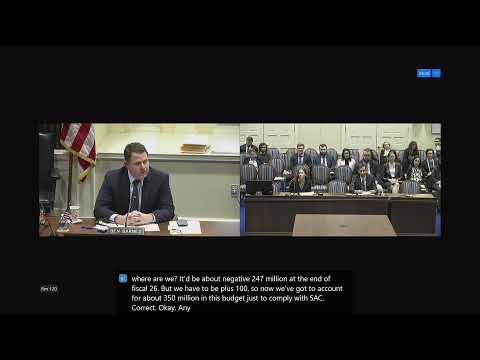
Committee process: after the presentation and short Q&A about the BRE revision, the committee chair noted the Legislature will need to act: "we've got to account for about $350,000,000 in this budget just to comply with SAC," the chair said during questioning of staff. The committee adjourned and scheduled a reconvening at 2:30 p.m. to vote on committee business.
What was not decided: the hearing was a staff presentation and discussion; it did not include formal committee votes on the supplemental or enact statutory changes. Analysts and committee members repeatedly described several items as contingent on BRFAA actions or other legislation, meaning further committee and floor action would be required to effect the transfers and payback schedules described in the presentation.