Get Full Government Meeting Transcripts, Videos, & Alerts Forever!
Get email alerts on the Chesapeake Bay Legacy Act topic
No spam. Unsubscribe anytime.
Committee Hears Broad Chesapeake Bay Legacy Act Aimed at Farming, Fisheries and Monitoring
Summary
A multidisciplinary bill to modernize agricultural incentives, fisheries management and water-quality monitoring in the Chesapeake Bay drew lengthy testimony and stakeholder support at the House Environment and Transportation Committee on March 6.
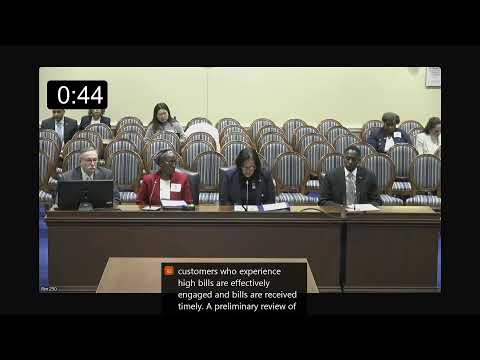
House Environment and Transportation Committee members heard detailed testimony on House Bill 506, the Chesapeake Bay Legacy Act, on March 6, a multi-part bill the administration says would update agricultural incentives, fisheries management and the state's water-quality monitoring systems to accelerate Bay restoration.
Saif R'Toole, deputy legislative officer for Governor Wes Moore, told the committee the proposal is intended to "accelerate Bay restoration" and was developed with "watermen and conservationists" as well as state agencies. "Simply put, this is a comprehensive legislation provides a unique opportunity for Maryland to step up and make real progress for the Bay's future," R'Toole said.
The bill as presented would: - Establish the LEAF (Leaders in Environmentally Engaged Farming) program, a voluntary, scored incentive program modeled on LEED certification to encourage conservation and community practices on farms; - Add a statutory definition for regenerative and healthy-soil practices and incorporate those into existing healthy-soils language; - Modernize the Department of Natural Resources' role in water-quality monitoring to accept and process standardized community, academic and nonprofit monitoring data; - Clarify and expand statutory authority for fisheries management planning to allow pilot fisheries, integration of climatological data, and more flexible permitting for aquaculture leases; and - Permit the Department of Natural Resources to offer longer-term agricultural leases on state land to improve land access for beginning and specialty farmers.
Kevin Addicks, Secretary of the Maryland Department of Agriculture, described LEAF as a scored program that will "encourage our farmers to adopt conservation practices" and said the department envisions using incentives beyond traditional cost-share rules. "Much like you can walk into a LEED-certified building and notice whether it is LEED bronze, silver, gold or platinum," Addicks said, "that that will be for farming." He also said the bill includes an amendment to secure year-one funding for initial staff to support farmers.
Josh Kurtz, Secretary of the Department of Natural Resources, called for updated water-quality monitoring and said the bill would formalize DNR's role in processing diverse data streams. "Things are changing rapidly in the Bay and in order for us to make our best management decisions we need to have up-to-date water quality monitoring," Kurtz said, describing aims to accept vetted community and academic data, speed permitting for aquaculture, and enable cross-cutting fisheries plans that account for climatic shifts.
Industry and conservation groups provided largely favorable testimony. Ward Slacum, executive director of the Oyster Recovery Partnership, said HB 506 would clarify leasing and dispute-mediation steps for aquaculture leases and help attract private investment. Kim Coble of the Maryland League of Conservation Voters called the bill's water-quality monitoring provisions ‘‘robust and efficient' and highlighted expanded conservation practices on agricultural land.
Members asked officials to clarify several items. Delegate Kent Jacobs pressed the administration on language requiring state alignment with the Atlantic States Marine Fisheries Commission (ASMFC), asking whether the word "shall" in the bill could be changed to "may." Secretary Kurtz said the language reflects the interstate compact but does not remove Maryland's ability to appeal or take legal action when disagreements arise; he also acknowledged ongoing conversations about how the state can better represent the charter-boat sector within interstate management.
Delegate Michael Delgado asked how third-party community monitoring data would be validated. Kurtz responded that the bill would establish recognized protocols and training so that data collected by an individual or group could be used by the state if it followed the program's procedures.
Several watermen's organizations and aquaculture advocates testified they are favorable with amendments after negotiated changes, including restoration and fishery-management clarifications and explicit language about angler and commercial-participant definitions. Captain Robert Newberry of the Delmarva Fisheries Association said his group had initially opposed the bill but moved to support it after changes; he also announced pending litigation against ASMFC in the U.S. Supreme Court seeking standing to challenge interstate management (the litigation was described by Newberry as newly filed and pending).
Committee members and agency officials emphasized the bill's cross-cutting approach: agriculture, aquaculture, and fisheries measures are framed as interdependent actions intended to accelerate attainment of Bay restoration targets and to support the regional seafood economy.
The committee concluded the hearing on HB 506 with no formal vote recorded on March 6. Administration witnesses said they would continue to work with stakeholders on amendments and funding details.