Get Full Government Meeting Transcripts, Videos, & Alerts Forever!
Get email alerts on the School Facilities Bond topic
No spam. Unsubscribe anytime.
Eagle Pass ISD board appoints facilities committee after bond-capacity presentation
Summary
The Eagle Pass Independent School District board voted to appoint a facilities improvement committee to develop a five-year facilities plan after hearing financial advisers outline potential bond timing, tax impacts and funding scenarios.
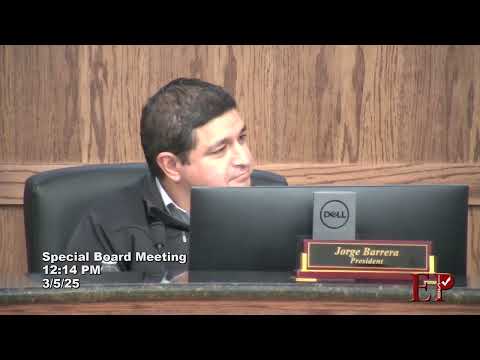
The Eagle Pass Independent School District Board of Trustees voted Wednesday to appoint a facilities improvement committee to begin a five-year district facilities improvement plan after a presentation on potential bond timing and tax impacts by financial advisers from PFM.
The board approved the administration’s request to form the committee in a motion by Trustee Morris Lipson, seconded by Trustee Tom Gonzales; the motion passed by voice vote. The meeting also included a presentation from Blake Roberts, managing director and partner at PFM, on bond-market conditions, the district’s debt capacity and how state support could affect tax-rate impacts.
Why it matters: the committee will inventory campus needs, prioritize projects and inform whether the district should place a bond measure before voters. Bond authorization would affect the district’s debt service tax rate; PFM presented multiple scenarios showing how the same bundle of projects could change taxpayers’ bills depending on the total authorization and the amount of state debt-service support.
Roberts told the board that while headline interest rates for mortgages and taxable borrowing remain high, school districts typically borrow on a tax-exempt basis and can still access relatively lower rates. “On a 30‑year school bond, today that would be between 4 and 4.5 percent on an interest‑rate basis,” Roberts said, adding that tax‑exempt rates are different from mortgage or treasury headlines.
PFM outlined timing and process steps for a potential November bond election, including forming a citizens bond committee, engaging architects to scope projects, and approving an order calling the election at an August board meeting to meet the calendar. Roberts said some projects may need separate propositions under current state law — for example, certain athletic or performing‑arts facilities may be required to stand alone as separate propositions on the ballot.
On capacity, PFM presented three illustrative scenarios: a $90 million authorization would increase the district’s I&S (interest and sinking) tax rate by roughly 0.095 (9.5) cents per $100 of taxable value with state debt‑service support, or about 0.11 (11) cents without it; a $100 million scenario would be roughly 0.107–0.12 (10.7–12) cents depending on state support; and a $120 million scenario could be on the order of 0.13–0.15 (13–15) cents without state support. Roberts emphasized these are modelled examples and can be refined.
The presentation also summarized the district’s existing debt: a 2019 tax note with about $5.1 million outstanding (final maturity 2034) that is paid from M&O (maintenance and operations) tax receipts, and 2016 refunding bonds with about $31.1 million outstanding (final maturity 2038) paid from debt service tax receipts. PFM noted Eagle Pass ISD’s strong bond rating (A/A+) and said the district would likely seek the Texas Permanent School Fund guarantee to help secure better pricing for any new bonds.
District staff described the facilities improvement plan — also called a five‑year plan — as a roadmap to assess, prioritize and plan repairs, upgrades and new construction. The staff presenter summarized likely topics for the committee: HVAC and mechanical upgrades, plumbing and fire‑safety work, accessibility and ADA compliance, technology and fiber upgrades, site and parking improvements, perimeter security, energy‑efficiency projects and repurposing or new construction where needed.
The board was given an outline of the proposed committee composition and timing. The plan presented calls for 14 appointed community members plus district representatives (two principals, two teachers, two parents, a district architect, the maintenance director and the deputy superintendent for district operations), producing a 23‑member committee once the remaining community seat is filled. Staff said the committee could meet as early as March or April to begin campus assessments and produce recommendations to the superintendent and the board.
The board also moved to convene in closed session under the Texas Government Code, chapter 551, to consult with the district’s attorney on new construction and procurement matters; that motion, made by Trustee Barrera and seconded by Trustee Perry, passed by voice vote. No action was reported from the closed session.
Next steps: the board approved forming the committee and directed administration to fill appointed community seats and begin scheduling the first meeting and campus assessments. District staff and financial advisers will continue refining project lists and tax‑impact modeling ahead of any decision to call a bond election.