Get Full Government Meeting Transcripts, Videos, & Alerts Forever!
Get email alerts on the Closed Session Attorney Client Privilege topic
No spam. Unsubscribe anytime.
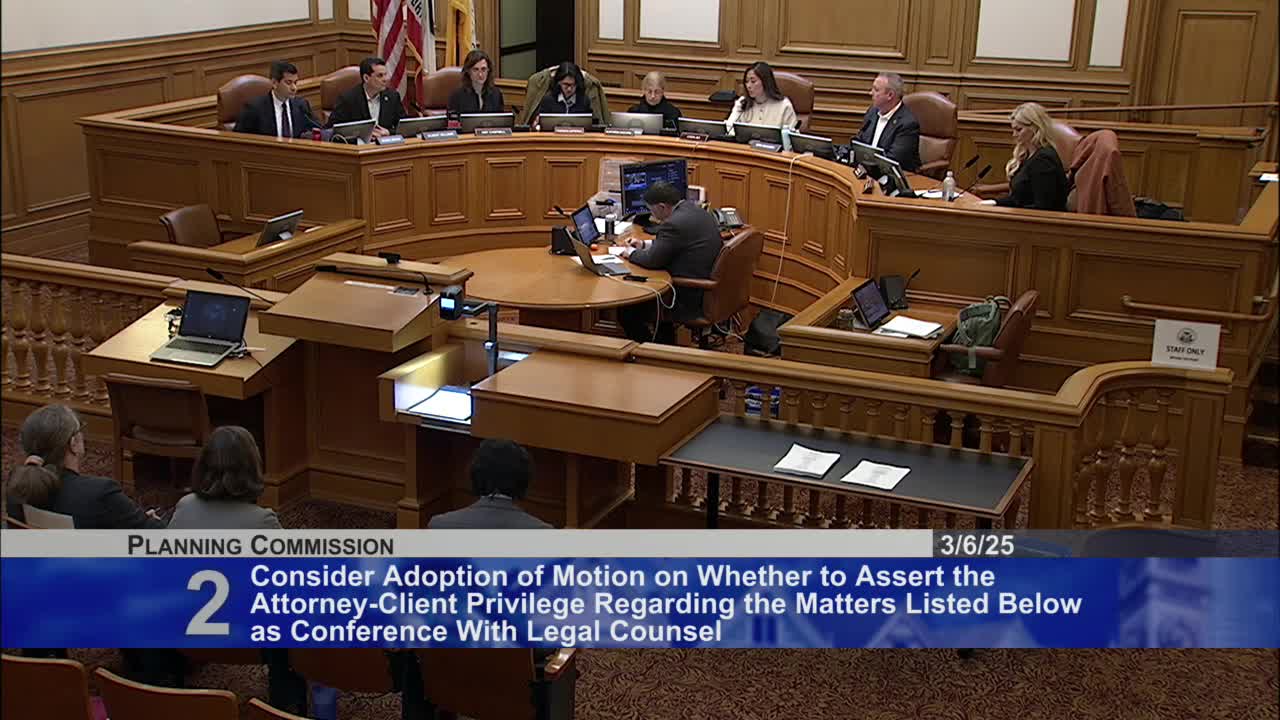
Planning Commission asserts attorney–client privilege, votes not to disclose closed-session discussions
Summary
The San Francisco Planning Commission voted unanimously March 6 to enter a closed session under attorney–client privilege, reported no action taken during that session and then voted unanimously to keep the discussions confidential.
The San Francisco Planning Commission voted unanimously Thursday, March 6, 2025, to enter a closed session under attorney–client privilege and later voted to withhold any disclosure of the closed-session discussions, the commission reported.
Commissioner Imperial moved the first motion to assert attorney–client privilege and convene a closed session. "Move to adopt, to assert the attorney client privilege regarding the matter," Commissioner Imperial said. Commissioners then voted 7–0 in favor of the motion.
The commission president said staff would lock the public WebEx and secure the meeting room before the closed session began. After the closed session, the commission reconvened in open session and reported there had been no action taken during the closed session.
Upon reconvening, Commissioner Braun moved that the commission not disclose any part of the closed-session discussions. "Move to not disclose any part of the discussions during closed session," Commissioner Braun said. The motion was seconded and the commission again voted unanimously, 7–0, to withhold disclosure.
Commission President Soh confirmed the outcome and concluded the closed-session portion of the special hearing, noting that the commission would take a 15-minute break before the regular hearing resumed.
The actions were procedural: the commission voted to assert attorney–client privilege to permit a closed session, heard no reportable actions during that closed session, and then voted not to disclose the discussions. No substantive policy decisions or ordinance votes were recorded in the transcript for this special hearing.