Santa Barbara Clean Energy outlines expanded EV rebates, home‑electrification programs and a native‑trees pilot
Loading...
Summary
Stephanie Holmes, energy employment specialist for Santa Barbara Clean Energy, updated the committee on expanded EV incentives, the Jan. 15 launch of the Home Electrification Accelerator Program (HEAP), a native‑trees pilot and planned multifamily charging and heat‑pump programs.
Stephanie Holmes, energy employment specialist for Santa Barbara Clean Energy (SBCE), presented an update to the committee on residential electric‑vehicle (EV) and home‑electrification programs and sketched several future offerings.
"I'll be providing the update on our residential EV and thermal electrification accelerator program," Holmes said, describing recent program expansions and planned pilots. She said SBCE expanded offerings in fall 2024 to include rebates for EV chargers and associated electrical work, and added tiered, income‑qualified incentive levels to concentrate funds for lower‑income customers. Holmes said the EV purchase incentive has been available since November 2023 and that charger and electrical incentives began in the fall of 2024.
Holmes described the Home Electrification Accelerator Program (HEAP), launched Jan. 15. She said HEAP provides rebates, fast and free permitting and live assistance to encourage customers to replace gas appliances with electric alternatives; eligible projects require permits, itemized invoices and photos and must be installed after the program start date. Holmes said HEAP rebates can be stacked with most other incentives; she noted there are some exceptions but did not specify which programs are excluded.
Holmes also introduced a nascent native‑trees pilot intended to support the Climate Action Plan's carbon‑sequestration section. The pilot would distribute drought‑tolerant native trees — sourced from the botanic garden — to residents for planting on private property with the property owner’s permission; initial tree tracking would use a mapping tool and staff said the pilot could expand depending on demand and lessons learned.
On multifamily charging, Holmes said an FY26 program would provide free technical assistance to building owners, site assessments, and incentives for level‑1 and level‑2 chargers plus make‑ready electrical work. She said the program is designed to produce a tailored charging plan for each property (panel review, options for service upgrades, and siting choices such as individual parking spaces, communal charging or ‘‘EV‑ready’’ outlets).
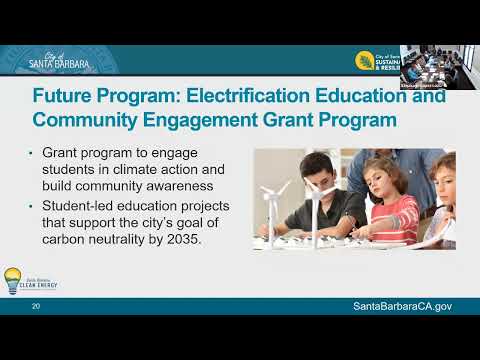
Holmes said SBCE is also planning an HVAC heat‑pump offering modeled on the heat‑pump water‑heater incentive (tiered income‑qualified rebates, faster permitting) and an electrification education grant program to fund community projects. She said SBCE plans to offer a bilingual concierge service to help customers navigate incentives, permitting and contractor questions.
On budget, Holmes told the committee staff intentionally omitted budget numbers because the proposed budget had not been released. She said the pro forma discussion calls for delaying new programs but not reducing current incentive amounts; staff expect the EV and water‑heater incentives to remain in place.
Committee members asked about eligibility for condos and multifamily properties; Holmes said the initial HEAP launch covers single‑family homes and duplexes and that multifamily rules are more complex due to shared walls and utility arrangements — staff are planning to expand eligibility but did not provide a specific timetable. Council Member Harding asked whether incentives would be reduced; Holmes said current incentives are not being reduced, though some new programs may be pushed to a later fiscal year.
Next steps: SBCE staff will continue technical planning for multifamily charging and heat‑pump incentives, run the native‑trees pilot, stand up the concierge service, and return to the committee with program signup information and timelines; some program launches are subject to final budget approval.