Get Full Government Meeting Transcripts, Videos, & Alerts Forever!
Get email alerts on the Housing topic
No spam. Unsubscribe anytime.
Developers pitch 44-home Manhattan infill project; seek RHID for 32 workforce units
Summary
Frontier Development Group and partners presented a three-site Manhattan infill development that would create 44 homes — 40 workforce units and four market-rate units — and seek a Riley County RHID for 32 of those units. The developers said state awards and RHID support are both needed for the project to move forward.
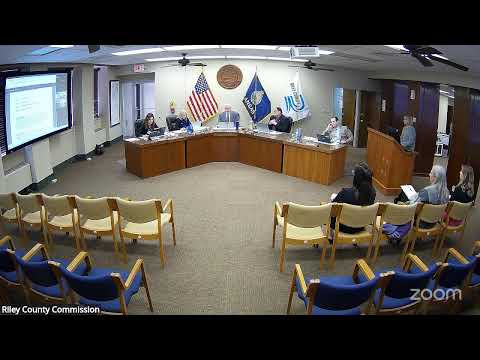
Developers representing Frontier Development Group presented a three-site infill housing plan to the Riley County Commission on March 6, proposing 44 new homes in Manhattan, including 40 workforce units and four market-rate homes. Tyler Holloman, identified in the presentation as president of Frontier Development Group, said the project would seek Riley County RHID approval for 32 workforce homes at two sites and would place 12 homes on the tax rolls immediately at a third site owned by the city.
The developers emphasized the project’s funding mix and timeline. Holloman and Gavin Schmidt told commissioners that the project has secured competitive state support from the Kansas Housing Resources Corporation (KHRC): $650,000 in a middle-income housing (MIH) grant and approximately $1.2 million in Kansas housing investor tax credits. Holloman said the KHRC awards add state oversight and reporting requirements, including land‑use restriction agreements and monthly or quarterly reporting to the agency.
Why it matters: Developers and city officials described the plan as workforce housing targeted at households in the county’s working income bands; commissioners pressed for clarity about infrastructure, tax impacts and whether the project would actually be financially viable without the county RHID. The developers said the RHID and the state awards together make the project feasible.
Project scope and timing - Sites: 3 infill sites within Manhattan city limits. Developers labeled them LK Flats (26 duplex-style units), Park Townhomes (6 townhomes adjacent to City Park) and Lee Mill Village (12 units on city-owned lots). LK Flats and Park Townhomes are the two RHID-eligible sites (total 32 RHID units); Lee Mill Village’s 12 lots would be taxable on completion, with eight workforce and four market-rate homes, the presenters said. - Unit mix and prices: The developer described the workforce homes as roughly 1,500 sq. ft., three-bedroom, two-bath units with two-car garages and an illustrative price point around $315,000. Holloman and Schmidt presented mortgage and debt-to-income (DTI) examples showing how two-earner households employed locally could fit the payment profile they outlined. - Funding: Total development budget for the primary RHID sites was presented at roughly $8.8 million with $1.95 million in RHID requested overall (developers said $1.95M is the abatement requested across RHID sites). The city and developers have already pursued KHRC competitive awards; the presentation said the KHRC grants were the first such awards for Manhattan and possibly for Riley County. - Timeline: Developers said they hoped to begin construction in 2025 with units delivered in 2026, subject to local RHID approvals and final developer agreements.
County fiscal and service impact Schmidt presented a county-level cost/benefit snapshot focused on police and ambulance costs and the incremental fiscal impact per new household. He said an incremental annual cost estimate per home to Riley County services came to about $375 per household, and noted 12 of the 44 homes would hit the county tax roll immediately, providing some near-term revenue. He also told commissioners that the developers’ analysis showed the project would be roughly “net neutral” for the county over time when immediate sales tax injection and long-term property tax growth were considered.
Developers’ case for RHID Holloman and Schmidt repeatedly told the commission they considered the RHID a financing tool that bridges the gap between construction costs and what the market will sustain. "Without this RHID, this project doesn't move forward," Schmidt said during the presentation, adding that the state monitoring and tax-credit structure reduce the likelihood of any "windfall" from the project. Developers said the RHID terms they proposed are shorter than statutory maximums (presenters cited roughly 15 years for the Little Kitten/LK Flats portion and about 17½ years for the Park Townhomes portion, well under the maximum available under the state rules).
Questions and concerns from commissioners Commissioners asked detailed follow-ups on infrastructure capacity, traffic impacts, and the sites’ utilities. One commissioner raised concerns about the Little Kitten site’s roadway capacity and whether sewer and drainage work would require substantial street reconstruction; the developers replied that the parcel had been platted for the intended density and that necessary sewer "sleeving" could be done without tearing up the road.
Several commissioners probed affordability assumptions: the $315,000 illustrative sale price, mortgage rates and required down payments, and whether resale would produce a market windfall. Schmidt and Holloman said the pricing was aimed at households earning approximately $95,000 per year (household income) under their DTI assumptions and that state land‑use restrictions and monitoring tied to the tax-credit awards limit speculative resale gains.
Next steps Developers said they planned to present detailed RHID ordinances and legal descriptions to the city commission in May and then to Riley County and USD 383 (as notified parties) during the county’s review period. They said the city anticipated mailing the ordinance, legal description and maps to the county clerk in August 2025 and that the county would receive notification and a public hearing schedule following the city process.
Speakers - Tyler Holloman — President, Frontier Development Group (business) - Gavin Schmidt — Project presenter (development representative) - Commissioner Greg — Commissioner (government) - Commissioner Ford — Commissioner (government) - Other commissioners and staff participated in questioning and clarifications.
Authorities - Kansas Housing Resources Corporation (KHRC) — referenced as source of MIH grants and tax credits (grant awards referenced by presenters). Referenced_by: ["manhattan-infill-rhid-presentation"] - RHID (redevelopment housing incentive district) — project financing/abatement mechanism referenced in presentation. Referenced_by: ["manhattan-infill-rhid-presentation"]
Discussion vs. decision - Discussion: The commission heard the presentation and asked substantive questions about traffic, utilities, affordability and the role of state awards. No formal county RHID ordinance or vote on RHID was taken at this meeting. - Direction: Developers were advised to return with more detailed materials as the city process advances; commissioners asked for site visits and additional financial detail. - Decision: No final county action recorded; this meeting constituted a project presentation and public Q&A.
Clarifying details - Total units proposed: 44 (40 workforce, 4 market rate); 32 RHID-eligible across two sites; 12 taxable units on a city-owned site to be taxable immediately. - Developer-stated funding: total project budgets and RHID requests were presented as approximate (e.g., $8.8M total on one package, $1.95M RHID requested across sites; KHRC awards: $650,000 MIH grant and approx. $1.2M in housing investor tax credit value). - RHID term examples: Little Kitten site ≈ 15 years; Park Townhomes ≈ 17.5 years (developers’ illustrative terms).
Provenance - topicintro: {"block_id":"block_2697.575","local_start":0,"local_end":180,"evidence_excerpt":"Alright. Well, commissioners, thanks for, allowing Tyler and myself. I'm Gavin Schmidt. This is Tyler Hallman. Just to just to explain a little bit about our project that that we're, moving through with the system and give you guys some information or an opportunity to make comments, ask questions, provide feedback.","reason_code":"topicintro"} - topfinish: {"block_id":"block_3756.7002","local_start":0,"local_end":220,"evidence_excerpt":"This is why we wanted to come here today to get in front of this to give you guys plenty of time to learn about the project for us to answer questions and have a good dialogue. So that's the presentation. I'm happy to answer any questions you guys may have.","reason_code":"topicfinish"}
searchable_tags":["housing","infill","RHID","Kansas Housing Resources Corporation","Manhattan","workforce housing"],"salience":{"overall":0.78,"overall_justification":"Project introduces 44 housing units including 32 RHID‑eligible workforce homes; state funding and county RHID are material to whether project proceeds—high local policy relevance.","impact_scope":"local","impact_scope_justification":"Directly affects Riley County and Manhattan city tax base, housing stock and services.","attention_level":"high","attention_level_justification":"Project depends on county decision and state awards already granted; will affect housing inventory and fiscal planning.","novelty":0.62,"novelty_justification":"Combination of KHRC awards with an RHID request is notable for the county; not routine.","timeliness_urgency":0.66,"timeliness_urgency_justification":"City process and county review timelines (public hearing, mailing, 30‑day review) are imminent.","legal_significance":0.45,"legal_significance_justification":"RHID is a formal tax‑abatement mechanism; county review can enable or block project elements.","budgetary_significance":0.42,"budgetary_significance_justification":"Short‑term revenue loss for up to 15–17 years on RHID parcels; long‑term revenue when RHID expires.","public_safety_risk":0.10,"environmental_impact":0.08,"affected_population_estimate":2000,"affected_population_estimate_justification":"Project targets young families and workforce households; indirect effect on wider community through housing availability.","affected_population_confidence":0.4},"engagement_forecast":{"newsworthiness":{"national":0.05,"regional":0.25,"local":0.88,"justification":"Primarily local interest in housing and development; regional trade‑press interest due to state KHRC awards.","justification":"See above."},"notify_recommendation":{"audience":"city","reason":"City and county planners, elected officials, housing advocates and local employers should be notified; city‑level approvals are underway.","audience_regions":["US‑KS‑RIL"],"justification":"Project ties to city RHID and state awards; local stakeholders directly affected."},"predicted_interest":{"national":0.02,"regional":0.15,"local":0.9,"justification":"High local relevance to taxpayers, planning and housing advocates."},"predicted_click_through":0.35,"predicted_click_through_justification":"Article content includes practical fiscal numbers and local controversy; moderate click potential."},"graph_signals":{"jurisdictions":["US‑KS","US‑KS‑RILEY"],"ontology_topics":["housing","economic_development","land_use"],"naics_codes":[],"entities":[{"id":"KHRC","name":"Kansas Housing Resources Corporation","type":"agency"},{"id":"FrontierDev","name":"Frontier Development Group","type":"organization"}],"events":[{"id":"rhid_application_2025","name":"Manhattan RHID application","date":"2025-05"}]}},{