Get Full Government Meeting Transcripts, Videos, & Alerts Forever!
Get email alerts on the Transportation topic
No spam. Unsubscribe anytime.
Marion County reviews transportation improvement plan; engineer warns $170 million in bonds may be needed
Summary
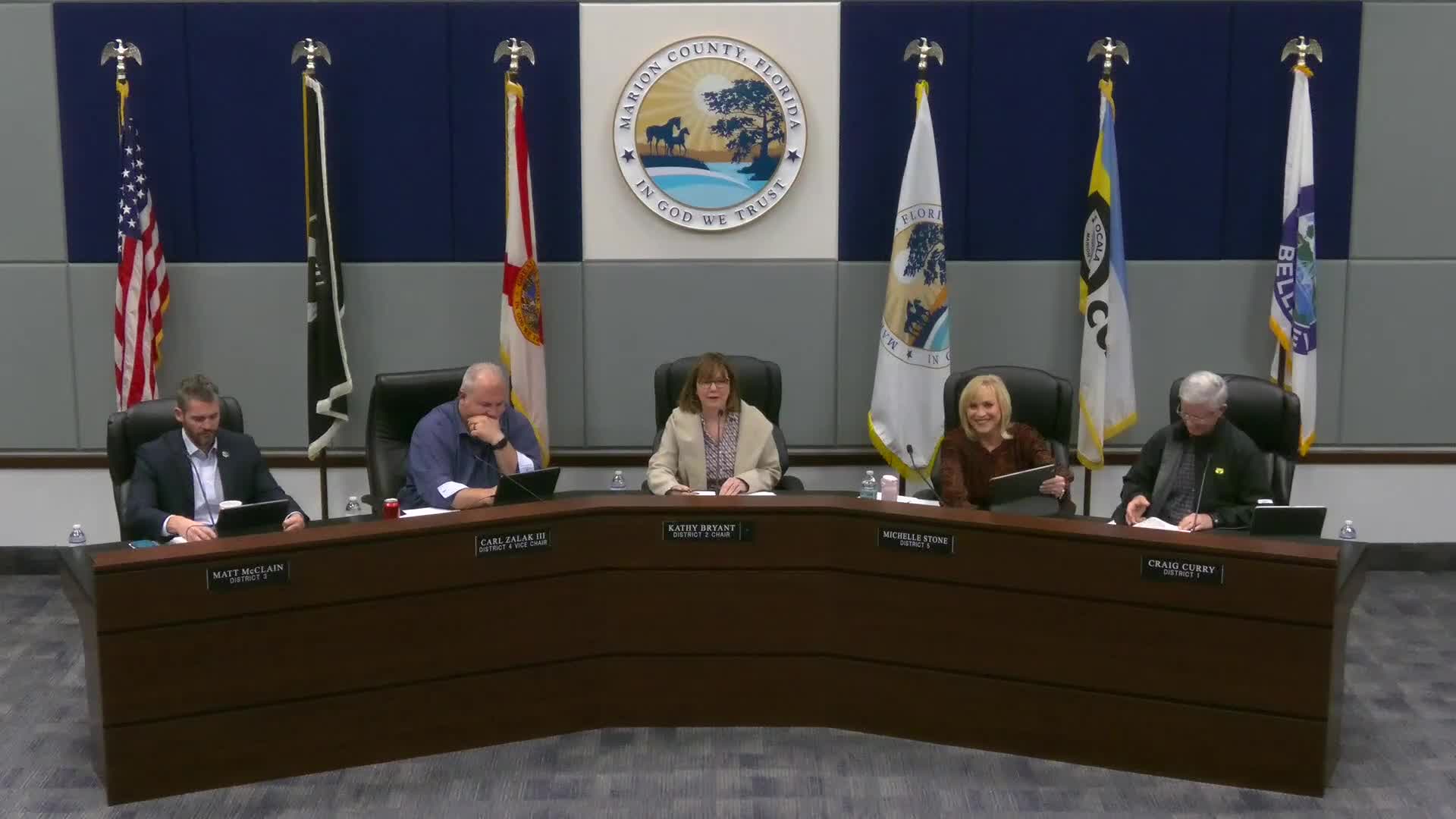
At a March workshop, Marion County Engineer Steven Cahoon presented a draft five-year Transportation Improvement Program that prioritizes major corridors, resurfacing and rural chip-seal work and outlines a scenario that could require roughly $170 million in bonds if revenues do not increase.
Marion County Commissioners reviewed a draft five-year Transportation Improvement Program (TIP) at a March workshop where County Engineer Steven Cahoon said the county could need about $170,000,000 in bonds over the TIP period if sales tax and other revenues do not rise.
The TIP lays out more than 113 miles of roadway work, including over 10 miles programmed this year for resurfacing, expansion of the county's rural chip-seal program, and multiple legacy capacity projects approaching construction, Cahoon said. He asked the board for feedback and said staff will return for final adoption at the March 18 meeting.
Why it matters: The plan attempts to balance capital capacity projects and routine preservation work while managing cost pressure from higher construction and property-acquisition prices. A bond program would accelerate projects now at today's prices but would add annual debt-service costs to the sales tax revenue stream, officials said.
Cahoon, Marion County engineer, summarized the financing options and project priorities, saying county staff reprioritized the TIP after a positive sales-tax report. "In this TIP, we've got over 113 miles of roadway," he said, and added the county had "over 10 miles of road that are programmed this year for resurfacing." He also described the chip-seal program for low-traffic rural roads: "We've got a lot of these rural roads, 50 to 100 vehicles a day."
On financing, Cahoon presented two scenarios for debt service if the county issued bonds to cover shortfalls. "When, if, and when we take the bond approach, if everything remains in the TIP as it is presented today, we're going to have about $170,000,000 worth of bonds that will be needed over this next 5 year TIP," he said, adding that figure assumed no additional sales-tax growth or other funding. Cahoon presented estimated annual debt-service ranges for different bond totals and terms, and said he expects staff will return with more detailed financial analysis once several large projects are bid.
Board members asked staff to produce detailed cost comparisons before any decision to issue bonds. "I'd like to see us have some hard data and numbers ... to show that ... that's an extra $65,000,000 in debt service," said Commissioner McLean, requesting the analysis that would compare long-term bond costs with projected inflation and construction cost growth. Cahoon said staff will provide the financial analysis and noted strategies to limit costs, including bundling resurfacing projects and staging bid packages to attract competitive contractors.
Projects and corridors highlighted
- 30 Fifth Street corridor and new interchange: Cahoon said the 30 Fifth Street corridor remains an important corridor and staff is attempting to move some work up in the schedule as readiness allows. "From a readiness standpoint, I believe that we'll be there at the onset of next fiscal year," he said.
- Southwest 30th / 40th area (listed in the TIP as C-16 and C-20): Cahoon described how project C-16 (the Southwest 30th to 40th segment) and C-20 (Southwest 80th Avenue Segment 1) will be designed and advertised so contractors are required to finish specified portions before proceeding. He said the approach allows construction to proceed on less-complex western segments while right-of-way and other design work continue to the east.
- C-17 (40 Ninth Avenue to Fortieth Avenue, Phase 1): The design-build team and contractor are working daily, Cahoon said, and he expected the signal at the north end (near 40 Second Street/Kohl's) to be in place before July or August. He said the contractor had procured mast arms and that construction could be completed before the end of the year.
- I-75 / Southwest 484 works and potential staging with FDOT: Cahoon said the county is coordinating with the Florida Department of Transportation (FDOT) on the I-75 at Southwest 484 extension and other state-owned facilities to explore staggered payments and to potentially shift some design and construction burden to FDOT. He also noted projects the county wants FDOT to prioritize after the I-75 work moves forward.
- 464 / Baseline intersection study: Cahoon said FDOT is studying the 464 and Baseline intersection, and that three of four legs of the intersection are under state jurisdiction. The TIP includes funding for future design and shows a county contribution in the TIP; Cahoon identified a county participation figure in the presentation materials (approximately $3,600,000 as shown in the TIP materials).
- Marion Oaks Manor extension and other local priorities: Commissioners pressed for the Marion Oaks Manor extension to be prioritized when bonding is considered. Several commissioners said the lack of east–west corridors in the south county contributes to congestion on 484 and 466.
Bidding and cost-control strategies
Cahoon described strategies to reduce cost growth: packaging multiple resurfacing jobs into larger bundles to increase competition; structuring large legacy projects so contractors bidding on a large contract would be more likely to bid additional nearby work; and negotiating staggered payment schedules with FDOT on state-related projects. He said property-acquisition costs have started to level off in some cases and that several large projects — "over $100,000,000 worth of projects" — are expected to go to bid before December.
Board response and next steps
Commissioners generally expressed support for moving projects forward while asking for more financial detail before committing to bonds. Several commissioners praised the staff work and asked for continued use of design-build and staged bidding where appropriate to accelerate delivery. Cahoon said staff will return with the final TIP for adoption on March 18 and that he expects to present a more complete bond recommendation after bids for the first round of large projects are received, likely in early 2026.
No formal votes were taken at the workshop. The county engineer and staff identified construction timelines and asked commissioners for feedback on the draft TIP during the workshop; staff will return with the final TIP and detailed financing analyses for the board's consideration.
Ending: Cahoon thanked his OCE team — including Beau Yancey and Doug Hinton — for preparing the materials, and the board adjourned after directing staff to prepare additional financial analysis and the final TIP for the March 18 meeting.