Get Full Government Meeting Transcripts, Videos, & Alerts Forever!
Get email alerts on the Behavioral Health Collaborative Care topic
No spam. Unsubscribe anytime.
Committee hears testimony on making collaborative care a Medicaid benefit; members adopt an oral amendment and lay bill over
Summary
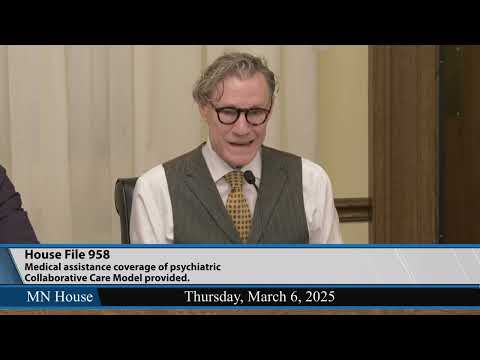
The House Human Services Finance and Policy Committee took testimony on House File 958 on March 10, 2025. Representative Nadeau sponsored the bill, which would add collaborative care — a team-based model integrating behavioral health into primary care — as a reimbursable Medicaid benefit in Minnesota.
The House Human Services Finance and Policy Committee took testimony on House File 958 on March 10, 2025. Representative Nadeau sponsored the bill, which would add collaborative care — a team-based model integrating behavioral health into primary care — as a reimbursable Medicaid benefit in Minnesota and provide start-up and training funding.
Representative Nadeau told the committee collaborative care is evidence-based and already reimbursed by Medicare and many commercial payers; her presentation said 37 states include collaborative care as a Medicaid benefit and the bill would make Minnesota the 38th. "The collaborative care model represents a transformative step towards comprehensive mental health care," Nadeau said.
Frank Jadwin, program manager for integrated behavioral health at Hennepin Healthcare, described the model’s components — a primary care provider, a behavioral health clinician, a consulting psychiatrist and a registry tool — and summarized the research base. "This model has shown significant success in improving patient outcomes, reducing health care costs, and increasing the overall quality of care," Jadwin said. He said Medicare and most commercial plans currently reimburse collaborative-care codes.
Cassandra Sanohansen, behavioral health access manager for CentraCare, described workforce shortages and uneven distribution of psychiatric providers in Minnesota, citing HRSA-based projections. "For rural healthcare, the collaborative care model ... is our lifeline," she said, arguing the model helps extend psychiatric expertise into under-resourced areas.
Oral amendment and committee action
Representative Knorr raised a concern about section 2’s appropriation language, noting a blank in the draft and referencing prior legislation, "16 B dot 9 81." Representative Noor offered an oral amendment to change the blank to "general" (page 4, line 15), which nonpartisan staff (Ms. Underman) read into the record and the committee adopted by voice vote. After discussion, Representative Nadeau renewed her motion and the committee laid House File 958, as amended, over for possible inclusion in an omnibus bill.
Details and fiscal context presented
- The bill would allow providers to bill Medicaid using collaborative-care billing codes, set a sustainable reimbursement rate, and allocate one-time start-up and training funds (amount not specified in the hearing record). - Testimony cited evidence of cost savings and effectiveness; the sponsor said "every $1 that's spent on collaborative care saves $6.50 in reduced health care costs and improved productivity," and Jadwin cited a Kaiser Permanente study estimating a roughly 13% reduction in total cost of care in some settings. - Sanohansen presented workforce data she attributed to HRSA and internal analysis showing shortage-area designations across many Minnesota counties and uneven psychiatrist-to-population ratios in several regions.
Why it matters
Committee testimony framed collaborative care as a way to expand access to behavioral health in primary care settings, improve outcomes, and lower system costs, particularly in rural and underserved regions of Minnesota. The committee accepted a ministerial amendment to specify the fund source and laid the bill over for further consideration.