Get Full Government Meeting Transcripts, Videos, & Alerts Forever!
Get email alerts on the Nursing Homes topic
No spam. Unsubscribe anytime.
Minn. House committee lays over bill to correct nursing-home rate timing for three nonprofit facilities
Summary
A Minnesota House committee heard testimony on House File 702, which would address reduced rate adjustments for three nonprofit nursing homes whose capital projects began before a Jan. 1, 2020 change to the moratorium-exception rate process; the bill was laid over for possible inclusion.
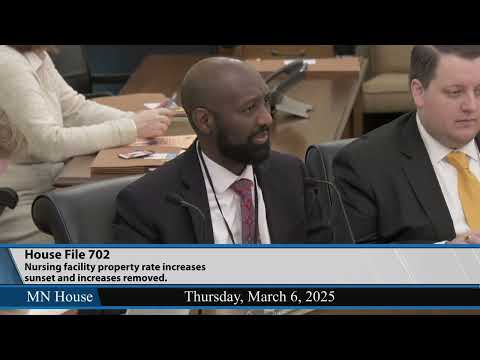
House File 702, a bill to address rate adjustments tied to the nursing-home moratorium-exception process, was introduced and laid over for possible inclusion after a committee hearing where an administrator from a Duluth facility described how timing of the process reduced rate increases for three nonprofit nursing homes.
Representative Davids introduced House File 702 and described it as “a very bipartisan bill,” saying the measure affects three nursing homes in the authors’ districts. Chester Fischel, administrator at Viewcrest Health Center in Duluth, told the committee his facility and two others — Linden (listed in testimony as Ling) Bloomston in Saint Paul and Chosen Valley Senior Living in Chatfield — began capital projects before Jan. 1, 2020, and completed them after that date. He said that sequence left the facilities subject to an older rate structure that provides smaller rate increases to cover project costs.
“The projects were completed after the 01/01/2020 change in the moratorium exception process,” Fischel said, describing the timing that produced the funding gap. He testified the three facilities started their projects in 2018 and 2019, and that last year the Legislature passed a correction to the rate process that now sunsets on May 30, 2026. Fischel said the three homes are the only ones in this particular timing situation and requested the committee’s support.
A staff speaker identified as Mr. Berg explained the moratorium-exception mechanism: “What we call the nursing home facility rate moratorium exception process” is a periodic process in which the Legislature appropriates funds and the Department of Health evaluates and approves individual requests so that, after projects are complete, rates can be adjusted to cover those capital costs. He said the three facilities currently remain on the older rate schedule rather than moving to the updated rate that would have provided larger adjustments.
Committee members asked clarifying questions about eligibility for the funding pot and how the Department of Health administers approvals. Representative Knorr asked whether nonpartisan staff or DHS could explain the grant process; Representative Noor thanked the speaker for clarifying that a limited pot of money is available for moratorium exceptions.
There was no public testimony. After discussion, the committee chair moved House File 702 to be “laid over for possible inclusion.” The transcript records the chair saying he will lay the bill over for possible inclusion; no floor vote was recorded during the hearing.
Background: Witnesses said the facilities made capital improvements that typically trigger a moratorium-exception review and, if approved and after project completion, a subsequent rate increase. Testimony specified projects began in 2018–2019, a statutory process changed on Jan. 1, 2020, and a prior legislative correction expires May 30, 2026. The hearing record does not include detailed dollar amounts, the exact language of the correction, nor a roll-call vote; those details were not specified in testimony.
The committee’s action to lay the bill over means HF 702 will remain before the committee for further consideration but did not itself adopt a substantive policy change at this hearing.