Get Full Government Meeting Transcripts, Videos, & Alerts Forever!
Get email alerts on the Social Districts topic
No spam. Unsubscribe anytime.
Anoka mayor, state representative describe early success of Minnesota social‑district pilot
Summary
City and state lawmakers told the House Commerce, Finance and Policy Committee that Anoka’s pilot social district has produced modest revenue, limited enforcement incidents and local interest in expansion; the city will submit a required two‑year report later this year.
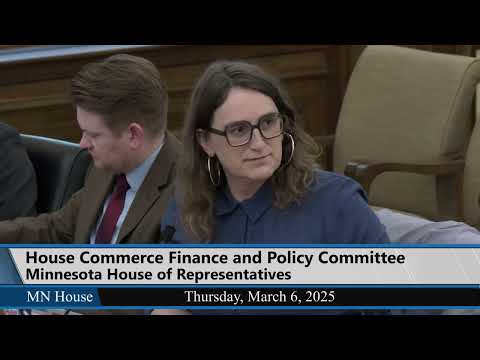
Anoka’s pilot social district, authorized by legislation enacted in 2022, has generated thousands of branded cup sales, created a modest local revenue stream and produced few reported enforcement incidents, Mayor Eric Skokquist and Representative Stevenson told the Minnesota House Commerce, Finance and Policy Committee on March 6.
Representative Stevenson, who sponsored language enabling the pilot, told the committee that Anoka “is also home to the very first social district in Minnesota,” a program created in the 2022 liquor bill and required to report back to the Legislature after two years of operation. He said early experience prompted the Legislature to authorize two additional social districts in 2024 for Shakopee and Stillwater and that several members are considering broader proposals this session.
The presentation was the committee’s opportunity to hear how Anoka implemented its program and to surface issues that lawmakers say they will need to address if social districts expand beyond the three cities currently authorized.
City implementation and rules
Mayor Eric Skokquist described a deliberate, local approach that emphasized clearly delineated boundaries, signage and public education. “We’re going to do this right. We’re going to take it slow,” Skokquist told the committee, saying the city adopted visible entrance and exit signs, QR codes linking to city webpages, and a set of simple rules intended to reduce confusion for visitors.
Anoka issues a specific social‑district license to participating establishments and requires the use of a city‑approved cup carrying identifying markings and the vendor license number. Skokquist said the city charges a small administrative fee for the license and sells the cups; he said the program was designed to track distribution and generate a modest user fee to cover program administration and district maintenance.
Early results and finances
Skokquist told the committee the city has sold more than 39,000 social‑district cups to date and recorded roughly $18,000 in cup sales revenue, about $8,000 of which covered the city’s cup purchase costs. He described a surcharge mechanism that channels a per‑cup amount into a social‑district fund to pay for recycling bins, extra maintenance and, if needed, additional patrols.
“Each establishment that wants to participate purchases [cups] from the city,” Skokquist said, and the city has used a per‑cup surcharge to seed a fund for district expenses. Committee members asked follow‑ups about exact fees and how much of the surcharge is passed through by businesses; Skokquist said some businesses list the surcharge explicitly while others fold the cost into retail prices.
Hours, licensing and enforcement
Anoka’s local ordinance sets the social‑district hours and other operational limits. Skokquist said the city currently limits open public consumption in the district to a 10 a.m.–10 p.m. window and runs the program seasonally; the city removed signage for the off‑season and reactivates the district in spring. The mayor said the city’s liquor licensing structure remains in force: establishments may serve beverages only within the scope of their existing licenses (for example, beer‑and‑wine licenses cannot sell full spirits unless they hold a full liquor license).
On enforcement, Skokquist said the city has used education and informal reminders as the primary tools and reported few incidents that required formal police action. “When it does happen, a lot of times it’s just simply, hey, you need to go back within the district or you need to pour that out,” he said. The city has not implemented wristbands or a systematic ID‑check mechanism in the public realm but said it is monitoring the issue and may change approaches if problems arise.
Business and community response
Skokquist said the social district has drawn participation from a broad set of downtown businesses beyond bars and restaurants, including retail and specialty shops that display window clings indicating whether they welcome drinking customers, sell drinks, or prohibit drinks on premises. He said participation grew after the pilot’s first season when initially hesitant businesses observed how the program worked.
The mayor described anecdotal evidence of economic spillover—business owners reporting higher sales on event nights and increased midweek activity around the city’s concert‑in‑the‑park series—but noted the city lacks comprehensive sales‑tax or foot‑traffic studies to quantify new vs. shifted revenue. He told the committee the city plans to gather more data and include findings in the mandated report at the end of the pilot’s second full summer.
Additional placemaking tools
Skokquist also described complementary efforts to animate downtown, including a free busker permit program, temporary street closures for communal seating and marketing through city communications and local public access television. He said the busker program registers performers for designated spots (the city reported having issued roughly 25 permits) and that the organized approach reduced competition for popular locations.
Questions for state policy
Committee members raised recurring concerns for a possible statewide rollout: preserving the character that made Anoka’s pilot successful, limiting spillover into nonparticipating places, underage access and controls on multi‑drink purchases. Representative Finke and others urged caution about creating a broader culture of public drinking without guardrails; Representative Stevenson said several bills this session propose different approaches, including geographic buffers or a limited statewide quota administered by the Alcohol and Gambling Enforcement Division.
Next steps
Anoka’s statutory report is due after the community’s second full summer of operation; committee members said they expect the city’s findings to inform any broader legislative approach. Representative Stevenson and other lawmakers said they are discussing comprehensive options this session and will weigh the Anoka report and stakeholder feedback in the months ahead.
Ending
Mayor Skokquist and Representative Stevenson invited committee members to visit Anoka to see the district in person; the committee said it plans further deliberations after the city’s required report and additional bill hearings if lawmakers propose broader authorization.