Get Full Government Meeting Transcripts, Videos, & Alerts Forever!
Get email alerts on the Nursing Home Workforce topic
No spam. Unsubscribe anytime.
Committee advances changes to Nursing Home Workforce Standards Board process, refers House File 500 to general register
Summary
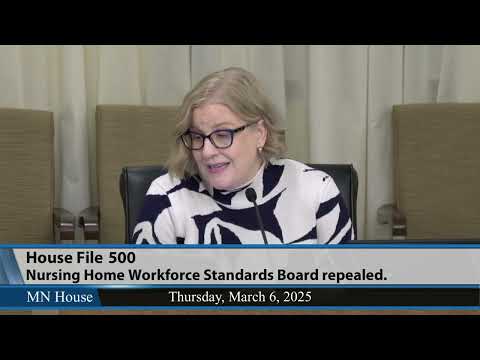
After testimony from labor, providers and state budget officials, the Workforce, Labor and Economic Development Finance and Policy Committee amended House File 500 to add procedural requirements and training language for the Nursing Home Workforce Standards Board and referred the bill as amended to the general register.
Representative Zalesnikar, the author of House File 500, told the Workforce, Labor and Economic Development Finance and Policy Committee on March 5 that the A1 amendment creates a three-part voting requirement for the Nursing Home Workforce Standards Board, eliminates expedited rulemaking for that board, and adds training language to include industry trainers for nursing homes.
The change is meant to require “two affirmative votes” from each of the board’s three appointing groups before rules move forward and to preserve federal compliance by removing expedited rulemaking, the author said. Representative Zalesnikar also said the amendment provides parameters for trainers who already work with nursing homes.
Supporters of the amended bill urged lawmakers to ensure the board’s actions are funded or rendered ineffective. Kyle Burt of the Long Term Care Imperative said the amendment requires facility-specific rate impact analyses and argued the value-based reimbursement (VBR) model used by Minnesota includes a 15-to-27-month lag that complicates forecasting. “The model used in the statute does not align with the reality of the value based reimbursement model,” Burt said.
LeadingAge Minnesota President and CEO Carrie Thurlow said the board’s standards should not take effect unless the Legislature funds them. Thurlow cited provider estimates — one community-owned nursing home in Cook County told the committee it could face $1.4 million in costs between 2026 and 2027 from the board’s minimum wage rule; a metro provider estimated nearly $500,000 in annual expense to comply with holiday-pay rules; a New Ulm care center estimated $723,000 in annual new costs — and warned of access risks in rural areas if mandates are unfunded.
Nursing home workers and advocates urged the committee to reject the bill. Teresa Vries, an LPN and AFSCME member, described staffing shortages and said the board’s minimum wage and paid-holiday rules have already produced pay improvements for some workers. “The board is doing amazing to address the staffing crisis,” Vries said. Brian Elliott, executive director of SEIU Minnesota State Council, said the VBR system does reimburse wage costs over time and warned that the bill risks double-counting natural wage growth and front-loading speculative indirect costs into an upfront fiscal test the Department of Human Services cannot conduct.
DHS budget director Elise Bailey told members the department does not believe the bill, as written, is implementable. Bailey said the bill’s requirement that a fiscal analysis include indirect or secondary impacts is not permitted under LBO (Legislative Budget Office) standards and lacks definitions for what those indirect impacts would include.
Committee action: The committee adopted the A1 amendment to House File 500 (voice vote) and accepted the amendment’s training and voting-process language. A separate DE3 amendment was withdrawn by its sponsor. After discussion and several failed motions to re-refer the bill to other committees, the chair moved and the committee voted to refer House File 500 as amended to the general register.
Members and advocates framed the debate around two core issues: (1) whether the Nursing Home Workforce Standards Board should retain expedited rulemaking and be able to set standards that take effect absent legislative funding, and (2) how to reconcile the timing of value-based reimbursement with any board-driven wage or benefit increases. Testimony included provider cost estimates, workers’ accounts of staffing strain, union perspectives that VBR reimburses costs over time, and DHS’ assessment that the bill’s fiscal requirements cannot be met under current fiscal-note procedures.
House File 500 as amended now moves to the general register for further action by the full House.