Get Full Government Meeting Transcripts, Videos, & Alerts Forever!
Get email alerts on the Committee Vote Roundup topic
No spam. Unsubscribe anytime.
Health and Government Operations Committee advances slate of health, veterans and consumer-protection bills
Summary
The Health and Government Operations Committee voted favorably on a package of bills during a March voting session, advancing measures on hospital population-health funding under the AHEAD model, burial eligibility for Guard and Reserve members, licensure reciprocity and workforce rules for nursing and dental professions, midwife discipline, opioid settlement transparency, and several consumer-protection and insurance items.
The Health and Government Operations Committee voted favorably on a package of bills during a March voting session, advancing measures on hospital population-health funding under the AHEAD model, burial eligibility for National Guard and Reserve members, licensure reciprocity and workforce rules for nursing and dental professions, midwife discipline, opioid settlement transparency, and several consumer-protection and insurance items.
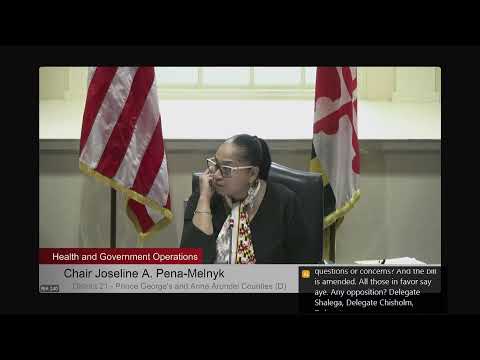
Committee chair opened the voting meeting as “voting list number 8,” saying the bills had been worked in subcommittees and would move quickly. The panel approved most measures unanimously or with only a handful of members recorded in opposition during roll calls.
Why it matters: The most consequential action for statewide health policy was approval of the Department of Health’s AHEAD-model implementation bill, which creates a Population Health Improvement Fund and authorizes a uniform, rate-based hospital assessment to generate funds for statewide population-health initiatives tied to the state’s AHEAD agreement with the Centers for Medicare & Medicaid Services (CMS). The fund and assessment mechanism are required elements of Maryland’s participation in the AHEAD total cost-of-care model, and the bill includes reporting and a sunset date for the fund’s assessment.
Key bills and committee action
AHEAD model and Population Health Improvement Fund (departmental bill): Staff analyst Erin told the committee the bill establishes the Population Health Improvement Fund to support statewide population-health targets under the AHEAD model and any successor models. The Health Services Cost Review Commission (HSCRC) may assess a uniform, rate-based, reasonable amount on hospital rates each year; proceeds would pay for statewide population-health initiatives that align with the statewide health equity plan and CMS state agreement. The bill requires annual reporting beginning July 1, 2026, to the General Assembly on funded programs, targeted populations, measures of effectiveness, and an accounting of all funding sources. The assessment mechanism and fund portion of the bill are scheduled to sunset on Jan. 1, 2032. The committee moved the bill as amended; several delegates recorded opposition on the final vote.
Military-related expansions and burial eligibility (House Bill 448 and House Bill 466): Committee staff member Lindsey described a pair of bills that update definitions by reference to the U.S. Code and expand certain protections for members of the uniformed services. House Bill 448 incorporates multiple technical and substantive changes, including expansion of eligibility for burial in a state veterans cemetery to members of the National Guard and Reserves (Burial Equity Act provisions) and restoration of honorable-discharge qualifications for certain uniformed-service groups. House Bill 466 extends uniform-service definitions across several state code articles and expands access to expedited health-occupation licensing and fee exemptions. Both bills were reported favorable with amendments and advanced by the committee.
State Board of Dental Examiners: expanded-function dental assistant certification (House Bill 573 and House Bill 723): The committee approved an amended House Bill 573 to reinstate an expanded-function dental assistant certificate under specified continuing-education and application conditions and to set a curriculum mix of online and in-person hours (including clinical, hands-on training) for initial certification. The committee also approved House Bill 723, requiring the board to license dentists or hygienists coming from another state within 15 business days if they meet licensure requirements; similar 15-business-day processing is required for dental radiation technologist certificates when out-of-state qualifications are met.
Advanced practice nursing reciprocity, licensing discussions (House Bill 602): The committee approved a bill directing the State Board of Nursing to hold discussions with neighboring jurisdictions (Delaware, Pennsylvania, Virginia, West Virginia and the District of Columbia) to pursue reciprocity agreements for advanced-practice nursing licensure and to report on those discussions by Nov. 1, 2025, and annually thereafter for four years. During debate, a delegate asked about the word “prioritize” in the bill text; the sponsor said the language was intended to signal that the effort should be treated as a priority by the board.
Direct-entry midwifery and discipline (House Bill 664): The committee approved a bill that clarifies disciplinary actions the State Board of Nursing may take against applicants or licensees practicing direct-entry midwifery, aligning available sanctions (reprimand, probation, suspension, revocation) with other professions overseen by the board. The measure was reported favorable as introduced.
Nursing home cost-reporting and direct-care wages (House Bill 933): The committee approved a bill requiring the Maryland Department of Health to review cost reports and Medicaid-participating nursing-home data, including revenues allocated to specified professions, and to publish annual findings (the transcript cites an annual report by October 2029). The bill moved out of committee with recorded opposition from several delegates.
Structural racism and implicit-bias training for health occupations (House Bill 783): The committee approved an amended bill to require implicit-bias and structural-racism training for licensees and certificate holders regulated by Health Occupations Boards, with the first attestation due on renewal after April 1, 2026. The amendments refine the definition of structural racism, permit accreditation by the Accreditation Council for Pharmacy Education, allow boards to award continuing-education credit, and express intent that grant funds provided to the Maryland Nurses Association by the American Nurses Association help develop and offer the training. The vote showed several members in opposition.
Opioid restitution fund dashboard (House Bill 798): The committee approved an amended bill directing the Maryland Office of Overdose Response, in collaboration with the Department of Health, to develop and maintain an interactive public dashboard showing opioid-restoration fund spending and settlement information. Counties and municipalities receiving settlement funds must submit specified information for posting; to the extent possible the dashboard should reuse existing platforms.
Phenibut consumer-protection measure (House Bill 996): The committee approved an amended bill that changes the bill title to the “J.T. Albee Phenibut Consumer Protection Act,” requires factual label disclosures for phenibut products, prohibits sale to persons under 21, and bars advertising therapeutic claims; the amendment removed an earlier reporting requirement.
Insurance and discretionary clauses (House Bill 1069): The committee approved an amended bill prohibiting carriers from issuing life, health, annuity or HMO contracts that reserve sole discretion to the carrier to interpret terms in a way inconsistent with state law.
Other notable actions: the committee also advanced a variety of procurement, licensing and veterans-benefits bills that the chair described as having been vetted in subcommittees; several measures passed with unanimous consent and some passed with a small number of recorded no votes.
Votes at a glance (selected bills)
- HB 1454 — procedural motion on voting list; advanced (see provenance seg_1). - HB 448 — Modernization of Military Laws Act (expanded burial eligibility, technical updates) — favorable with amendment; moved and approved (provenance seg_2 to seg_5). - HB 466 — Health Equity for Service Members Act (definitions, licensing, fee exemptions) — favorable with amendment (provenance seg_6 to seg_12). - HB 573 — State Board of Dental Examiners; expanded-function dental assistant certification — favorable with amendment (provenance seg_27 to seg_32). - HB 602 — Advanced practice nursing reciprocity discussions; reports due Nov. 1, 2025 — favorable (provenance seg_44 to seg_50). - HB 664 — Direct-entry midwifery; clarifies disciplinary authority — favorable (provenance seg_60 to seg_64). - HB 699 — Veterans benefits; honorable-discharge definition (amendment to defer to federal upgrades determined by the Department of Veterans and Military Families) — favorable (provenance seg_70 to seg_74). - HB 723 — State Board of Dental Examiners; out-of-state licensure processing within 15 business days — favorable (provenance seg_76 to seg_80). - HB 783 — Health occupations implicit-bias and structural-racism training — favorable as amended; recorded opposition by Delegates Shalega, Chisholm, Morgan, Riley, Hutchinson and Kipke (provenance seg_82 to seg_92). - HB 798 — Opioid restitution fund interactive dashboard — favorable as amended (provenance seg_94 to seg_100). - HB 933 — Nursing homes; direct-care wages and cost reports; annual reporting (transcript cites October 2029) — favorable with amendment; recorded opposition by multiple delegates (provenance seg_102 to seg_110). - HB 996 — Phenibut consumer-protection (J.T. Albee Phenibut Consumer Protection Act) — favorable with amendment (provenance seg_112 to seg_118). - HB 1069 — Insurance discretionary clauses banned; includes HMO contracts in amendment — favorable (provenance seg_120 to seg_126). - Departmental bill (AHEAD model / Population Health Improvement Fund) — favorable with amendment; reporting, fund sunset Jan. 1, 2032; recorded opposition by several delegates (provenance seg_130 to seg_140).
What the committee did not do: No items were tabled or rejected during the voting session recorded in the transcript; the chair said bills had been fully vetted in subcommittee and would be taken up on the floor after committee assignments.
Next steps: Bills that passed committee will be placed on the House floor calendar for further consideration by the full House of Delegates. The departmental AHEAD-model bill includes reporting requirements to the General Assembly beginning July 1, 2026, and a statutory sunset for the fund portion on Jan. 1, 2032.
Sources: Committee proceedings as recorded in the Health and Government Operations Committee voting session (voting list no. 8); presenters and speakers listed in the committee transcript.