Get Full Government Meeting Transcripts, Videos, & Alerts Forever!
Get email alerts on the Pesticide Regulation topic
No spam. Unsubscribe anytime.
Student mock hearing highlights clash between pesticide regulation and endangered‑species protections
Summary
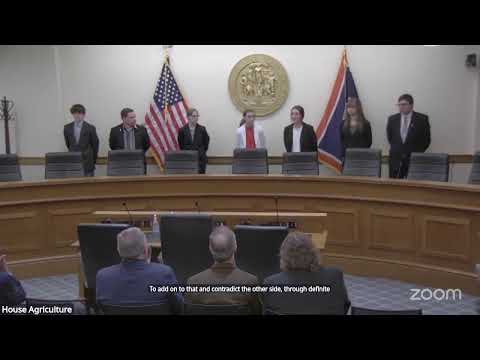
Students from East High School27s Frontier FFA chapter presented a mock congressional hearing before the Agriculture, State & Public Lands & Water Resources Committee in Cheyenne on whether pesticides27 benefits to crop production outweigh risks to endangered species.
Students from East High School27s Frontier FFA chapter presented a mock congressional hearing before the Agriculture, State & Public Lands & Water Resources Committee in Cheyenne on whether pesticides27 benefits to crop production outweigh risks to endangered species.
The session brought testimony from four witnesses and a series of public commenters who framed the dispute around two federal laws: the Federal Insecticide, Fungicide, and Rodenticide Act (FIFRA) and the Endangered Species Act (ESA). Attorneys and agency officials disagreed about whether compliance with FIFRA alone protects listed species and what additional steps, if any, are required under the ESA.
"Compliance with FIFRA does not satisfy the ESA requirements," said Paula Frost, an attorney with the Western Environmental Law Center, who testified that ESA protections require separate analysis and, where necessary, modification of pesticide approvals.
Karen Bud Fallon, an attorney who identified herself with Bud Fallon Law Offices in Cheyenne, told the committee that FIFRA provides a scientifically based framework that keeps pesticides available to producers while addressing human- and environmental‑health risks. "This pesticide label is a legal document and following it is mandated by law," Fallon said, describing the EPA registration and labeling process under FIFRA.
Doug Miyamoto, director of the Wyoming Department of Agriculture, characterized FIFRA as a balance between environmental safeguards and agricultural needs and warned that stricter restrictions could hurt farm incomes and state commodity production. "Wyoming agriculture relies on pesticides to support cash crop production," Miyamoto said, urging regulation that allows producers to operate effectively while following label requirements.
Karen McPeek, a field office supervisor for the U.S. Fish and Wildlife Service, emphasized biological pathways by which pesticides can affect wildlife. Speaking as a biologist, McPeek described how pesticides applied to fields can land on insects eaten by bats and said that exposure can affect respiratory function and reproduction. "When glyphosate . . . is sprayed in the fields, it lands on the bugs. When the bat eats the bugs, glyphosate is now getting into the bat system," she said, and added that timing of spraying at dusk can increase overlap with bat foraging.
Public commenters echoed the split. Todd Fornstrom, president of the Wyoming Farm Bureau Federation and a Pine Bluffs grower, warned that further pesticide restrictions would imperil farm profitability and cited widespread glyphosate use among farmers. Marcus Ishii, regional director at the Pesticide Action and Agroecology Network North America, argued for tighter regulation and said EPA work plans are moving toward greater ESA compliance; he urged reducing pesticide use to protect biodiversity.
Witnesses and commenters also debated related factual claims raised during testimony. Frost and McPeek stressed ESA obligations, including prohibitions on 22take22 of listed species and consultation requirements for federal pesticide actions. Fallon and Miyamoto emphasized label-based mitigation measures such as spray guidelines and buffer zones and said producers must follow label instructions.
The mock hearing included audience questions about food waste, soil health and bat biology; student participants and adults took turns addressing policy and technical points. The hearing concluded without any formal votes or committee actions. Organizers said the exercise was intended as an educational demonstration of the competing legal and scientific arguments surrounding pesticide regulation and species protection.
The record of the session shows a clear division: environmental advocates and the Fish and Wildlife Service urging stricter ESA‑driven protections for listed species, and agricultural representatives and state officials urging preservation of pesticide access under FIFRA with mitigation measures. The students and witnesses left the committee with the same question posed at the start of the hearing: are the negative impacts of pesticides on endangered species worth the benefits of increased agricultural productivity?