Get AI Briefings, Transcripts & Alerts on Local & National Government Meetings — Forever.
Comal County urges Legislature to increase notice and setbacks for quarries and concrete batch plants
Loading...
Summary
The court approved Resolution 2025-10 asking the Texas Legislature to require greater public notice for quarries and concrete batch plants and to change setback calculations to measure from property boundaries rather than existing residences or places of worship.
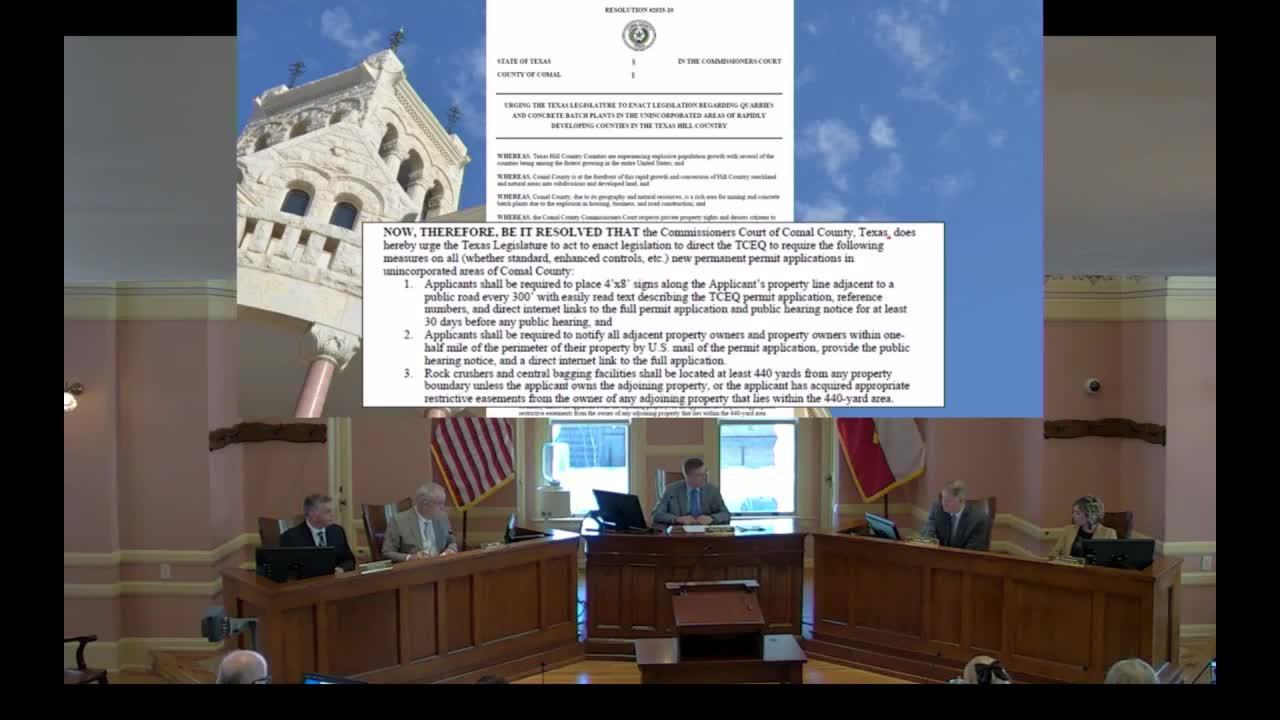
Comal County Commissioners on Thursday approved Resolution 2025-10 urging the Texas Legislature to enact changes governing quarries and concrete batch plants in unincorporated areas of rapidly developing Texas Hill Country counties.
Commissioner Webb introduced the measure, saying the county has seen instances where the public was unaware of proposed batch plants and rock crushers until after state hearings occurred. The resolution requests enhanced notification requirements—such as 4-by-8 signs along property boundaries—and asks the Legislature to revise setback calculations so that the required 440-yard (440 feet referenced in court as "yards" then described as feet) separation applies from a property boundary rather than only from an existing residence or place of worship. Webb told the court that, under current state practice administered by the Texas Commission on Environmental Quality (TCEQ), certain plant components such as central baggers can be sited near property lines and still meet the statutory 440-yard separation measured from residences.
In the court's discussion, members said the issue stems from developments in and near the county and that the county is often "dragged into" disputes even though authority for permitting rests with state agencies. The motion to approve the resolution, made by Commissioner Webb and seconded by Commissioner Crownover, carried by voice vote.
The resolution urges the county's legislative delegation to introduce or support statutory changes that would require more direct notification to affected neighbors and adopt setbacks measured from property boundaries to better reflect impacts on adjoining parcels.
The court did not specify particular legislative language; the resolution asks for legislative action and increased public notice measures but leaves statutory drafting to state lawmakers.