Get Full Government Meeting Transcripts, Videos, & Alerts Forever!
Get email alerts on the Higher Education topic
No spam. Unsubscribe anytime.
SUNY Sullivan officials flag enrollment dip, highlight criminal justice program and BOCES partnerships
Summary
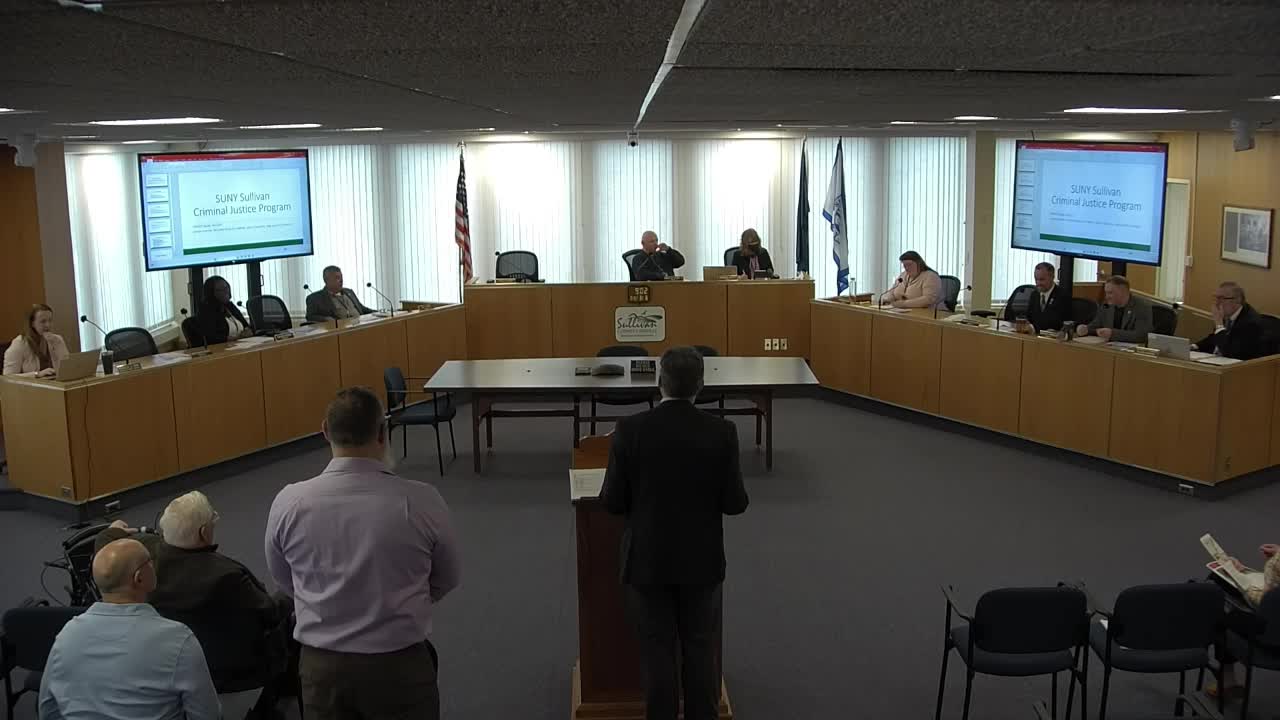
At a Sullivan County Government Services Committee meeting, SUNY Sullivan faculty described the college's criminal justice program, partnerships with BOCES, workforce and adult-learner outreach, and budget pressures tied to lower out-of-county enrollment and dorm closure.
SUNY Sullivan faculty told the Sullivan County Government Services Committee that the college's criminal justice program has about 43 students in its two-year degree and strong credit-transfer ties with Sullivan County BOCES, even as overall enrollment has declined since the dorm closed.
Committee members heard that SUNY Sullivan's two-year criminal justice degree requires 61 credits and currently has 'about 43' students enrolled. Professor Rob Reiler, a full-time criminal justice faculty member, said the program has kept recruitment local and noted a long-standing partnership with the county BOCES public safety program that allows roughly a dozen students who complete BOCES benchmarks to transfer in with credit and finish the degree more quickly. "We get about a dozen or so who just, seamlessly transfer right into the school," Reiler said.
The college emphasized hands-on training in trauma care and active-shooter response. Reiler said he brings training from the national ALERT organization and from his law-enforcement background, including work with Homeland Security and the New York City Police Department, into the classroom and into joint training with BOCES. He described instruction on "stop the bleed" and trauma care and said that some students pursue state police civil service tests or move on to four-year programs.
SUNY Sullivan officials also updated the committee on budget and enrollment trends. A college official reported that the closure of the dorm has reduced out-of-county student enrollment and that spring enrollment is down even as retention has improved. The college said it is using tighter hiring and spending controls, pursuing grants and outside support, and working with county finance staff to present clearer pro forma budget reports. The official said SUNY provided a $50,000 competitive planning-and-outreach grant to support adult-learner recruitment and advising.
College leaders described efforts to expand college-in-the-high-school partnerships across county high schools and to grow workforce programs tied to local business needs. The committee was told about a community Kite Fest on Saturday, May 3, from 11 a.m. to 3 p.m., described as an event to showcase the campus to families and prospective students.
During public comment, a resident urged the legislature to address long-running maintenance and management problems with the college dorm, saying the dorm's decline contributed to the loss of out-of-county students that previously helped the college's finances. Committee members and other speakers praised the program's community ties and offered assistance with outreach and recruitment.
Officials framed several near-term priorities for the college: clarify budget reporting to show county support's return on investment, sustain workforce and adult-learner outreach if statewide free-tuition proposals advance, and continue collaborations with BOCES and local law enforcement to keep program curricula aligned with employer expectations. No formal committee action was taken on the college updates during the meeting.
The presentation and subsequent discussion included: direct enrollment figures for the criminal justice program, the two-year 61-credit curriculum, the BOCES transfer pathway, a $50,000 SUNY planning grant for adult learners, and scheduled community events and outreach.