Get Full Government Meeting Transcripts, Videos, & Alerts Forever!
Get email alerts on the Animal Control Kennels Permits topic
No spam. Unsubscribe anytime.
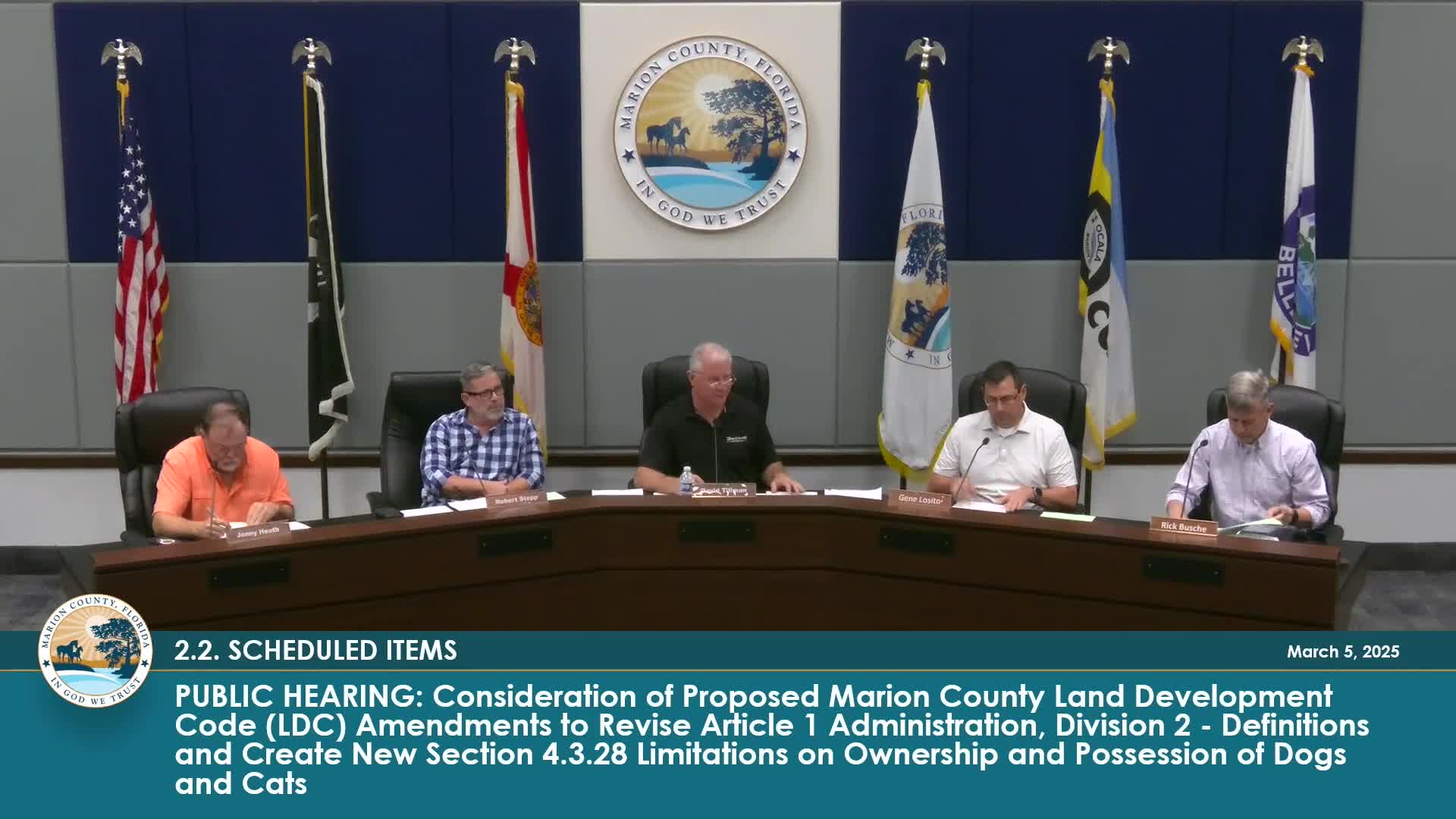
Marion County committee narrows animal rules to definitions, sets permit triggers after lengthy public hearing
Summary
After a long public hearing, Marion County’s Land Development Regulation Committee recommended carrying clarified animal‑related definitions into the county’s land development code, keeping the animal‑permit trigger at more than 15 animals and making owners with more than 30 personal animals subject to land‑use review via special use permit.
The Land Development Regulation Committee on Tuesday recommended that the Board of County Commissioners adopt revised definitions in Marion County’s Land Development Code covering kennels, breeders and “high‑volume” animal owners, while declining to forward a separate draft that would have imposed per‑residence numeric limits.
Staff presentation and recommendation
Dana Oluski, chief assistant county attorney, told the committee staff’s revised approach is to "disregard the limitations themselves and really just focus on the definitions," and to carry the definitions adopted in the county’s recently revised animal ordinance into the land development code. Oluski said the definitions to be recommended include “animal related business,” “animal related organization,” “commercial breeder,” “hobby breeder,” and a revised “kennel” definition that already existed in the code. Under the proposed language presented to the committee, a kennel would continue to be defined in part as any place where four or more dogs or cats over 4 months are groomed, bred, raised, boarded or trained for compensation. The proposal adds language that a kennel would also include a “high‑volume owner” (a personal owner threshold) with more than 30 dogs or cats in aggregate.
Oluski and Growth Services staff explained the county’s animal ordinance (adopted earlier this year) already requires an animal permit (formerly called a kennel license) for owners with more than 15 dogs or cats in aggregate; the proposed Land Development Code language would carry those definitions and the new nomenclature into zoning code so that special use permits and other land‑use tools align with animal services regulations.
What the thresholds mean in practice
- 4 or more dogs/cats (aggregate): included in the kennel definition as a use that can trigger a special use permit requirement when conducted as a business. - More than 15 animals (aggregate): existing animal‑services “animal permit” (formerly kennel license) requirement; staff said the permit requires rabies and county tags, a veterinary relationship, an emergency/contingency plan, compliance with standards of care, and annual renewal of the animal permit. - 31 or more animals (aggregate)/"high‑volume owner": under the proposed LDC language, owners with more than 30 personal animals would require a special use permit in addition to the animal permit.
Oluski said the staff recommendation reduced the number of regulatory triggers compared with earlier drafts that had lower per‑residence caps (e.g., 8–15); this prompted staff and the chair to emphasize the change from earlier workshop language to the larger 30‑animal threshold for triggering land‑use review. Staff said the focus is to give the county the ability to address operations that become neighborhood nuisances or present animal welfare concerns while avoiding over‑regulating responsible owners and rescues.
Public comment: dozens of speakers, mix of support and concern
The committee heard extensive public comment (multiple dozen residents and stakeholders). Speakers included small‑scale and hobby breeders, AKC‑affiliated exhibitors, nonprofit rescue operators, dog hunters, and neighbors who described impacts from adjacent kennel operations (odor, animals digging under fences, and uncontrolled animals entering yards). Common themes:
- Support for clarifying that the county’s existing animal permit and special use permit pathways apply consistently, and concern that overly strict per‑residence numeric caps would penalize responsible hobby breeders and nonprofit rescues. - Calls for clearer exemptions or different handling for small, home‑based rescues and foster‑based 501(c)(3) organizations; some home‑based rescue operators said the current definitions could require a special use permit for only four animals and requested the same 30‑animal threshold that applies to private owners. - Concerns about enforcement and fees: several speakers asked how the county would enforce the rules, what happens to animals if a special use permit is denied, and whether the Board of County Commissioners can reduce or waive fees (commenters said a prior fee of about $1,000 for a special use permit had created hardship in some cases). Oluski and Growth Services staff said the county commission (BOCC) sets fees and could consider waivers or fee adjustments; staff gave approximate current animal‑permit fee figures (around $100 base with inspection fees historically charged at about $45 per inspection) and said fees are being reviewed. - Right to Farm: a few commenters raised the Right to Farm Act in the context of agricultural (A‑1) zoned properties and asked how state protections would interact with county zoning.
Committee discussion and motions
Committee members asked staff to clarify several items, including whether kennels are allowed to apply for special use permits in all zoning categories (staff said that, by practice, special use permits for kennels have been accepted across zones and that the code lists kennel as a use that can be requested by special use permit). Staff agreed to clarify language to state that the 4+ and the high‑volume 30+ counts are measured in aggregate (cats and dogs combined).
After public comment closed, the committee made two formal recommendations:
1) The committee voted unanimously to recommend adoption of the proposed definitions (animal related business, animal related organization, commercial breeder, hobby breeder, and kennel revised to include high‑volume owners) with a drafting clarification that the kennel definition should read “4 or more dogs and/or cats in aggregate” and that the “high‑volume owner” threshold is measured in aggregate.
2) The committee voted unanimously not to recommend approval of the separate draft limitations document (identified in meeting materials as Section 4.3.28) that had imposed tiered per‑residence numeric limits (e.g., 4 per residence, 8, 10, 15 categories). Staff noted the board could still consider fee and other implementation decisions when the BOCC takes up the item.
Next steps and open questions
Staff and the chair told the audience the Board of County Commissioners will hold public hearings on the ordinance and related animal‑permit fees; staff announced two BOCC hearings: March 25 at 9:00 a.m. (BOCC chambers) and April 8 at 6:00 p.m. (BOCC chambers). Staff said fees for animal permits and inspection schedules will be considered by the BOCC and that the BOCC can choose to set, reduce, or waive fees for nonprofit rescues.
Several public speakers asked that the county clarify distinctions between at‑home foster‑based rescues and brick‑and‑mortar nonprofit shelters; staff acknowledged the concern and said it would be discussed further. The committee discussion emphasized enforcement pathways already available to the county: animal cruelty prosecution (for welfare violations), animal services permitting and inspections, and code enforcement or special‑use permit conditions to address nuisances or noncompliance.
The committee forwarded its recommendation on definitions to the Board of County Commissioners and explicitly declined to forward the numeric limitations draft (4.3.28).