Get Full Government Meeting Transcripts, Videos, & Alerts Forever!
Get email alerts on the Parks And Recreation topic
No spam. Unsubscribe anytime.
Littleton ESB urges South Suburban to add sustainability body, action plan and reporting in operating agreement
Summary
The City of Littleton Environmental Stewardship Board recommended that the South Suburban Parks and Recreation District establish a sustainability management body, create a jurisdiction-specific environmental stewardship action plan with measurable goals, and adopt regular reporting and review timelines tied to the district operating agreement.
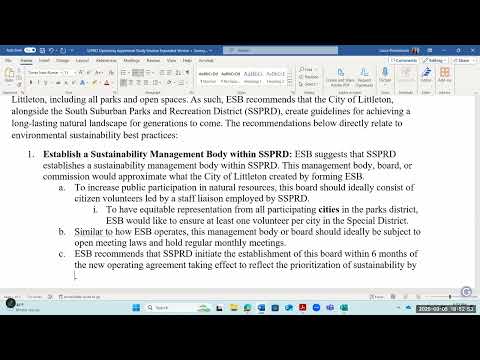
Laura, an ESB member who drafted the recommendations, presented the board’s suggested priorities for negotiations over the South Suburban Parks and Recreation District (SSPRD) operating agreement and said, “ESB recommends that the City of Littleton, alongside the South Suburban Parks and Recreation District, create guidelines for achieving a long lasting natural landscape for generations to come.”
The board’s key recommendations are threefold: create a sustainability management body within SSPRD, require an environmental stewardship action plan for the district, and commit to regular reporting and reviews. The ESB proposes that the management body be a volunteer advisory board supported by an SSPRD staff liaison, include at least one volunteer representative from each member community, and be subject to open-meeting laws. The ESB recommended that SSPRD initiate establishment of that body within six months of any new operating agreement taking effect.
The proposed action plan would be tailored to SSPRD’s jurisdiction and include measurable goals, targets and timelines. ESB offered examples of plan elements: a greenhouse gas inventory following U.S. community-protocol standards with updates every three to five years as the baseline is revised; commitments to reduce pesticide and herbicide use; an urban-forestry management plan to catalog tree diversity and map canopy (the City of Littleton adopted an urban forestry master plan in 2023 that ESB said could serve as a starting guide); water-use management; and expanded recycling and composting access within parks and facilities.
ESB recommended that progress on the action plan be tracked with a quarterly report to SSPRD’s management body and an annual public report. The board debated cadence and language, and members suggested changing some items from prescriptive commands to framing them as items for negotiation with SSPRD and the City Council. ESB members emphasized framing the recommendations in ways that invite collaboration — “we’re on this journey together,” one member said — rather than presuming SSPRD must adopt each item unchanged.
On governance and personnel, ESB recommended that Littleton encourage SSPRD to prioritize sustainability in leadership recruitment and performance evaluation. The board discussed wording that would signal sustained emphasis — for example, evaluating leadership “based on environmental stewardship and natural-resources management” rather than a one-time hiring criterion.
The board also proposed routine revisits of the operating agreement to keep it current on environmental issues; members suggested a reassessment cycle of about three to five years so that the agreement can address “the most pressing and up-to-date environmental aspects” as conditions change. ESB debated whether certain items (for example, electoral access and ballot distribution) should remain in the negotiation document; some members argued for a brief additional paragraph addressing leadership and equitable access rather than making those stand-alone numbered items.
City staff and ESB members discussed funding implications. ESB suggested the City of Littleton consider earmarking funds, in part, to help implement recommendations related to City of Littleton parks, recreation and open space if the city negotiates a higher level of service from SSPRD. The board noted that implementation could include partial cost-sharing rather than full funding by Littleton.
The board requested staff follow-up: refine wording to remove duplicative or “fluffy” phrasing, make the volunteer-representation language inclusive of unincorporated areas and member communities, and prepare a presentation and a concise one-sentence addition that would appear after the numbered recommendations describing leadership hiring and equitable-access priorities. ESB planned to present the revised recommendations to City Council at the end of the month.
Speakers quoted or paraphrased in this article are limited to those who appear in the meeting record.