Get Full Government Meeting Transcripts, Videos, & Alerts Forever!
Get email alerts on the Remote Patient Monitoring topic
No spam. Unsubscribe anytime.
Provider group says remote patient monitoring can cut ER visits; DC Medicaid not reimbursing service
Summary
A Medicaid-focused remote patient monitoring pilot funded by DC Health Care Finance Administration showed promising engagement and potential cost savings, witnesses said, but DC Medicaid currently does not reimburse for the service — a gap providers urged the committee to address.
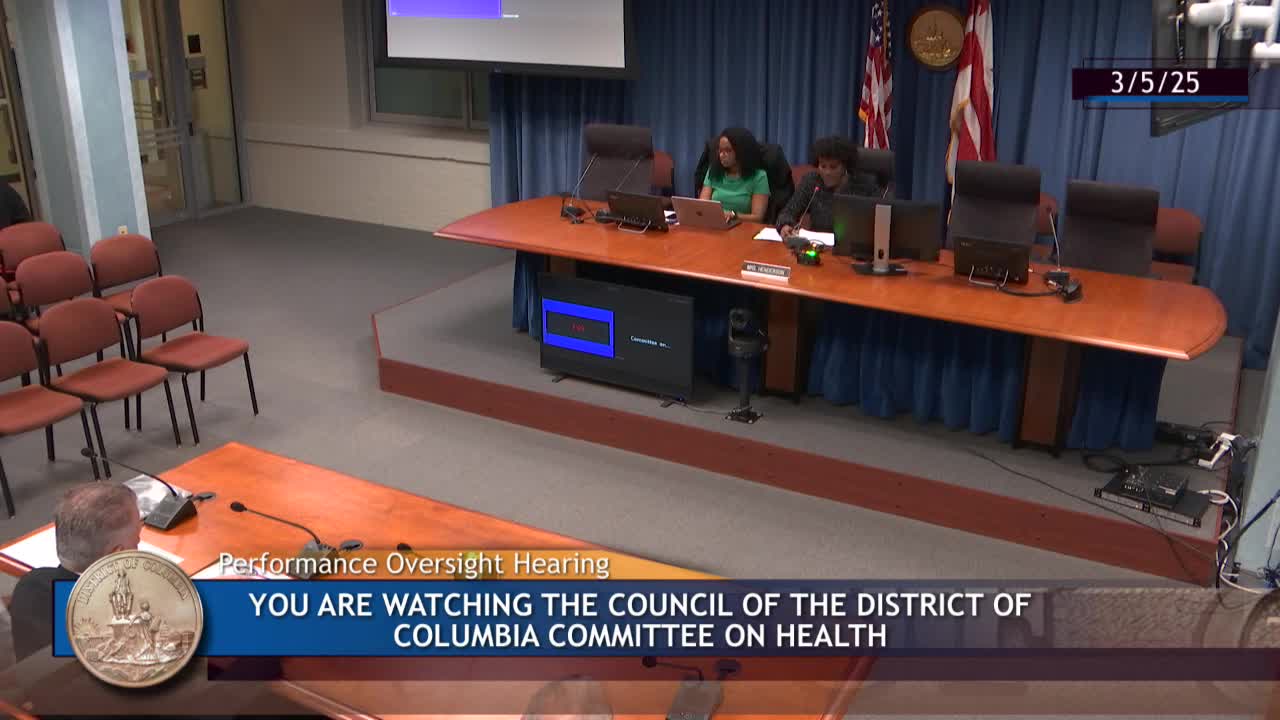
A remote patient monitoring (RPM) pilot funded by the District’s Health Care Finance Administration (DHCF) demonstrated strong patient engagement and potential to reduce costly emergency department visits, a witness told the Committee on Health — but he said DC Medicaid does not currently reimburse for RPM services.
"We received a grant from the DC Health Care Finance Administration in 2022 to demonstrate the power of remote patient monitoring as a strategy for reducing health disparities, but also as a strategy for reducing costs by keeping people out of the emergency room," said George McFarland, president and founder of McFarland and Associates. McFarland said his organization worked with Medicaid beneficiaries in Wards 6, 7 and 8 and that participants who provided the program’s required biometric readings were more likely to avoid high-cost emergency care.
McFarland described the monitoring devices as Wi‑Fi enabled, transmitting blood pressure and glucose readings in real time and triggering alerts to the care team, which then calls the patient to triage and coordinate care. He cited high emergency-room costs for the District and lengthy wait times at some hospitals, and said Medicare reimburses for RPM but DC Medicaid does not. "Medicare provides reimbursement for this service, but DC Medicaid does not," he told the committee.
McFarland and other witnesses suggested the committee consider whether Medicaid could adopt reimbursement pathways for RPM or otherwise support wider adoption of the technology, paired with multidisciplinary care teams that can act on the data. Committee Chair Christina Henderson asked staff to follow up with DHCF, given the FY25 Medicaid budget and ongoing affordability concerns for the city.
Ending: Witnesses urged the committee to examine reimbursement policy for RPM in the District Medicaid program so the model can scale and potentially reduce emergency department utilization and costs.