Get Full Government Meeting Transcripts, Videos, & Alerts Forever!
Get email alerts on the Corrections Budget topic
No spam. Unsubscribe anytime.
Senate subcommittee reviews $24.7 million increase in Alaska DOC FY26 request and funding shifts
Summary
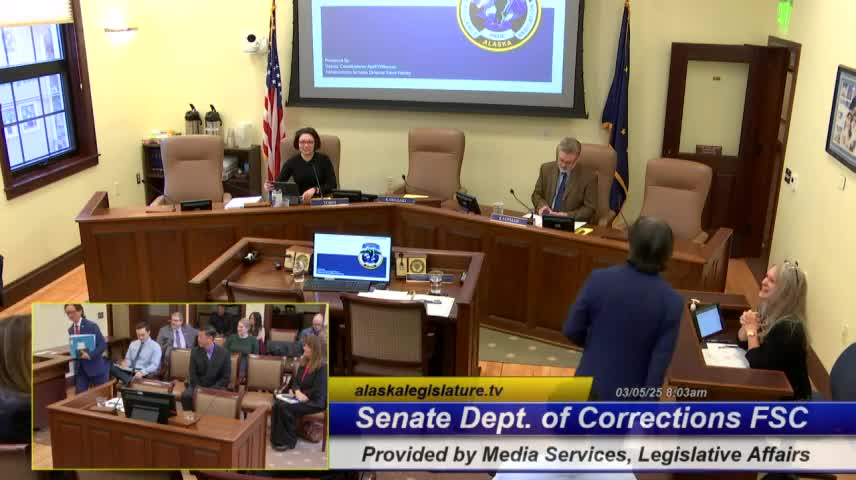
The Senate Finance Budget Subcommittee heard a Department of Corrections overview Feb. 5 on a $24.7 million FY26 operating request, proposed fund-source shifts tied to U.S. Marshals billing and restorative-justice balances, staffing and wellness initiatives, vocational training expansion and CRC contract adjustments.
Deputy Commissioner April Wilkerson and Administrative Services Director Kevin Worley presented the Department of Corrections’ FY26 operating budget request to the Senate Finance Budget Subcommittee on Feb. 5, telling the panel the department seeks an overall increase of $24,700,000 (about 5.4%) on a $481 million operating base and is proposing several fund-source changes to replace reduced federal and other restricted revenue with unrestricted general funds (UGF).
Why it matters: the Department of Corrections is one of Alaska’s largest general fund consumers. Lawmakers pressed department leaders on long-term cost growth, capacity and program investments that aim to reduce recidivism and staff burnout while the department manages near-capacity institutions.
Wilkerson said about “just over 90%” of the department’s operating budget is unrestricted general funds; other revenue sources include federal funds (1.9%), other revenue such as the Mental Health Trust Authority and interagency receipts (4.8%), and designated program receipts (2.7%). The department told the committee it employs roughly 2,100 permanent full-time positions and that population-management (institutional) operations account for the largest share of spending, followed by health and rehabilitative services and pretrial/probation/parole work (referred to in the presentation as DP3).
Funding shifts and federal billing. Wilkerson and Worley described a projected reduction in federal revenue tied to how the U.S. Marshals Service bills for federal holds: the department estimates a 7.5% reduction in federal mandate revenue that it proposes to backfill with UGF and has submitted a matching FY25 supplemental. Wilkerson said the department “has been continually coordinating with Department of Law…to try and renegotiate” with the Marshals Service but has not been successful, and asked the committee for any assistance with legislative or federal delegation engagement.
Restorative-justice and recidivism-reduction funds. Worley outlined a proposed fund-source realignment for restorative-justice and recidivism-reduction funds: initially the FY26 request included a roughly $2.5 million reduction in restorative-justice authority to be backfilled with UGF; a governor’s amended request later increased restorative-justice funding by $5.5 million with an offsetting UGF decrease. The department also plans to consolidate recidivism-reduction funds into the community residential centers (CRCs) allocation rather than leaving those funds dispersed across multiple components. “We’re proposing…to put it in one place,” Wilkerson said, so the department can manage restrictions and fluctuations in that fund balance more consistently.
CRCs, contracts and local increments. The department reported recent CRC contract negotiations and asked for a $4.128 million UGF increment (with $750,000 in designated authority) to meet contractual obligations. Worley also identified an incremental $195,000 request to fully fund the Dillingham contract after Dillingham rejoined the regional and community jail program. Those contract adjustments are described in the FY26 request and as part of a supplemental for FY25.
Personnel, overtime and supervisory pay. Wilkerson emphasized staffing as the primary budget driver and described vacancy trends: department-wide vacancies fell from over 17% at a prior high to about 10% in January; correctional-officer vacancies statewide recently fell to just under 5%, and Spring Creek’s officer vacancy dropped from roughly 38% to about 28%. The department proposed a $3.9 million UGF request for supervisory standby pay (and a matching FY25 supplemental). “The commissioner’s number-one guiding principle is the health and well-being of staff,” Wilkerson said, linking staffing stability to reduced overtime and better outcomes.
Programming and recidivism interventions. The department requested $850,000 to expand vocational services (construction technologies) at Goose Creek, Highland Mountain, Spring Creek and Wildwood to add electrical and plumbing classes, and said the expanded programs would make carpentry, plumbing and electrical training available to about 2,500 inmates across those facilities through partnerships with trade unions, community contractors, training centers and universities.
Technology pilots and medical/transport savings. Wilkerson described a tablet pilot at Highland Mountain intended to deliver programming and to digitize grievance and request processes to reduce manual staff time. She said the department is also pursuing broader telehealth and e-consult approaches to reduce outside medical transports and associated costs while maintaining safety. Worley noted a $249,000 EGF increment tied to the tablet pilot at Highland Mountain.
Education and outcomes. Wilkerson said the GED program issued 56 GEDs in FY24 and 57 in the first six months of FY25, and argued that stabilizing education and vocational funding through UGF backfills will reduce the need for periodic restrictions that have interrupted programming. Senators pressed the department on recidivism metrics, evidence-based programming and whether the state follows an identifiable out-of-state “template.” Wilkerson said the department uses evidence-based practices but cautioned that differences in law and system structure limit direct comparisons between states.
Capacity, closures and deferred maintenance. Committee members asked about an intent-language report analyzing possible facility closures. Wilkerson said the department reviewed operations and capacity and concluded it is operating at or near 91–95% of usable capacity once offline beds and emergency/segregation capacity are excluded; some beds are unusable because of deferred maintenance (for example, a Fairbanks unit with a nonfunctional locking system). She warned past closures required higher reopening costs and operational trade-offs and said Palmer Correctional Center “is operating at almost 100% capacity on both sides.”
Pretrial population and case-processing. Senators asked about the unsentenced (pretrial) share of the incarcerated population. Wilkerson said unsentenced individuals made up about 51% of the incarcerated population on July 1 and were about 45% in late January, noting local municipal case processing in Anchorage had recently reduced a backlog of misdemeanor cases. She said faster case movement in the courts has reduced pretrial counts in recent months.
Reports and legislation. Wilkerson told the committee House Bill 66 reporting requirements had been delayed by procurement timelines; the department contracted with the Alaska Federation of Natives (AFN) for the Alaska Native disparity study and expects an interim report in April with a draft due by June 30. The separate study on other disparities remains under discussion with the university; the department said a full study would likely require a longer time frame and outside grants.
Concerns raised by lawmakers. Senators asked for follow-up hearings on specific issues. Sen. Tobin asked for a deeper briefing on suicides in custody and prevention efforts; Wilkerson said the department had recently held a hearing and invited further discussion with the director in the room. Lawmakers emphasized the intersection of education investment and long-term population trends and requested more clarity on the department’s model for projecting long-term general fund needs; Wilkerson said the Office of Management and Budget provided a three-year-average forward-projection model but not a long-range 10-year projection.
What the department requested (selected line items described to the committee): $24.7 million increase overall on a $481 million operating base; $3.9 million UGF for supervisory standby pay (FY26 and FY25 supplemental); $850,000 to expand vocational programs; $249,000 EGF for an inmate tablet pilot; a $4.128 million UGF increment (plus $750,000 designated authority) to meet CRC contractual obligations; and incremental funding to fully support the Dillingham CRC contract ($195,000). The department also described backfilling roughly $2.5 million in restorative-justice authority with UGF in its initial FY26 materials, later adjusted in a governor’s amendment.
Decisions and next steps. The department made no formal votes; senators asked for additional materials and potential follow-up hearings. Wilkerson asked for legislative assistance in ongoing negotiations with the U.S. Marshals Service. The subcommittee left open further meetings and review of intent-language responses and fiscal projections.
Ending note: the subcommittee adjourned at about 9 a.m.; committee members signaled continued interest in staffing, suicide-prevention data, long-range cost projections and program outcomes that the department said it will return to in future briefings.