Get Full Government Meeting Transcripts, Videos, & Alerts Forever!
Get email alerts on the State Income Tax topic
No spam. Unsubscribe anytime.
House Tax Committee lays over HF812 after debate over cost and who benefits
Summary
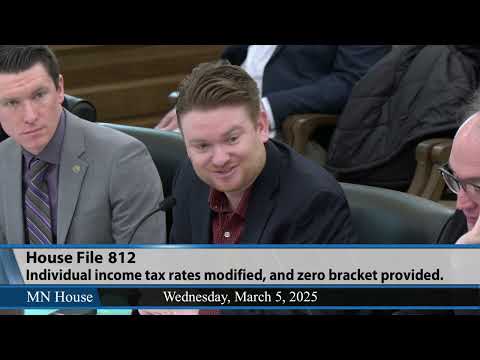
Representative Weiner introduced House File 812, a proposal to lower Minnesota's lowest individual income tax bracket, telling the House Tax Committee the bill would deliver "tax relief for the hardest working people in the state of Minnesota." The committee did not vote on the bill and Representative Weiner moved to lay it over for possible inclusion in the omnibus tax bill.
Representative Weiner introduced House File 812, a proposal to lower Minnesota's lowest individual income tax bracket, telling the House Tax Committee the bill would deliver "tax relief for the hardest working people in the state of Minnesota." The committee did not vote on the bill and Representative Weiner moved to lay it over for possible inclusion in the omnibus tax bill.
The bill's author, Representative Weiner, argued Minnesota's rates are uncompetitive with neighboring states and said reducing the first bracket would help households earning under about $38,000 a year. "Imagine if you will, you're making under $38,000 a year. If this bill were passed, it would be like getting 50¢ to a dollar per hour onto your check," Weiner said, calling the measure "a common sense bill." He also cited neighboring state rates, saying, "Iowa has a 3.9 single rate, Wisconsin has a 3.5 lowest bracket, South Dakota has no income tax, and North Dakota has a graduated income tax ranging from 1.95 to 2.5." Representative Weiner said he was willing to work with colleagues on amendments and targeting.
Nan Madden, Minnesota budget project director at the Minnesota Council of Nonprofits, testified in opposition or with concern and questioned whether HF812 would target households struggling the most. "This bill as it's drafted is not a good tool for that goal," Madden said, adding that the Department of Revenue analysis estimates roughly 20% of Minnesota income tax filers would not receive any benefit from the proposal. Madden said the measure would deliver larger dollar cuts to higher-income filers because Minnesota taxes only taxable income, not total adjusted gross income, and family-dependent exemptions can reduce taxable income for lower-income families.
Madden gave an example of a married couple with two children and $60,000 adjusted gross income whose taxable income could remain under the first bracket and therefore receive a smaller reduction. She estimated the proposal would cost "roughly $4,000,000,000 a year" and warned that cutting that amount could require deep reductions in services including health care, supports for seniors and people with disabilities, schools, and transportation.
Representative Ursula Smith and Representative Gomez also pressed on the fiscal and distributional effects. Smith pointed committee members to a memorandum in the packet showing distributional modeling and said higher-income households would receive the largest share of the tax reduction: "Those who have an income of greater than 100,000, will account for 53.7% ... of the decrease in revenue," she said, and that lower-income households would receive a much smaller share. Gomez called the bill effectively creating a multibillion-dollar hole in the budget and warned that reductions could translate into cuts to schools, human services, roads and local government aid.
The committee did not take a recorded vote on HF812 during the hearing. Representative Weiner moved that House File 812 be laid over for possible inclusion in the omnibus tax bill; the motion was made on the record and the hearing concluded with the bill laid over. Representative Weiner reiterated willingness to negotiate amendments to better target relief to lower-income households.
Votes at a glance: No formal vote was taken on House File 812 during this hearing; the measure was laid over for possible inclusion in the omnibus tax bill.