Get Full Government Meeting Transcripts, Videos, & Alerts Forever!
Get email alerts on the Broadband Certification topic
No spam. Unsubscribe anytime.
House committee advances fix to Minnesota broadband installer law after safety, timing debate
Summary
The House Ag Finance and Policy Committee voted 7-6 to send House File 47 to the general register after debate about training timelines, staffing mandates and safety standards in last year’s telecommunications installer law.
House File 47, a bill to amend Minnesota’s underground telecommunications installer certification requirements, advanced out of the House Ag Finance and Policy Committee on a 7-6 roll call after committee members debated whether the law’s training timeline and staffing mandates are workable for the industry.
Supporters said the bill preserves safety standards while providing flexibility to avoid disrupting broadband deployment. Opponents said reducing training hours and clarifying who must be certified could weaken public and worker safety.
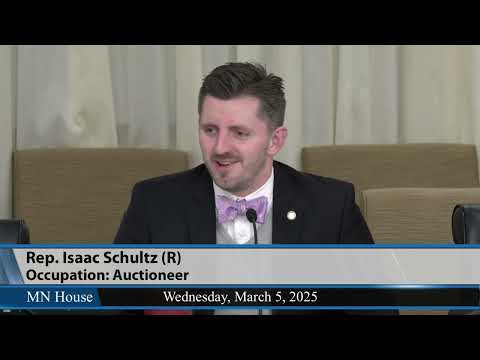
Representative Schultz presented the bill and a related A1 amendment, which the committee approved before debate. Melissa Wolf, executive director of the Minnesota Cable Communications Association, testified the law enacted last session will disqualify ‘‘thousands of experienced broadband installers’’ without changes, because a July 1 compliance deadline and a 40-hour training requirement are impossible to meet statewide before thaw and peak construction season. Wolf told the committee, “When this deadline is missed … providers and contractors will have three impossible choices. Shutdown projects … continue working out of compliance … or lose permits delaying broadband access indefinitely.”
Industry witnesses said the implementation schedule and the hands-on portion of training cannot be completed across the state by July 1. Nick Anderson of Anderson Underground and Brent Christensen of the Minnesota Telecom Alliance described apprenticeship programs and industry safety curricula they say should be recognized as qualifying training. Joel Hansen of Associated Builders and Contractors said his organization is developing a program and estimated demand for roughly 1,000 trainees, but said Minnesota’s abbreviated construction season makes meeting the July 1 deadline unlikely without an extension.
Labor and safety proponents urged caution. Kevin Prentice of Laborers’ International Union (LiUNA) and Jake Schweitzer of North Star Policy Action cited continuing high rates of damage to buried utilities tied to telecom installation and warned that cutting training hours “would turn safety standards into a box‑checking exercise.” CenterPoint Energy’s damage prevention manager, Crystal Gores, presented utility data showing increases in telecom-related underground damages and urged retaining robust requirements.
Representative Schultz said the bill does not repeal the safety standards established last year but seeks to make them workable by clarifying who must be certified and extending timelines so installers can complete required hands‑on training after thaw. The bill’s supporters noted federal broadband funding expected in Minnesota — cited in testimony as roughly $652,000,000 over four years — and argued the state must avoid interrupting deployment.
After discussion the committee took a roll call. Chair Anderson renewed his motion that House File 47 be passed and sent to the general register; the chair and seven members voted yes, and six members voted no. The clerk recorded the following votes: Chair Anderson — aye; Representative Harter — aye; Representative Hansen — no; Representative Smith — no ("in its current form"); Representative Agbache — no; Representative Buerkle — aye; Representative Frederick — no; Representative Gander — aye; Representative Jacob — yes; Representative Lawrence — yes; Representative Lee — no; Representative Nelson — aye; Representative Vang — no. The motion passed, and the bill will move to the general register for further consideration.
Committee members said they expect continued stakeholder work on the specific language clarifying which workers must be certified and on timing. Representative Hansen indicated he would withhold a final vote in other settings until further daylighted committee work occurs.
The committee record shows extended testimony from industry, trade associations, labor unions and utilities; the debate centered on implementation logistics rather than disagreement that safety is a priority. For now, the committee’s action advances the bill but leaves outstanding work for subsequent floor and interchamber consideration.