Get Full Government Meeting Transcripts, Videos, & Alerts Forever!
Get email alerts on the Education Reading Rea D Act topic
No spam. Unsubscribe anytime.
Committee advances Read Act changes emphasizing ‘science of reading,’ rejects proposals to remove teacher assessment requirement
Summary
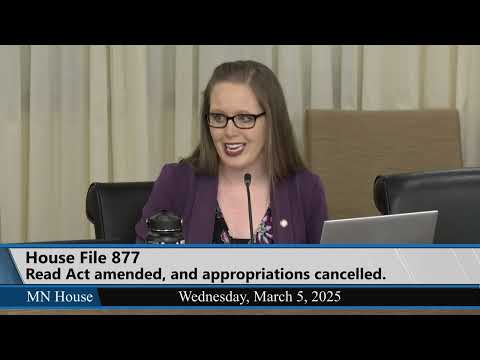
The House Education Policy Committee on March 5 voted to send House File 877, as amended, to the Education Finance Committee after adopting an author’s amendment that emphasizes instruction and materials aligned to the “science of reading” and moves certain REED Act duties to the Minnesota Department of Education.
ST. PAUL, Minn. — The House Education Policy Committee on March 5 voted to send House File 877, a measure reshaping parts of the state’s REED (Read Early Education and Development) Act implementation, to the Education Finance Committee after adopting an author's amendment (A2).
The bill's author, Representative Erin Mueller, told the committee the measure would require that “instruction and practices, interventions, teacher development, textbooks, all the instructional material” be “on the science of reading,” and would move certain activities assigned to CARI (the statewide contractor carrying out REED Act tasks) to the Minnesota Department of Education (MDE) beginning July 1, 2025.
Supporters said the change would clarify that evidence-based reading instruction must align specifically with the science of reading and increase transparency in curriculum and teacher‑preparation reviews. Opponents and several testifiers urged caution, saying the bill as drafted could narrow local control, risk teacher retention if additional assessments are required, and remove protections for culturally and linguistically responsive instructional materials.
Representative Mueller said the bill does not require a paper‑and‑pencil exam for Tier 3 and Tier 4 teaching licenses, noting the statute would allow a “performance assessment of knowledge” and that the state could use rubrics or practicum options. “It does not have to be a paper pencil test,” she said. She also referenced other states’ approaches: “In Mississippi...they have a requirement for their teachers to pass an exam. That exam is 4 hours long,” she said, as an example of one extreme.
Education Minnesota’s Justin Killian testified that many union members support structured literacy and phonics-based instruction but worry about an absolute prohibition on other practices. “They get very, very nervous when you handcuff them and say, you can only do this thing and this thing only,” Killian said, urging the committee to preserve flexibility for multilingual learners and others.
Representatives of Minnesota training organizations sought changes to ensure several longstanding, nationally accredited teacher‑training programs are recognized under the REED Act and that teachers who previously completed rigorous practicum‑based training be grandfathered. Cindy Russell, executive director of the Reading Center Dyslexia Institute of Minnesota, described training that includes an Orton‑Gillingham practicum and said enrollment in her programs dropped after implementation choices under the REED Act. Karen Sande, founder of Orton Gillingham Reading Specialists, told the committee, “To train a teacher without including a practicum is like taking drivers ed without doing behind the wheel.”
Assistant Commissioner Bobbi Burnham of MDE warned the committee that swapping the statutory phrase “evidence‑based structured literacy” for the broader term “science of reading” could have implementation consequences. “The science of reading is informed by many branches of science but may be too broad for the targeted purposes of the REED Act,” Burnham said. She also said several deliverables currently contracted to CARI would not be finished by the bill’s June 30, 2025 deadline and that MDE currently lacks the staffing and some specialized expertise to immediately absorb all contracted tasks.
The committee adopted the author’s A2 amendment to place the bill in the shape the author preferred. Two subsequent floor amendments — A3, offered by Representative Tina Jordan to remove the requirement that Tier 3 and Tier 4 applicants pass a performance assessment, and A4, offered by Representative Tim Green to restore the struck language requiring curricula be culturally and linguistically responsive — were both defeated in committee voice votes. Representative Jordan said she opposed adding another test requirement because of concerns about teacher shortage and racial bias in testing; Mueller replied she expected there were non‑paper assessment options and urged members to retain an “independent mechanism” to verify teacher knowledge.
After discussion, the committee voted to re‑refer House File 877, as amended, to the Education Finance Committee.
What remains unresolved in committee: the bill’s definition of “science of reading,” the precise nature of any assessment or performance requirement for Tier 3/Tier 4 licensure, how nationally accredited, practicum‑based training programs will be recognized or grandfathered, the timeline and staffing implications if CARI activities move to MDE, and a working definition of culturally and linguistically responsive materials that would satisfy proponents on both sides.
Votes at a glance: A2 adopted; A3 failed; A4 failed; final re‑refer motion passed (voice votes recorded in committee minutes as “ayes have it” or “the motion prevails”).
The committee heard extensive public testimony and discussion but did not complete final statutory language on several contested points. Committee members said they will continue negotiations and staff work as the bill moves to the finance committee.