Lifetime Citizen Portal Access — AI Briefings, Alerts & Unlimited Follows
House committee hears bill to increase penalties for politically motivated arson
Loading...
Summary
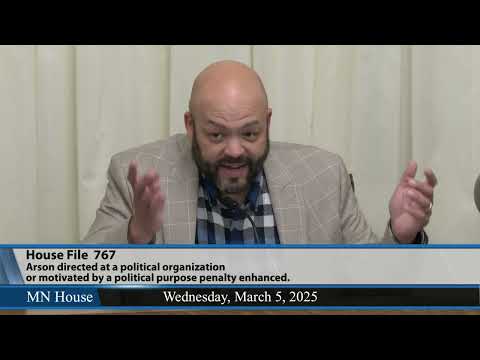
Representative Matt Hudson introduced House File 767 to the Minnesota House Public Safety Committee on March 5, 2025, proposing an enhanced first-degree arson penalty when a fire damages a building that houses a political organization or when the offense was committed "in whole or substantial part" to make a political statement.
Representative Matt Hudson introduced House File 767 to the Minnesota House Public Safety Committee on March 5, 2025, proposing an enhanced first-degree arson penalty when a fire damages a building that houses a political organization or when the offense was committed ‘‘in whole or substantial part’’ to make a political statement.
The bill, Hudson said, responds to a January arson that damaged offices housing three conservative organizations. "When your intention in committing an offense against somebody else is to keep them from being able to freely exercise their First Amendment rights, that's the heart of what this bill gets at," Representative Matt Hudson said.
Supporters who testified described the January incident as a targeted attack. Kendall Qualls, founder of Take Charge and a resident of Medina, said his office and two neighboring conservative groups were firebombed in the dead of night; he told the committee that the attack displaced multiple businesses and left staff and interns fearful. "We were targeted to be silenced," Qualls said. Bill Walls of the Center of the American Experiment described the scene to committee members: "You walk in, you see the hallway. It's just completely black and charred." Walls said the FBI and ATF have investigated but the suspects remain at large.
Committee members pressed the bill's authors and testifiers on constitutional and practical questions. Representative Carlie Pinto asked why the bill would impose a higher penalty for a single action—such as burning a T-shirt—if the defendant's motive is political, arguing that differential punishment tied to expressive motive raises First Amendment concerns. "Why are we gonna punish that more?" Pinto asked. Representative Hudson responded that actions endangering others can be regulated even when expressive, and that the bill targets conduct intended to chill speech rather than protected expression.
Several members raised the bill's scope and potential for overbreadth. Representative Lee Muller and Representative Greta Hollins warned that vague definitions of "political" or "political organization" could allow prosecutorial discretion to expand charges in ways the committee had not intended. Representative Johnson and others urged drafting a definition or guardrails to avoid incidental enhancements where the political organization merely happened to be located in a building that was damaged.
Representative Novotny and others discussed parallels to hate crime statutes and federal law; Representative Engen cited Texas v. Johnson and Title 18 U.S.C. 247 to argue that courts have distinguished protected symbolic acts from property destruction and that statutes can lawfully consider motive when the underlying act is criminal.
Hudson told the committee he is open to narrowing language and to working with colleagues and prosecutors on definitions and implementation. Because a fiscal note had not yet been received, and amid the constitutional and drafting questions raised, the committee laid House File 767 over for further work.
The committee record shows extensive debate over constitutional limits, the precise wording of the enhancement, and practical prosecutorial issues; no final vote on the bill occurred at the March 5 hearing.
Looking ahead, Hudson said he would work with colleagues and prosecutors on a narrower definition of political motive and on drafting guardrails to avoid incidental charging where a nonpolitical arson happens to damage a building that houses a political organization.