Get Full Government Meeting Transcripts, Videos, & Alerts Forever!
Get email alerts on the Education Stem topic
No spam. Unsubscribe anytime.
4-H robotics team visits Wyoming House to showcase STEM projects, including stock-tank monitoring robot
Summary
Members of the Laramie County 4-H robotics team introduced their robot “Blackout” to the House floor and described a project to monitor stock-tank water levels remotely to reduce ranchers’ driving time.
Members of the Laramie County 4‑H robotics team visited the Wyoming House and presented their work on robotics and STEM outreach, telling lawmakers they hope to increase youth interest in technology across the state.
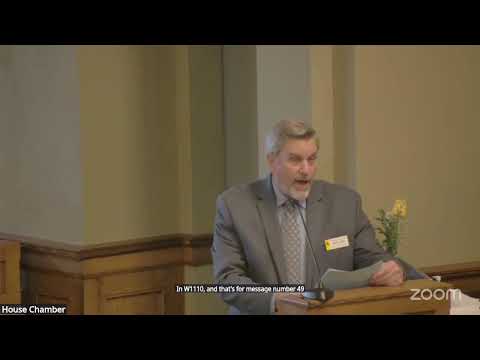
“Hello. We are the Circuit Breakers team 21618 from here in Cheyenne, Wyoming. And this is our robot Blackout,” said Jacob, a 4‑H team member, introducing the team and the robot. The students said they built the robot from scratch over about four months and described their broader motivation: to bring STEM education to Wyoming youth.
The team described a current project aimed at helping ranchers monitor stock-tank water levels. “These farmers or ranchers are going out to the stock tanks, driving there all day, driving back… Our estimate was they spend about three to five hours driving around a day just checking stock tanks. So what if they could look at their phone and see an app that told them how deep each one was,” Jacob said, explaining the project’s objective to reduce time spent checking frozen tanks in winter.
Representative Singh introduced the team from the West Gallery and asked members to be welcomed on the House floor. The presiding officer thanked the students and encouraged them to continue work in technology, saying that as artificial intelligence and other technologies advance, Wyoming needs a trained workforce.
Why it matters: Students’ projects link K‑12/4‑H STEM education with practical local needs — such as remote sensing for agriculture — and lawmakers highlighted the importance of building technical skills in the state workforce.
The visit was brief and ceremonial; no legislative action resulted from the presentation during the session record.
(Reporting based on remarks from 4‑H team members and House floor introductions.)