Get Full Government Meeting Transcripts, Videos, & Alerts Forever!
Get email alerts on the Transportation Planning topic
No spam. Unsubscribe anytime.
Council committee delays resolution on Greater Hartford Mobility Study after DOT presentation
Summary
After a lengthy presentation by the Connecticut Department of Transportation, the committee voted to postpone Councilman Mitcham’s nonbinding resolution asking the state to revise its approach to the Greater Hartford Mobility Study and requested additional briefings with the Bureau of Public Transit and other state staff.
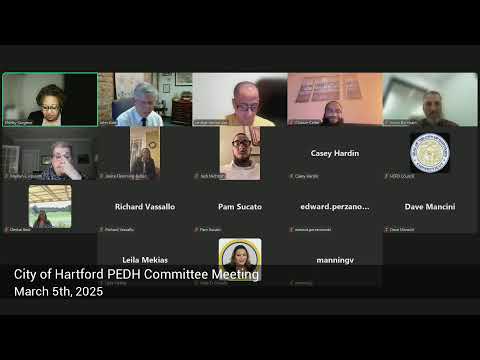
The Planning, Economic Development and Housing Committee voted Wednesday to postpone action on a nonbinding resolution from Councilman Josh Mitcham asking the state to revise its approach to the Greater Hartford Mobility Study after a presentation from Connecticut Department of Transportation staff and extended public and committee discussion.
Kevin Burnham, project manager for the DOT’s Greater Hartford Mobility Study, delivered an overview of the study’s goals, outreach and implementation program, highlighting options ranging from near-term pedestrian and transit improvements to longer-term highway capping and rail and transit realignments. “We were challenged by the community to look at this not just to repair that piece of infrastructure, but to repair the damage that that infrastructure has done to the city by dividing it,” Burnham said, describing the study’s evolution from repairs to a regional mobility vision.
Burnham outlined early-action work including pedestrian improvements at highway ramps, safer crossings at Pulaski Circle, and a Blue Hills Avenue pilot. He said the study looks at extending CTfastrak and bus-priority corridors, improving shelters at roughly 100 stops, and expanding night and Sunday service on multiple routes. Burnham also described long-term concepts such as lowering and capping highway segments and co-locating or adjusting rail alignments to reconnect neighborhoods.
Council members and community representatives focused questions on outreach and service details. Committee members asked whether DOT had provided materials and translation in Spanish; Casey Harden (project consultant) said printed materials were made available in Spanish and that outreach included Spanish-language radio spots (named La Bamba) and on-the-ground bilingual staff. Janice Fleming, who described partnership work with Voices of Women of Color and other local groups, said the engagement effort included door-to-door outreach, translated materials, and targeted events in Latinx and other communities.
Chance Carter, who serves on Hartford’s Planning & Zoning Commission and the Connecticut Public Transportation Council, urged closer coordination with the Bureau of Public Transportation and warned against service reductions that would affect riders. Carter also announced a public meeting on proposed CT Transit service changes for March 19, 5:30–7:30 p.m. at the Park Street Library and urged residents to attend and comment on proposed cuts to some routes.
After questions and comments from multiple committee members about roundabouts, transit-priority corridors, and the role of rail, Councilman Mitcham moved to postpone the resolution so the committee could obtain additional briefings — including from the Bureau of Public Transit — and consider potential amendments. The motion to postpone was seconded and carried unanimously.
The committee requested staff coordination to invite Bureau of Public Transit representatives and transit stakeholders to a future meeting and to continue city-level outreach through community house parties and neighborhood events.