Get Full Government Meeting Transcripts, Videos, & Alerts Forever!
Get email alerts on the Wastewater topic
No spam. Unsubscribe anytime.
Paradise weighs local wastewater options after regional plan stalls
Summary
Town of Paradise officials, consultants and more than a dozen residents discussed local alternatives for the Paradise Sewer Project after a regional agreement with Chico became financially infeasible; attendees urged effluent-only, step and modular solutions and asked the town to prioritize commercial corridors.
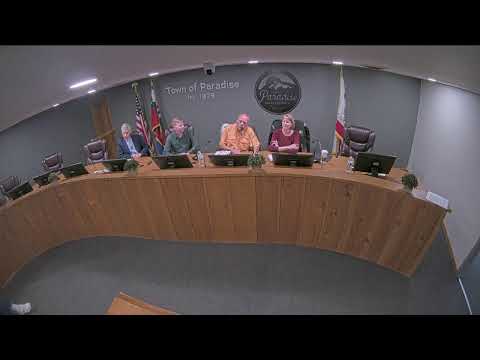
PARADISE, Calif. — Town of Paradise officials and consultants held a community meeting to gather public input on alternatives for the Paradise Sewer Project after the town voted in January to shift away from a regional hookup with the City of Chico due to soaring costs and reduced funding.
The meeting’s purpose was “to make this about you and how the project should go moving forward,” Mark Netdix, the town’s public works director and town engineer, told residents as the town outlined why regionalization was abandoned and what local options remain.
Town leaders said the Paradise Sewer Project remains central to recovery objectives — improving groundwater quality, restoring affordable housing and supporting commercial recovery — but that the previously planned regional option is no longer financially feasible. Officials described existing funding, new funding prospects and a process for vetting alternatives and vendors, and they sought community direction on phasing and siting.
Background and funding
Officials reviewed the project’s history, saying a 2017 study evaluated both regional and local approaches and that after the 2018 Camp Fire the town selected a regional alternative with Chico. The town said it has an adopted programmatic environmental impact report and that it received Community Development Block Grant Disaster Recovery funds for preconstruction work: "$30,000,000 for planning" with an identified $15,000,000 toward construction that may be reallocated to preconstruction as needed. Netdix said the town also received a congressional allocation of $1,750,000 secured by Congressman Doug LaMalfa, and is pursuing a possible $50,000,000 U.S. Army Corps of Engineers Section 219 allocation and a $27,000,000 state water board Division of Financial Assistance grant; a $20,000,000 low-interest loan option was also noted.
Netdix said the town does not yet have enough funding to build a revised local project and that no single system has been chosen: “there is not any system that we've decided on moving forward with now.” He urged residents and vendors to provide input and noted the town had sent a vendor invitation packet and posted materials at paradisesewer.com.
Options discussed
Consultants gave a technical overview of treatment approaches and footprints. JB Neethling, HDR wastewater treatment process specialist, summarized core treatment choices and tradeoffs, noting that wastewater is “over the 99% of it is water” and describing treatment methods ranging from lagoons and aerated lagoons to conventional mechanical plants and membrane bioreactors (MBRs). He explained that more compact technologies such as MBRs reduce land footprint but increase operational complexity and cost.
Among residents and local vendors, several alternatives drew consistent attention: decentralized or effluent-only collection (often described as a STEP or STEP/STEP-type system), modular packaged treatment (including pre-engineered MBR package plants), constructed wetlands, and a phased approach that targets commercial corridors first.
Advocates for STEP/effluent-only systems argued they reduce solids transported to central treatment and require smaller collection infrastructure. “A step system is the best way to eliminate having to deal with the solids,” said Cliff Jacobson, a town resident with decades of water and wastewater experience. Supporters said STEP systems can be installed with smaller-diameter piping, cause less surface disruption, and be phased across corridors such as Skyway and Clark Road.
Local vendors and manufacturers offered modular packaged options. Jake Lincoln, sales manager for Closina, described pre‑engineered, stainless-steel MBR package plants that can be manufactured off-site and erected quickly on-site; he said such modular plants can be expanded as demand grows. Developer and distributor Kelly Consselman said modular and on-site treatment options can allow targeted development in commercial and multifamily areas without relying solely on a single large plant.
Constructed wetlands also received attention from residents as a lower-cost, lower‑chemical option used elsewhere in California and internationally. William Kellogg urged the town to investigate constructed wetlands, saying they have EPA and state approvals and can be scaled from individual lots to community systems.
Business concerns and priorities
Local business representatives urged clarity on connection costs, operating fees and construction impacts. Monica Nolan, CEO of the Paradise Ridge Chamber of Commerce, put the chamber’s priorities plainly: “A reliable system is necessary for survival for small businesses that have fought to reopen and stay afloat in the aftermath of disaster and pandemic.” The chamber asked for transparent information about connection fees, ongoing charges, and mitigation for construction disruptions.
Multiple speakers asked that any initial phase prioritize commercial corridors where higher-density development and new businesses are most constrained by current septic and leach-field limits. The meeting included an on-site survey and an online form asking whether the first phase should prioritize the Skyway/downtown corridor or the Clark Road corridor and whether an initial treatment facility should be located inside town limits or outside.
Process, next steps and town direction
Netdix and staff said the council formed an ad hoc committee to accelerate work while keeping the public informed; the town aims to identify a revised project description by May or June to resume funding pursuits, environmental revalidation, and design work. The town is inviting vendors to request meetings by March 21 to present treatment or collection concepts to staff and consultants.
Staff noted a previous formal action: at a January 21 special meeting, the Paradise Town Council voted to direct the project toward a local option rather than the regional Chico alternative. Netdix said the town remains open to multiple approaches that meet state standards and fundability criteria but emphasized that details on costs will depend on the chosen technology and phasing.
What was not decided
There was no final selection of a treatment technology, no contract award for a new treatment plant in the meeting record, and no vote adopting a specific phase map or cost schedule. Officials repeatedly said funding remains insufficient to construct a revised local project without additional grants or allocations.
Public input highlights
- Technical vs. practical tradeoffs: Consultants emphasized land footprint, energy, and nitrogen limits for land application; residents urged minimizing road closures and disruption to existing businesses. - STEP/effluent-only proponents argued lower capital and maintenance burdens and faster implementation. - Vendors promoted modular packaged plants and offered turnkey build-and-operate proposals. - Several residents proposed constructed wetlands or multiple small treatment sites rather than one large centralized plant.
The town will summarize meeting input and survey results, continue vendor outreach, and present findings back to the ad hoc committee and town council. Netdix said staff hopes a revised project direction in late spring will enable renewed funding efforts and design work; the chamber urged faster answers, warning that long uncertainty would hinder small-business recovery.
Residents and vendors who want to meet with staff were directed to the vendor packet on paradisesewer.com or to contact town staff for appointments.