Get Full Government Meeting Transcripts, Videos, & Alerts Forever!
Get email alerts on the Hydropower Permitting topic
No spam. Unsubscribe anytime.
Rhinebeck planning board continues hearing on Mill Road hydro project amid DEC, Army Corps permitting and erosion concerns
Summary
The Rhinebeck Planning Board continued the public hearing on Joel Perm’s proposed run-of-river hydroelectric project at 443 Mill Road to April 7 after site-visit findings raised questions about stream-bank disturbance, missing erosion controls and outstanding state and federal permits.
The Rhinebeck Planning Board on Monday continued the public hearing on a proposed run-of-river hydroelectric installation at 443 Mill Road, owned by Joel Perm, after site-visit reports and public comments raised concerns about stream-channel work, erosion risks and outstanding state and federal jurisdictional determinations.
Perm, who described the project as a run-of-river installation and said he has filed a joint application with the U.S. Army Corps of Engineers and the New York State Department of Environmental Conservation (DEC), told the board he paused the project after the turbine supplier went out of business and later changed the design. "I might be coming back to the board in a year or two with that system," Perm said. He apologized to the board for beginning work before design changes were returned to the board.
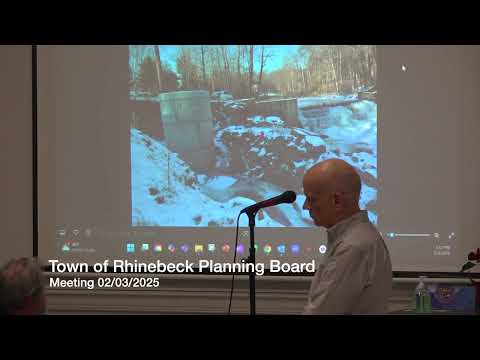
Board planning staff and members said the site visit revealed a trench separated from the stream by only a narrow berm, large piles of rock and spoil without silt fencing and rock broken out of the embankment with a hammer attachment. "There was a trench dug into the stream bed, separated from the stream flow by a narrow length of rock and soil," a site-visit report presented to the board said. The report said piles of rock and dirt were uncovered by snow and lacked erosion controls.
Planning staff advised that a DEC jurisdictional determination and confirmation of Army Corps permit status remain outstanding. "Based on information I got from CPL, the proposed work may include the need for a joint permit application," planning staff said. The board discussed asking the applicant to pay for an outside inspector — CPL was suggested — to perform construction inspection if the project proceeds, to ensure erosion controls and reconstruction are completed to the town's satisfaction.
Residents and board members pressed Perm on erosion and long-term stability of backfill. One site-visit participant said that rock ledge removed from the bank had been tightly compacted when in place and that replacing it with loose rock and soil could leave voids susceptible to water erosion and cause scour behind the existing concrete retaining wall. "If the clay washes through, you're just going to get erosion on the backside," a resident said during the public discussion.
The board also discussed the limits of its enforcement authority. Members said a stop-work order is issued by the building/code officer, and noted that Ryan (code enforcement) would make any on-site stop-work determination. The board voted to continue the public hearing to April 7 to allow time for DEC and Army Corps responses and for staff and the applicant to provide outstanding materials. The motion carried by voice vote.
What happens next: The board requested that Perm provide evidence of permit filings and suggested the applicant arrange for a construction inspector if work resumes. The board also asked staff to confirm whether the piles of spoils are currently protected and to follow up with the building department on the status of any stop-work order.