Get Full Government Meeting Transcripts, Videos, & Alerts Forever!
Get email alerts on the Small Business topic
No spam. Unsubscribe anytime.
Supervisors hear case to extend First Year Free program after city reports 9,400 enrollments
Summary
At a March 5 Budget and Finance Committee hearing, city officials reported that the First Year Free program has enrolled about 9,400 businesses and waived nearly $5 million in fees since November 2021 and urged a legislative extension before the program sunsets in July.
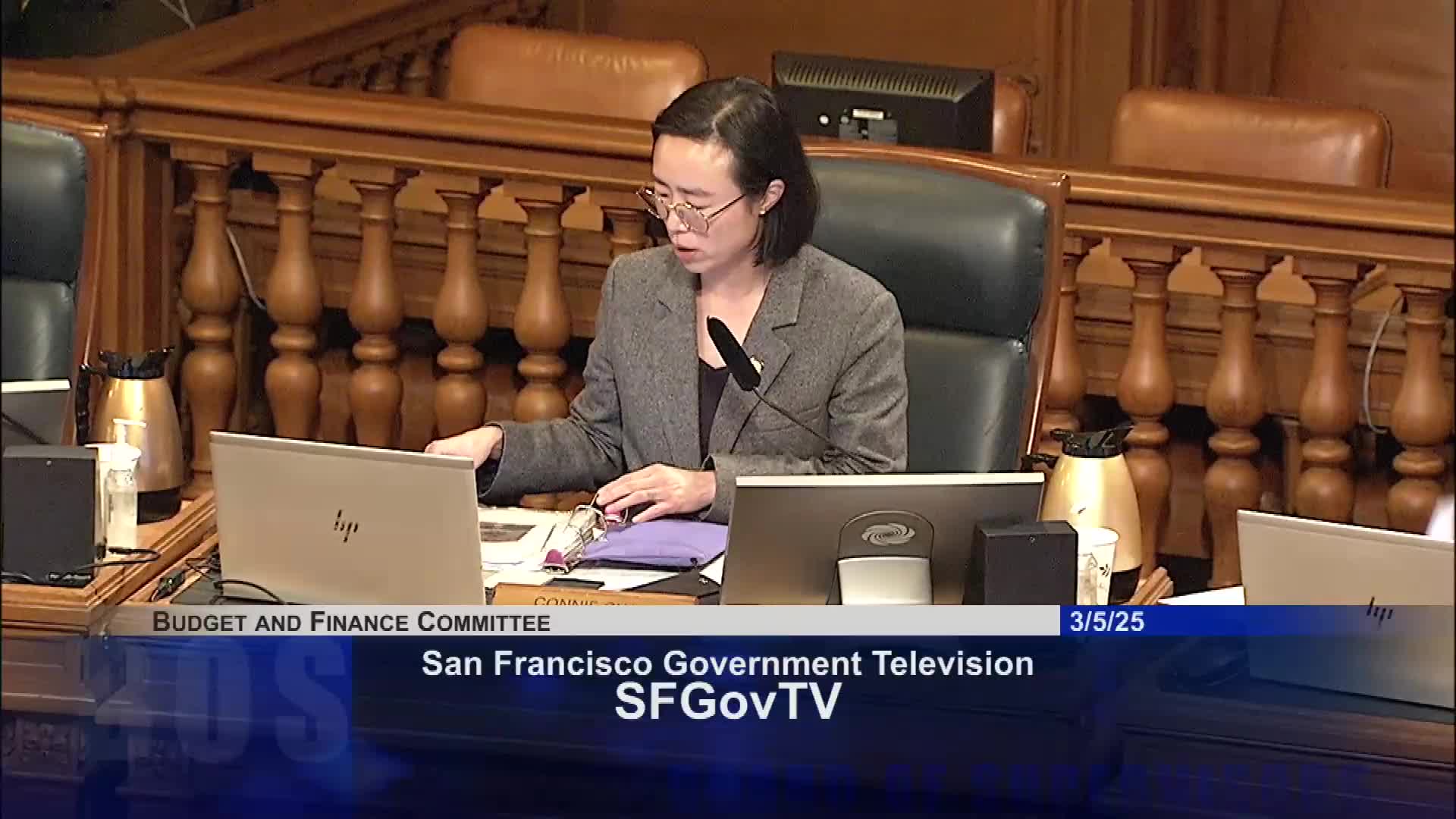
San Francisco supervisors on the Budget and Finance Committee heard testimony March 5 on whether to extend First Year Free, a city program that waives initial registration, permit and license fees for qualifying new small businesses and for existing businesses opening new storefronts.
Treasurer's Office officials told the committee the program has enrolled about 9,400 businesses since it launched in November 2021 and that the city has waived nearly $5 million in fees during that period. The program is set to sunset this July unless the Board of Supervisors acts to extend it.
Amanda Fried, chief of policy and communications in the Treasurer and Tax Collector’s Office, and Katie Tang, director of the Office of Small Business, described how First Year Free enrolls businesses automatically during new business registration, notifies them by email and mail, and provides a citywide lookup so departments can confirm waiver eligibility at point of service. Fried said the waiver applies to initial registration fees, first-year permits and application fees and first-year license fees and that businesses with $5 million or less in San Francisco gross receipts and a commercial location qualify.
Tang and Fried both told the committee the program also benefits businesses expanding to additional San Francisco locations: owners simply add the new address to their tax account and are automatically prompted for enrollment and fee waivers. Tang described the program as an effective “marketing tool” that has persuaded some entrepreneurs to locate or expand in San Francisco instead of other jurisdictions.
Committee members pushed presenters on operational hurdles. Staff said the most frequent problems arise when a contractor, architect or other third party pulls a permit and the business owner’s account is not clearly tied to that permit, causing fees to be charged incorrectly. Fried said the Treasurer’s Office will request refunds in those cases and that some departments’ billing systems are not fully integrated with the Treasurer’s database, particularly the Department of Building Inspection and Planning. Tang said the program’s pilot status has in some cases reduced departments’ willingness to invest in system changes to improve coordination.
Officials described the existing administrative footprint: the Treasurer’s Office funds two positions dedicated to First Year Free work — one serving accounting/fiscal reconciliation with departments and one supervising customer service. Fried said the office handles monthly reimbursements to departments for waived fees and fields customer service inquiries; she deferred broader economic-impact questions (such as projected sales-tax gain) to the Controller’s Office.
Supervisors and staff discussed the program’s fiscal implications and potential scale-up. Tang suggested a longer multi-year runway — she said five years could be workable but a 10-year horizon would allow the city to justify larger technology investments that could produce broader efficiencies and better data on business interactions with city government. Fried and Tang noted that changes in departmental fee schedules increase the program’s cost over time.
Committee members heard several business examples cited by staff illustrating the range of fee savings: Casa Guadalupe (about $1,800 in waived fees), Blue Truck Studio (about $2,500), and El Milamores (about $11,000 in permit fee waivers). Staff said actual savings vary widely based on the scope of tenant improvements or permit work.
Supervisor Steve Sherrill, who called the hearing, said the committee must weigh First Year Free’s cost against the city’s fiscal constraints while recognizing the program’s role in supporting small businesses and neighborhood retail corridors.
After questions and public comment (none), the committee voted 3–0 to hear and file the item; staff said items acted on at the committee are expected to be on the full Board of Supervisors agenda of March 11 unless otherwise stated.
Ending: The hearing captured both the program’s uptake and operational limits as a pilot. Staff urged legislative extension and more stable funding and systems investment to reduce administrative friction, while supervisors signaled support but noted the city’s broader budget constraints.