Get Full Government Meeting Transcripts, Videos, & Alerts Forever!
Get email alerts on the Kahoolawe Restoration Transfer topic
No spam. Unsubscribe anytime.
Kahoolawe commission outlines restoration work, transfer options to sovereign Hawaiian entity
Summary
Kahoolawe Island Reserve Commission executive director Michael Naho'opi briefed the Office of Hawaiian Affairs committee on ongoing restoration work, island infrastructure investments and the statutory requirement to transfer management to a federally and state-recognized Native Hawaiian sovereign entity when such recognition occurs.
Mike Naho'opi, executive director of the Kahoolawe Island Reserve Commission, told the Office of Hawaiian Affairs Committee on Investments and Land Management on March 5 that the commission is focused on restoration, cultural access and preparing the island for eventual transfer "once a federally and state recognized native Hawaiian sovereign entity" is in place.
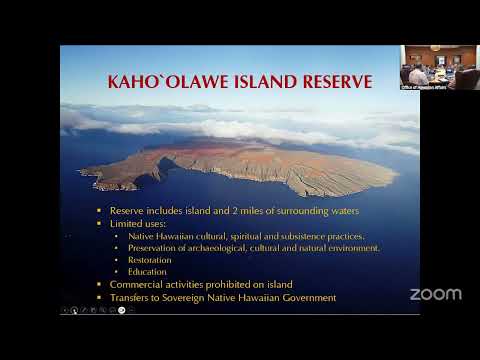
Naho'opi said the reserve and the two-mile surrounding waters are governed by statute and limited to "Native Hawaiian, cultural, spiritual, and subsistence practices, preservation of its archaeological, historical, cultural significance and resources, restoration and education," and that commercial activities are prohibited on the island. He described the commission's mission as involving communities in restoration so "we are not only restoring Kahoolawe, we are restoring our own people."
The briefing highlighted three practical priorities: ongoing restoration of 28,000 acres of devastated landscape, island operations and infrastructure, and advance planning for a transfer of management. Naho'opi said the commission currently runs base-camp logistics on the island (power, reverse-osmosis drinking water, communications and transport), ocean management for roughly 85 square miles of ocean, and active programs including native-plant restoration, seabird reintroduction, invasive mammal eradication and erosion control. He said the commission has installed photovoltaic power, microwave relay links for internet and telephone, and a reverse-osmosis system to produce potable water.
Naho'opi reviewed the statutory transfer requirement and five possible models the commission has considered for conveying the island and surrounding waters to a Native Hawaiian sovereign entity. Models discussed include conveyance of title and trust to the sovereign (including residual trust funds and water and transfer of certain liabilities), transfer of title only, transfer of management and control while the state retains liability, transfer of commission seats to a sovereign entity while state funding and liability remain, or a sovereign declining the conveyance. He cautioned that the statute, quoted in the briefing as "Hawaii statute 6 k dash 9," requires federal and state recognition to trigger transfer and that details such as which liabilities and MOUs (including the existing Navy MOU on unexploded ordnance and safety) will transfer will require negotiation and public hearings.
On cleanup scope and timing, Naho'opi said the federal cleanup that followed turnover to the state completed about 75% of surface clearance and roughly 10% of subsurface work; the U.S. military ended its active cleanup responsibility around 2004 after a multi-year federal program. He said any additional large-scale UXO (unexploded ordnance) cleanup would require another government initiative and funding from either federal or state sources. "Any new cleanup on the island will have to come from somebody else, and somebody else will have to push for either the federal government or a state-run cleanup," he said.
Trustees asked practical questions about access and stewardship. Trustee Lindsey asked about arranging trustee visits; Naho'opi said trustee visits are possible by boat with overnight stays. Trustees also raised whether OHA could act as an interim custodian for the island until a Native Hawaiian sovereign entity is recognized; Naho'opi said that model is possible under some scenarios the commission has developed but would require negotiation and clarity on funding and liability.
Naho'opi emphasized building resources and infrastructure so a successor entity would not have to start from scratch: "We're developing an innovative and native-centric management model so that whoever comes will have something. They don't have to start from scratch like what we did." He said the commission has documented assets and inventories in preparation for any future negotiations.
The commission noted volunteer and stewardship programs that bring community groups and students to the island monthly; those volunteer programs include unexploded ordnance safety training for access guides. Naho'opi said the commission conducts restoration work using techniques that minimize digging (to limit UXO risk) such as soil-building and wind-capture to establish plantings in exposed areas. He also reiterated that the island is managed to prioritize native ecology and cultural practice.
The briefing included a funding outline for a shore-side support facility in Kīhei: the commission owns an 8-acre site and estimates a 24,000-square-foot facility recessed into the landscape with administration, exhibit and archive space, community and meeting facilities, and revenue-generating retail and rental spaces. Naho'opi said the commission estimates total funding needs near $43 million over multiple years and that it is seeking about $4.25 million from the legislature in the current cycle to finish design and expand an existing boathouse.
Naho'opi closed by underlining the commission's intent to leave the island in stronger condition for any future managing entity, citing existing island infrastructure and planning as a deliberate part of that work.
Members of the committee were invited to follow up with the commission for additional detail and to schedule visits; the committee moved on to later agenda items after questions and public comments.