Get Full Government Meeting Transcripts, Videos, & Alerts Forever!
Get email alerts on the Municipal Budget Six Month Report topic
No spam. Unsubscribe anytime.
Six‑month fiscal update shows $36 million improvement; committee continues hearing to chair’s call
Summary
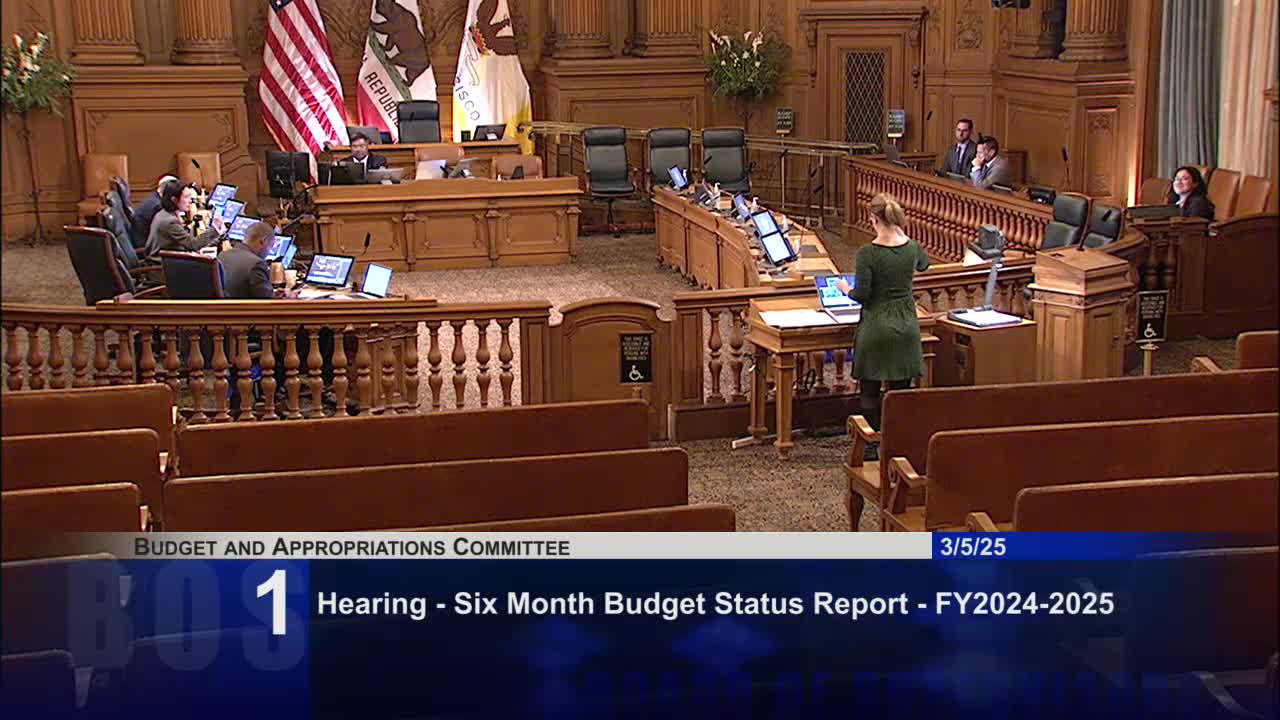
At its March 5, 2025 meeting, the San Francisco Budget and Appropriation Committee received the controller’s six‑month fiscal report showing a $36 million improvement from the prior projection, a roughly $115 million current‑year revenue shortfall and a department operating surplus of about $98 million; the committee continued the hearing to the call of the chair.
At its March 5, 2025 meeting, the San Francisco Budget and Appropriation Committee received a six‑month fiscal update from the controller’s office showing an improvement of about $36,000,000 from the prior projection, a projected current‑year net revenue shortfall of about $115,000,000 against budget and a roughly $98,000,000 combined departmental operating surplus.
The controller’s presenter, Michelle Ellersmith of the controller’s office, told supervisors the midyear update incorporates recently filed property assessment appeals and department fiscal performance. “We are improved from our prior projection by about $36,000,000, which reduces our 2 year projected shortfall by a like amount, so to 840,000,000,” Ellersmith said. She also reported the current‑year net revenue shortfall is “about a hundred and 15,000,000 from budget.”
Why it matters: the six‑month report updates the revenue base used to craft the upcoming mayoral budget and informs choices about reserve use, department hiring and midyear adjustments. The controller noted that any use of the general reserve in the current year is likely to require a like deposit in the budget year to maintain required funding levels.
Key revenue and expenditure items
- Assessment appeals: The office incorporated a record number of assessment appeals filed for tax year 2024 and applied refund assumptions; that change is a major driver of the revenue adjustment.
- Department performance: Ellersmith said departments are generating about $98,000,000 in net operating surplus overall, driven largely by revenue improvements at the Department of Public Health and salary savings tied to a hiring freeze imposed by the new mayor. Ellersmith noted Laguna Honda Hospital has a remaining shortfall tied to population and patient admission timing but that the facility has “overcome the decertification problem.”
- Taxes and fees: Hotel tax cash receipts were down about 11% in the first half of the fiscal year; the controller’s office said it now assumes a 5% decline for the full year because January and February were relatively stronger. Business tax is weaker in part because Proposition M delayed an expected rate increase that had been assumed in the budget. Real property transfer tax and interest income produced brighter outcomes than some other revenue streams.
- Public safety and reserves: Ellersmith said the mayor introduced an overtime supplemental for the police and sheriff departments; she warned that approved uses of the general reserve must be matched in the next budget to retain required reserve levels. The controller’s slides also showed current fiscal‑year planned use of reserves of about $75,000,000 (plus a $500,000 general reserve use) and a planned $63,000,000 use in the budget year, subject to the mayor’s upcoming proposal.
Federal uncertainty, litigation and closed session question
Supervisors pressed staff about the degree of uncertainty from potential federal changes. Supervisor Matt Dorsey said the “biggest uncertainty out there is the federal government.” Supervisor Walton asked whether the committee should hold a closed session. City Attorney Brad Russi responded that “the board can only go into closed session for identifying purposes under the Brown Act,” and that the board would need to identify the specific pending or anticipated litigation to determine whether a closed session is appropriate.
Forecasting approach and risk management
Ellersmith and supervisors discussed forecasting practices. The controller’s office said it uses a consistent methodology — including standard inflation assumptions on non‑salary costs — so that results are comparable across years. Ellersmith highlighted reserves created for volatility in public‑health revenue and for potential federal/state emergency grant disallowances as tools to absorb shocks. She said these reserves allow the city to be more assertive in revenue projections because there is a management mechanism if reimbursements are later disallowed or federal policy changes.
Public comment and procedural outcome
No members of the public signed up to speak on the item. At the end of the presentation and discussion, Chair Connie Chan moved that the hearing be continued to the call of the chair; Supervisor Walton seconded. The committee approved the continuation on a roll call vote with four ayes and one absence: Dorsey, Gardio (recorded as "Member Engadio" in the transcript), Walton and Chan voted aye; President Rafael Mendelmann was absent. The committee will receive the mayor’s budget and any supplemental materials in coming weeks for further action.
Next steps
The controller’s office indicated it did not assume any changes to budgeted federal revenue in this midyear projection; the mayor will introduce a new balanced budget proposal in the coming weeks and supervisors said they expect further briefings on federal uncertainties and reserves as they prepare decisions for the next fiscal year.