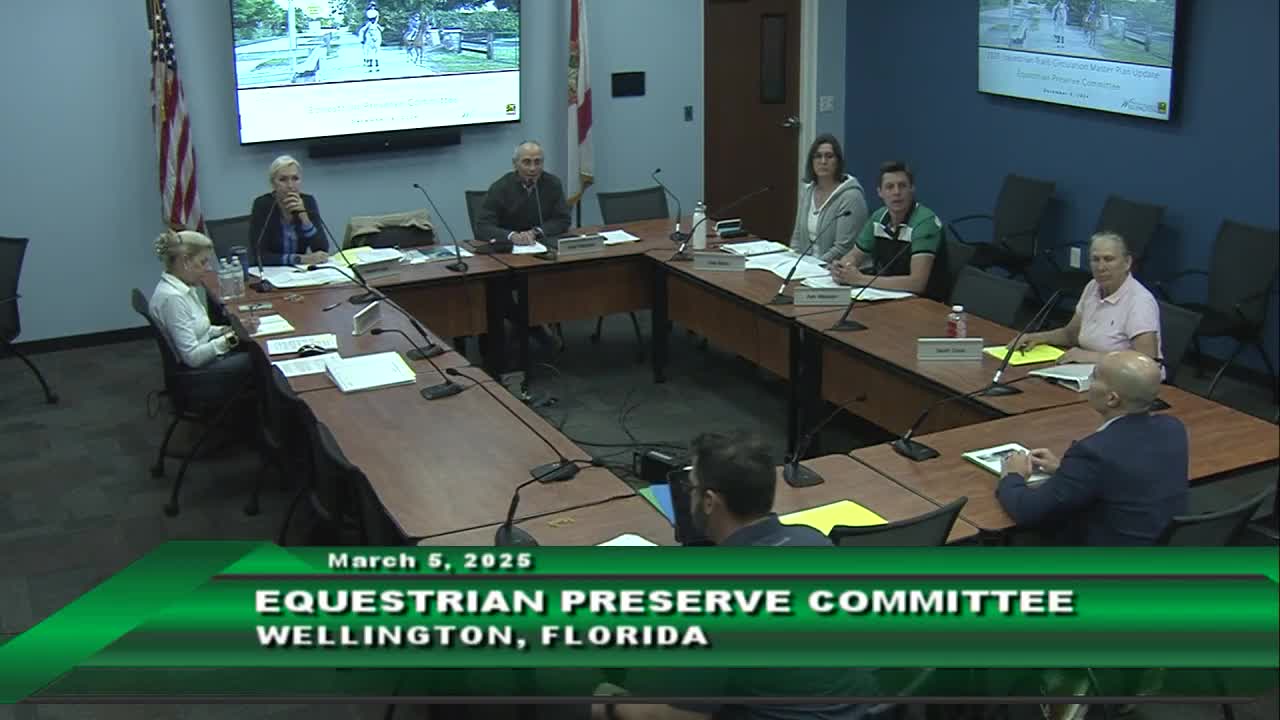
Wellington committee reviews 2025 equestrian trails circulation plan; delays formal recommendation pending further review
Loading...
Summary
Before the Village of Wellington Equestrian Preserve Committee on March 5, planners presented the proposed 2025 Equestrian Trails Circulation Master Plan, outlining eight capital improvement projects, project sequencing changes and a plan to program work that improves equestrian safety and connectivity.
Before the Village of Wellington Equestrian Preserve Committee on March 5, planners presented the proposed 2025 Equestrian Trails Circulation Master Plan, outlining eight capital improvement projects, project sequencing changes and a plan to program work that improves equestrian safety and connectivity.
Planner Christian Santa Gonzalez, describing the document, said, “before you today is the 2025 Equestrian Trail Circulation Master Preservation Element, [which] identifies an Equestrian Trails circulation plan as a key component to improve the safety and provide a connected circulation system.” He told the committee the plan is reviewed annually and programs capital projects intended to improve safety and connected circulation for equestrian users.
Committee members and residents focused discussion on a small set of programming changes staff proposed since the last meeting. Staff said one change was moving installation of fencing along the Pink Trail up one year; another was moving the Sixtieth Street culvert crossing (listed as Culvert Crossing 3B in the budget exhibit) later in the program to the 2026–27 program year. Committee members questioned the basis for including the Sixtieth Street crossing, noting it appears lightly used and that a nearby homeowner said trail access would require crossing a private driveway.
A committee member noted the culvert crossing’s estimated cost is substantial: “300000,” one speaker said during the meeting when asked about price. Members said that a large price tag warrants verifying the original rationale for adding the project; staff agreed to review prior meeting records and Rachel Edelman’s prior advocacy for that item.
Committee members repeatedly raised the larger issue that some trails shown on maps are no longer usable or safe for horses. One member said sections such as the yellow Pearson bridle path and perimeter routes around Little Ranches are “not accessible to most residents” and in some locations utility or private- property actions (for example, an FPL gate) have blocked former trail access. Staff acknowledged the limits of enforcement over private property easements and said the public works department prioritizes maintenance for trails with heavier use while still maintaining a maintenance budget line separate from the capital improvement budget.
Members asked staff to study crossings that residents had flagged as dangerous, including the Indian Mound/South Shore intersection. Jonathan (staff) said the plan includes trail trip counts (exhibit D-1) and staff can add targeted counts or camera-based observations for intersections not yet measured; he agreed to study the South Shore crossing and to follow up with the committee.
Regarding next steps, staff requested a committee recommendation to the Wellington Council if the committee was ready. The committee instead agreed to delay a formal recommendation until members could review Rachel Edelman’s prior notes explaining why specific projects were added and until staff supplies additional information on trip counts and the Sixtieth Street crossing. At the meeting’s close on the agenda item, members agreed to defer the adoption recommendation and to revisit the project list at the next meeting.
Residents who spoke during public comment reiterated safety and access concerns. Maureen Brennan said she saw material on the village website that, in her view, inappropriately encourages bicycle use on equestrian trails; committee members noted trail guidance on the village site and asked staff to address trail-use guidance as part of the plan’s implementation.
Staff also flagged two near-term crossing upgrades recommended as higher-priority, lower-cost interventions based on recent counts and project comparisons: South Shore Boulevard at Fiftieth Street (a four‑way stop location) and South Road at Grecita Street. A staff technical note presented at the meeting estimated the South Shore/Fiftieth location would require flashing beacon equipment in all directions and estimated that project at about $50,000; the South Road/Grecita location was estimated at about $25,000. Staff said they would check whether developer conditions of approval for the new showgrounds require immediate upgrades to additional crossings being used for event access.
The committee asked staff to return with: documentation of why projects were inserted in earlier plan iterations, the original justifications Rachel Edelman provided, detailed trip-count information for flagged intersections (including Indian Mound/South Shore), and clarification of maintenance-versus-capital budgeting and timing for the Sixtieth Street culvert crossing. Staff agreed to provide those items and to schedule public works staff for a future discussion on maintenance responsibilities and priorities.
The committee did not take a final vote to recommend the 2025 master plan to council at this meeting; it instead tabled a recommendation pending the follow-up items staff committed to provide.
Why it matters: Wellington’s bridle-trail network is integral to the village’s equestrian identity. Committee members framed their role as protecting both safety and the functional integrity of trails, and they emphasized the need for data-driven prioritization before committing large capital funds.
What’s next: Staff will supply a clean list of the changed line items and prior meeting notes about the Sixtieth Street project, add any missing trip-count data, and coordinate a public‑works briefing on maintenance budgeting at a future committee meeting. The committee will revisit a recommendation to council after it has reviewed that documentation.