Get Full Government Meeting Transcripts, Videos, & Alerts Forever!
Get email alerts on the Fire Safety High Rise Sprinklers topic
No spam. Unsubscribe anytime.
Committee hears testimony to expand high-rise sprinkler grant, lower height and income thresholds
Summary
The House committee heard testimony on House File 1334 to expand a high-rise sprinkler retrofit grant program, adjust the 75-foot height cutoff and raise the income eligibility to 60% AMI; sponsors requested another $10 million and said the change would help several public housing buildings that narrowly missed current eligibility.
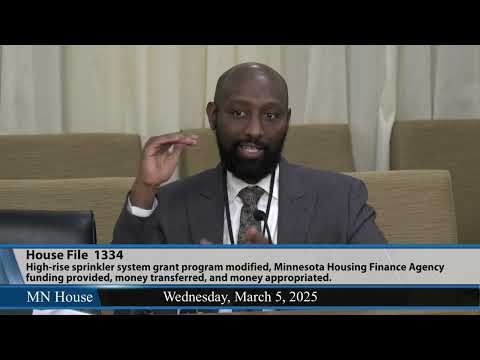
The House Committee on Housing Finance and Policy on March 6 heard testimony on House File 1334, carried by Rep. Mohammed Noor, a bill that would add $10 million to the state's high-rise sprinkler retrofit grant program and change eligibility by lowering the effective height threshold and raising income eligibility from 50% to 60% of area median income (AMI).
The measure is intended to help retrofit more affordable residential high-rises with automatic sprinklers after a 2019 fire in Minneapolis that killed five people. Rep. Mohammed Noor, author of the bill, told the committee the state fire marshal's report concluded that sprinklers would have saved lives in that incident. "From that time on, we took the initiative to address life saving effort by requiring high rise buildings to be retrofitted with sprinklers," Noor said.
Supporters told lawmakers the changes would make several buildings newly eligible. Tim Butler of the National Fire Sprinkler Association said the state inventory shows 624 high-rise buildings statewide, 569 of which are fully sprinkled; 10 residential high-rises remain unsprinkled and six of those would meet the lowered height threshold proposed in HF1334. "Six of them would meet the lowered height requirements of House File 13 34," Butler said, listing locations including Albert Lea, Hopkins and North Mankato.
Hopkins Mayor Patrick Hamlin described Dow Towers, a 76-unit, seven-story building that serves very low-income residents and said the city lacked the reserves to cover the nearly $2 million retrofit cost. "As a small community with a small tax base, finding nearly $2,000,000 it would take to sprinkle this building is a challenge," Hamlin said, noting many residents are elderly or have disabilities. Deputy Fire Chief Mike Wenshaw of Hopkins testified that some buildings just under the 75-foot statutory cutoff present operational challenges for fire departments because ladder reach and other equipment cannot reliably reach upper floors, forcing firefighters to both evacuate and fight fires via stairways.
Testimony summarized recent program experience and costs. Dan Kitzberger of Minnesota Housing said the program had been under-subscribed and that amended language should allow the agency to cast "a little bit wider net" in the next request for proposals. Tim Butler cited the Seward Towers retrofit: two 22-story buildings received a $3.3 million grant with an $800,000 local match, totaling roughly $4.0 million to protect 640 units, which Butler said amounts to about $3 per square foot.
Committee members asked about program structure and per-building costs. Representative Nash summarized program parameters discussed in committee: a potential one-time $10 million appropriation, with individual grants of up to $2 million that require up to a 50% local match. Noor and testifiers described a mix of grants and loan options in the draft language and said past retrofits were completed with little or no resident displacement.
The proposal also includes two technical eligibility changes described by Noor: (1) adjusting the 75-foot height measurement that currently excludes some seven-story buildings that fall narrowly below the cutoff; and (2) changing the AMI threshold from 50% to 60% so more affordable buildings qualify. Testifiers recommended aligning some definitions with federal standards and checking tax-credit compatibility with IRS rules.
After testimony and member discussion, House File 1334 was laid over for possible inclusion in the committee's omnibus package. No final floor or appropriation vote was taken at the hearing.