Get Full Government Meeting Transcripts, Videos, & Alerts Forever!
Get email alerts on the Utility Wildfire Spending topic
No spam. Unsubscribe anytime.
Assembly hearing examines $27 billion in utility wildfire spending and debates who should pay
Summary
Lawmakers and utility, public-safety and academic witnesses debated the scale and effectiveness of investor-owned and publicly owned utility wildfire investments, the role of ratepayers, and alternative funding options including securitization, state grants and greenhouse-gas funds.
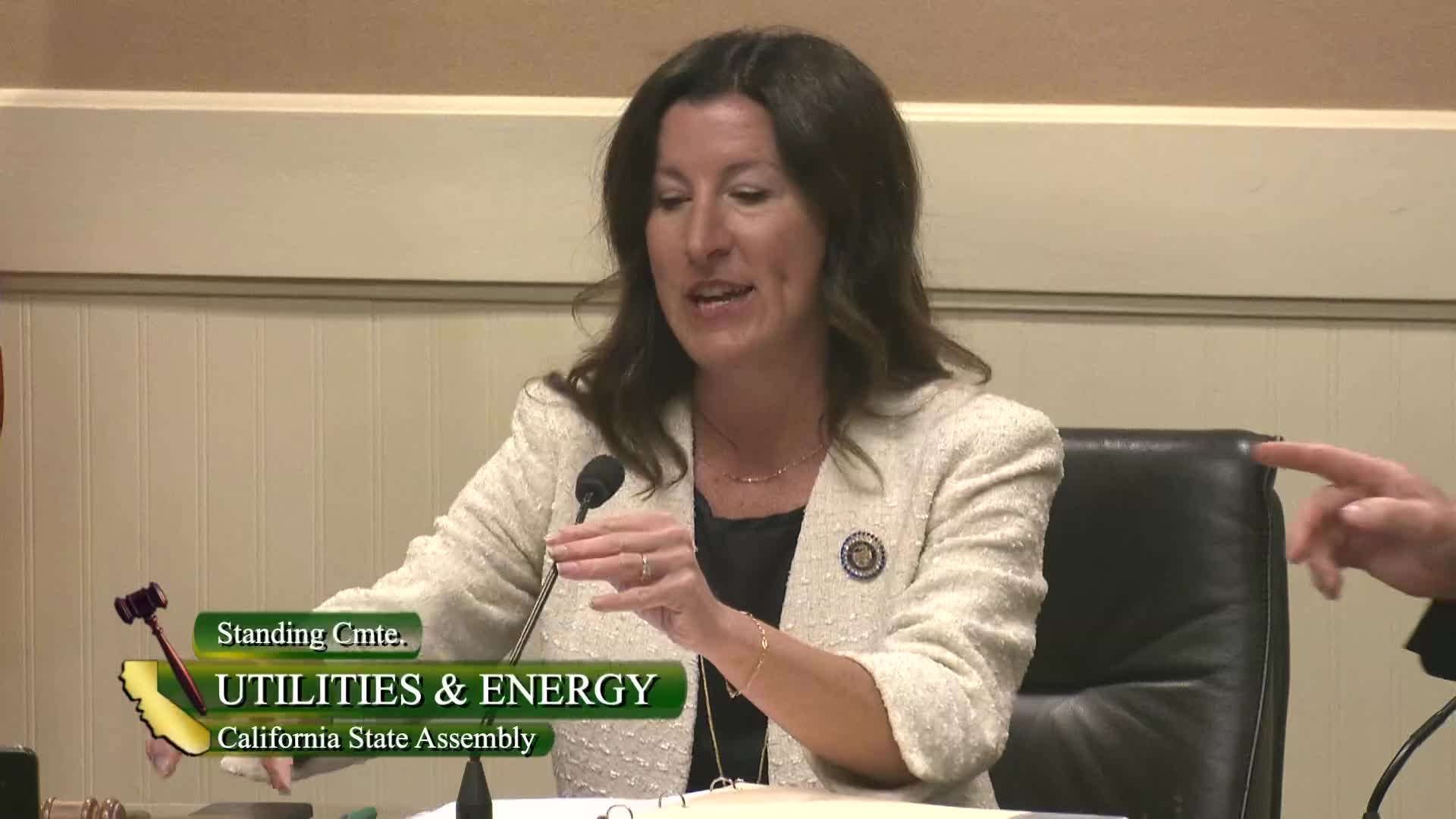
The Assembly Committee on Utilities and Energy convened an oversight hearing to examine utility wildfire spending, its effect on residential bills and alternative ways to finance wildfire mitigation.
The hearing featured witnesses from the California Public Utilities Commission, the Office of Energy Infrastructure Safety, investor-owned and publicly owned utilities, local fire chiefs, university researchers and fiscal analysts. Committee Chair Petrie Norris opened the session saying California's three large investor-owned utilities have invested "$27,000,000,000 over the last 5 years in wildfire mitigation," and that these investments are a major driver of recent rate increases.
Why it matters: Lawmakers said they want wildfire risk reduction to continue, but raised questions about affordability and whether ratepayers should continue to fund the bulk of mitigation. Witnesses and analysts described a mix of operational and capital approaches — from operational controls known as "fast trip" to large-scale undergrounding — and debated how to prioritize and pay for them.
Panelists described how wildfire mitigation spending shows up in utility rates. Forrest Kayser, chief deputy executive director at the California Public Utilities Commission, said many wildfire programs are captured in distribution costs and that those distribution costs have been the largest recent driver of rate increases. Kayser also described two rate-saving tools the commission has overseen: utility self‑insurance and securitization, which he said have produced multi‑hundred‑million‑dollar savings for ratepayers to date.
Caroline Thomas Jacobs, director of the Office of Energy Infrastructure Safety, said the agency's role is to evaluate and audit utility wildfire mitigation plans and that the framework established by the Legislature in 2019 has improved utilities' understanding of where ignitions are likely. "The reality is our legacy grid was not built to avoid all sparks," she told the committee, describing equipment replacement and new inspection methods required under approved plans.
Utility witnesses described both the scale of their investments and operational constraints. Carla Peterman, executive vice president and chief sustainability officer at Pacific Gas & Electric Co., said PG&E expects average electric bills to be more stable in 2025 and that the company has not had a catastrophic wildfire in two years, but that the company still faces a funding gap. She told the committee IOUs invest about "$6,000,000,000 annually in wildfire prevention," while state contributions typically total "less than $500,000,000 annually."
Randy Howard, general manager of the Northern California Power Agency representing publicly owned utilities, described permitting delays on federal and state lands that slow vegetation management and other mitigation work and urged faster approvals so projects can be executed before fire season.
Researchers and analysts offered differing cost‑effectiveness perspectives. Duncan Callaway, professor at UC Berkeley, presented modeling that credits operational measures — especially enhanced power system safety settings known as fast trip — with large reductions in ignition risk and argues those measures have changed the cost‑benefit calculus for broad undergrounding. Helen Christine of the Legislative Analyst's Office and Nathaniel Skinner of the CPUC Public Advocates Office urged policy changes to coordinate funding and to bake predictable wildfire spending into general rate cases to improve budgeting and oversight.
On funding alternatives, witnesses discussed securitization to lower borrowing costs for large capital projects, increasing state wildfire resilience spending from the Greenhouse Gas Reduction Fund or general fund, and targeted programs such as microgrids, coordinated trenching and new bioeconomy approaches to pay for forest fuels work. Sam Uddin of Net0 California estimated statewide wildfire resilience needs at "at least $6 to $7 billion per year," including $3–4 billion for vegetation management.
Lawmakers and witnesses emphasized trade-offs. Several said moving wildfire mitigation out of rates and onto the state ledger would require significant new state spending or reallocation of existing funds, noting the Greenhouse Gas Reduction Fund is already largely committed and that the general fund faces projected deficits.
Public comment: Fire survivors and community groups urged that any funding changes not short‑change past wildfire victims. Will Abrams, who identified himself as a survivor of the February wildfires, told the committee that many past victims have not been fully compensated and cautioned against shifting resources away from claims and recovery.
What the committee directed: Members asked the CPUC and Office of Energy Infrastructure Safety to return with additional analysis on aligning wildfire mitigation planning with general rate cases, the potential savings from securitization, and barriers created by permitting processes. No formal votes or legislative actions occurred at the hearing.
Looking ahead: The committee said this is the first of four hearings on energy affordability and signaled further hearings will probe funding, permitting and specific programs in more detail.