Get Full Government Meeting Transcripts, Videos, & Alerts Forever!
Get email alerts on the Heat Resilience 2025 topic
No spam. Unsubscribe anytime.
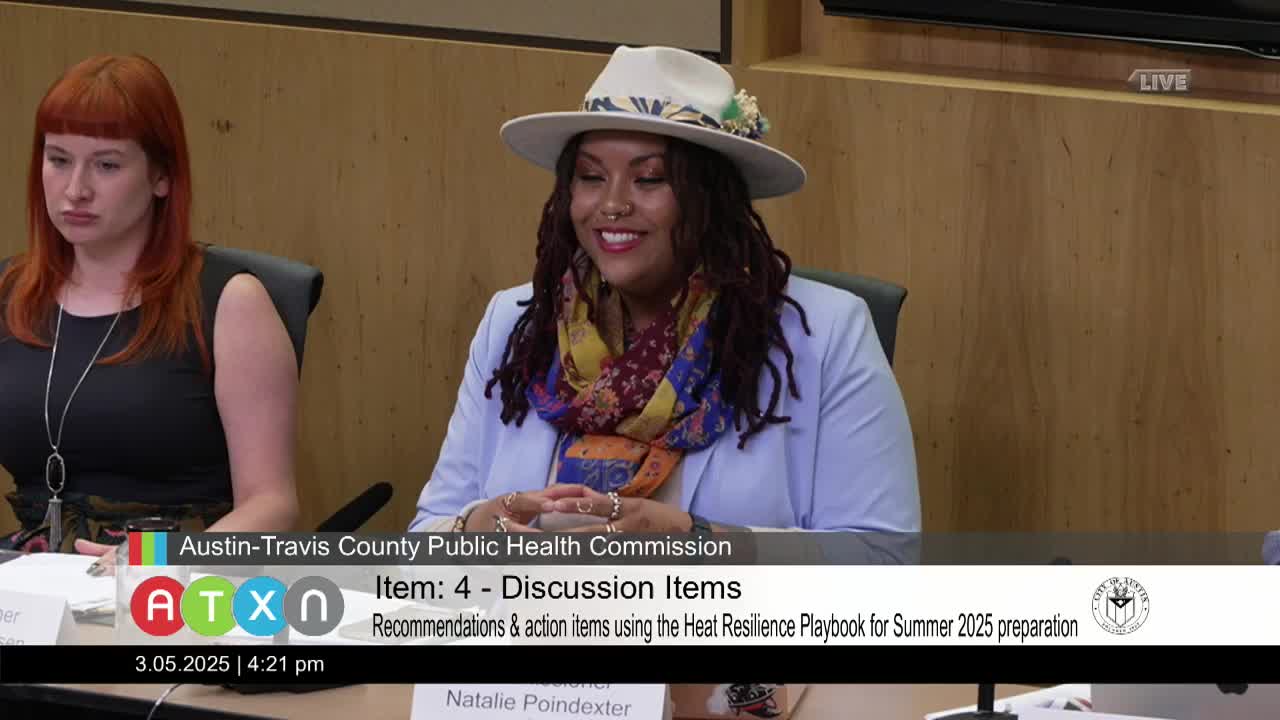
Commission discusses heat‑resilience playbook, suggests employer incentives, EMS data and outreach beyond digital channels
Summary
Commissioners reviewed the heat resilience playbook and proposed employer incentives, EMS data requests and improved non‑digital outreach to reach high‑risk populations ahead of the 2025 warm season.
The commission discussed preparations for the 2025 warm season using the city’s heat resilience playbook and proposed actionable next steps including employer incentives, better outreach to vulnerable populations and targeted data requests.
Key proposals and rationale: Commissioners suggested pilot incentives for employers who adopt mandatory water breaks or other heat‑safety practices for outdoor workers. Ideas included modest fee reductions or permitting incentives tied to demonstrable worker protections, though staff noted permitting and interdepartmental coordination would be required.
Data and targeting: Several commissioners asked staff to request EMS run and emergency‑department data that would show where heat‑related illness and injury occur (for example, job sites, parks or residences). Commissioners argued that knowing settings and ZIP codes with higher heat‑related calls would help target employer outreach and public messaging.
Outreach and dissemination: Commissioners repeatedly emphasized that many residents lack regular internet access and that outreach cannot rely on the web alone. Staff and Central Health representatives pointed to harm‑reduction and community partner networks that distribute physical materials and run in‑person programs; commissioners asked for recommendations on non‑digital dissemination strategies and for PIO coordination across agencies during heat events.
Coordination with ongoing programs: Commissioners noted existing work—the county’s climate resiliency pilot program, the city’s resiliency network, and trusted‑partner communications pilots—and asked that the commission be briefed on how the playbook aligns with those efforts. Commissioners asked that Dr. Walks (identified in the meeting as a subject‑matter contributor) share her presentation with the commission ahead of further recommendations.
Next steps: Commissioners proposed forming a small internal team to draft two deliverables: a macro recommendation addressing permitting/large‑employer incentives and a community outreach recommendation focused on vulnerable groups (outdoor workers, elderly residents, parents of young children). Staff agreed to arrange follow‑up briefings and to supply Dr. Walks’ materials to commissioners for their review before the commission considers formal recommendations.