Get Full Government Meeting Transcripts, Videos, & Alerts Forever!
Get email alerts on the Green Building topic
No spam. Unsubscribe anytime.
Austin Energy outlines local green building rating, pilot programs and incentives
Summary
Austin Energy staff presented the city's Green Building program history, rating structure and links with city policy, and answered commissioners' questions about a passive-house pilot, incentives and bird-collision measures.
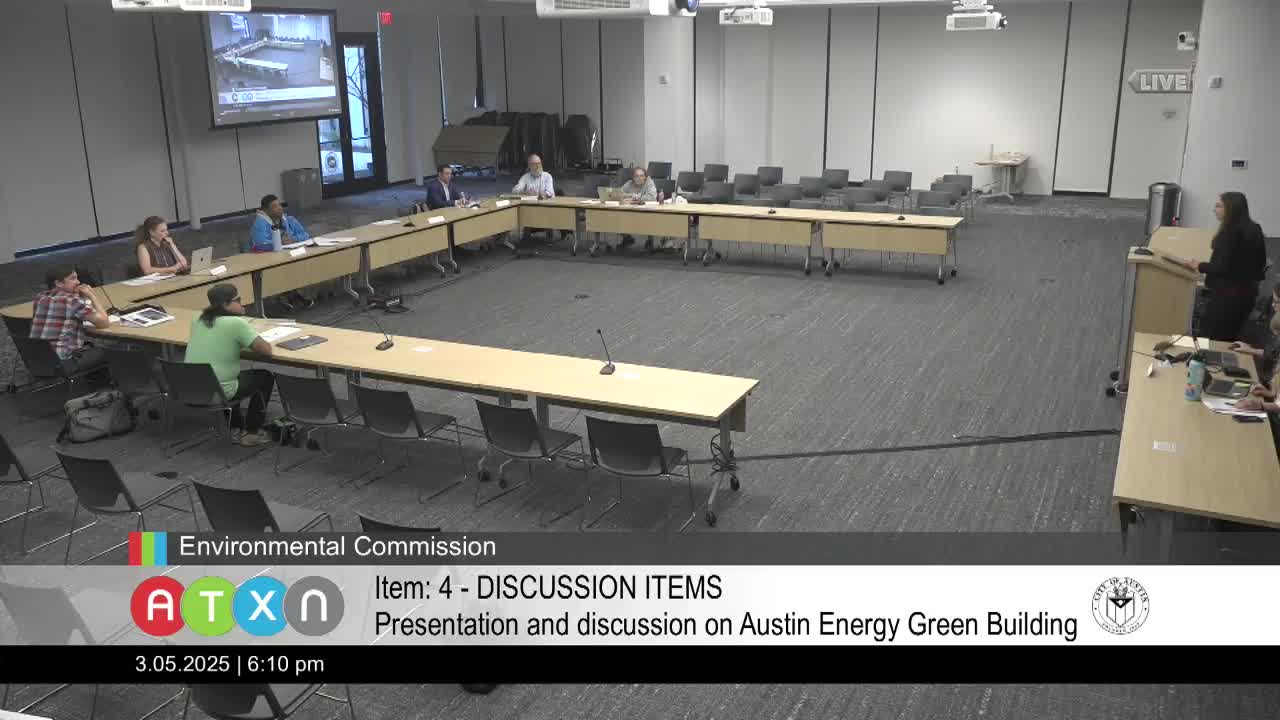
Heidi Casper, director for Green Building and Emerging Technologies at Austin Energy, gave an overview of the utility's Austin Energy Green Building program during the March 5, 2025, meeting of the Austin Environmental Commission.
Casper said the program was established in 1991 as the nation's first municipal green building rating system and has been regularly updated to reflect Austin-specific building goals. "The program has a very, very long history," she said, and described the program's three primary functions: ratings, education and outreach, and policies and codes.
The ratings, Casper said, cover single-family, multifamily and commercial projects and use a prerequisite-plus-points structure that can yield one- to five-star ratings. Projects that meet basic requirements receive a one-star rating; additional voluntary measures in categories such as energy, water, materials, health and equity earn extra points. Casper told commissioners the program's criteria are used within multiple city programs and policy tools including planned-unit-development (PUD) agreements, the downtown density-bonus program, the university neighborhood overlay and the Smart Housing program.
Nut graf: Commissioners were given detail on how the local rating ties into city policy and development incentives, how the program supports affordable housing goals and what new pilot projects and incentives the utility is pursuing. The briefing clarified that the green rating itself is not a direct cash incentive but is often a component of zoning or fee-waiver programs and that Austin Energy is considering targeted financial incentives to spur specific technologies.
Casper said Austin Energy's rating is used as a way to demonstrate "superior" development in zoning processes and Smart Housing partnerships and that because ratings are woven into zoning and program requirements the system touches roughly 20% to 30% of new construction in Austin. She said the program has tracked energy, demand, greenhouse gas and water savings since about February 2007 and is transitioning away from tracking construction waste because those measures are now part of code enforcement.
Commissioners asked questions about several items. Commissioner Fleury asked whether the city must meet particular ratings on city buildings; Casper answered that the city has a green-building policy that typically requires use of LEED or the Austin Energy Green Building rating and that staff works with city departments to set appropriate goals per building type. Commissioner Krueger asked about a passive-house pilot: Casper said development of the pilot's guidance documents is complete and legal review of terms and conditions is underway; Austin Energy plans to open applications in spring and begin enrolling projects in summer, and she estimated it could be five to six years before enrolled projects reach completion and yield lessons learned.
Commissioner Sullivan raised questions about data centers and large electric loads. Casper said Austin Energy is tracking interconnection requests and the utility is engaged in studies of how to serve large loads; she noted that green-building ratings focus on building fabric and site strategies rather than data-center operational efficiencies, which are driven largely by equipment and operational choices.
Commissioner Bridal asked whether the program works with single or small clusters of buildings outside PUDs; Casper said the program is open to any project in Austin Energy's service territory and that the single-family rating includes an extended-area program operating across a 27-county area through trained raters. On incentives, Casper said Austin Energy currently offers incentives for rooftop solar and EV charging and is considering targeted new-construction incentives for technologies that need market support, citing heat-pump water heaters as an example.
The presentation addressed bird-collision measures in the commercial rating. Casper described a "threat factor" approach that evaluates facade materials, glazing size and patterns, and lighting to create a holistic point structure rather than prescribing a single material. "We're addressing the lighting through a lighting measure, on reducing your up light and your sky glow and then constructing that building facade," she said.
Ending: Commissioners thanked Casper for the overview; several expressed appreciation for the program's local focus and for details on the passive-house pilot and potential incentives. No formal action was taken following the presentation.