Get Full Government Meeting Transcripts, Videos, & Alerts Forever!
Get email alerts on the Public Health Bond 2026 topic
No spam. Unsubscribe anytime.
Austin Public Health outlines criteria for 2026 bond projects, cites equity and two priority neighborhoods
Summary
Austin Public Health presented the department’s prioritization criteria and past bond projects and said it will submit projects for the city’s 2026 bond cycle with equity and accessibility as the central criteria.
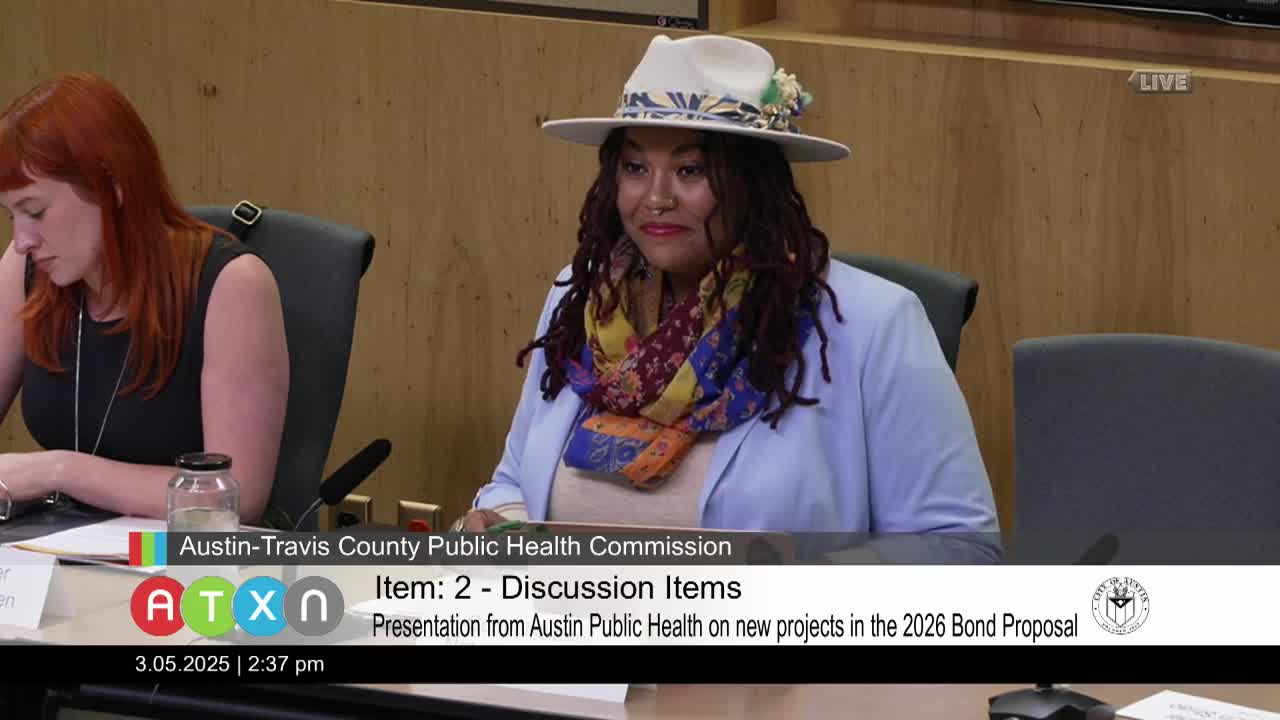
Philip Getzic, facility planning manager with Austin Public Health, told the Public Health Commission that APH will submit projects to the city for the 2026 bond cycle and walked commissioners through the department’s guiding principles and technical criteria.
“My director asked me to give a short intro into the process,” Getzic said, describing a standard city process in which departments use city guidelines and department-specific grading matrices to prioritize projects. He said APH is not yet able to discuss the specific projects’ funding amounts while the city completes its process.
Why it matters: APH said it receives capital for new construction almost exclusively from general obligation bonds and that in 26 years APH projects have received about 1% of city bond appropriations. The department argued that targeted bond investments—paired with facility design that emphasizes accessibility, sustainability and community engagement—are a primary way APH can add new neighborhood assets such as clinics, WIC sites and neighborhood centers.
Getzic and the director’s presentation summarized recent APH bond projects, including Springs (a 23,000-square-foot neighborhood center completed in 2024 at about $20 million), Montopolis Public Health Center (completed in 2020 at about $15.5 million and cited as a hub in mass-vaccination and winter-storm response) and past work at a Salvation Army women and children’s shelter (2018; total budget cited ~ $6.7 million, with $3.8 million from bond funds and $2.9 million added by City Council). Officials also described smaller capital investments such as improvements at the Betty Dunkerley campus (budget cited $1.7 million) and parking/drainage work in 2016 (budget cited $906,000).
APH said its prioritization framework ranks candidate projects against equity, affordability, sustainability, accessibility and resilience criteria. The department presented maps using the Centers for Disease Control and Prevention Social Vulnerability Index and the Climate and Economic Justice Screening Tool to demonstrate higher vulnerability, lower tree cover and longer drive times from public-health sites in Colony Park (ZIPs 78724/78725) and parts of Northeast Austin. Getzic noted long travel times to immunization clinics and the department’s use of drive-time analysis in prioritization.
Commissioners’ questions and process details: Commissioners asked whether the department is seeking a change to APH’s historical share of bond funding (questions referenced hypothetical 2–3% allocations and comparisons to other cities). APH staff said they do not have comparative budget data on peer cities available immediately but offered to try to obtain it. Staff described the citizen review committee process: departmental requests are reviewed by a citizen review committee (the transcript said 22 citizens plus the mayor in prior cycles) that recommends projects for the ballot.
Staff emphasized timing: bond cycles are infrequent (every six to eight years), and missing the 2026 cycle could mean waiting another cycle for capital funding. Staff also said bond-funded projects are APH’s only reliable mechanism for adding capital assets because the department lacks other discretionary capital funds.
What commissioners asked APH to provide: commissioners requested comparative funding data from peer cities; a concise packet that summarizes multi-year trends in priority ZIP codes (to show persistent need over 13+ and 26-year horizons); and clarification about how residents and commissioners can provide input to the citizen review committee. Staff said the committee’s meetings are public and that boards and commissioners may submit comments. Commissioners also asked APH to produce a succinct briefing that shows what will happen if the 2026 bond proposals are not funded (impacts over the next 6–8 years).
Ending: APH asked commissioners for input on its prioritization and encouraged commissioners to engage with the citizen review committee and other public-comment opportunities during the bond process. Staff said they would supply follow-up materials and data requested by commissioners.