Get Full Government Meeting Transcripts, Videos, & Alerts Forever!
Get email alerts on the Proposition 98 Budget topic
No spam. Unsubscribe anytime.
Administration and LAO outline Proposition 98 growth, sensitivity and options on $1.6 billion settle‑up
Summary
Department of Finance and the Legislative Analyst’s Office told the Assembly Budget Subcommittee that the governor’s budget raises the Proposition 98 guarantee but proposes postponing roughly $1.6 billion of a settle‑up payment; LAO recommended alternatives including a reserve deposit.
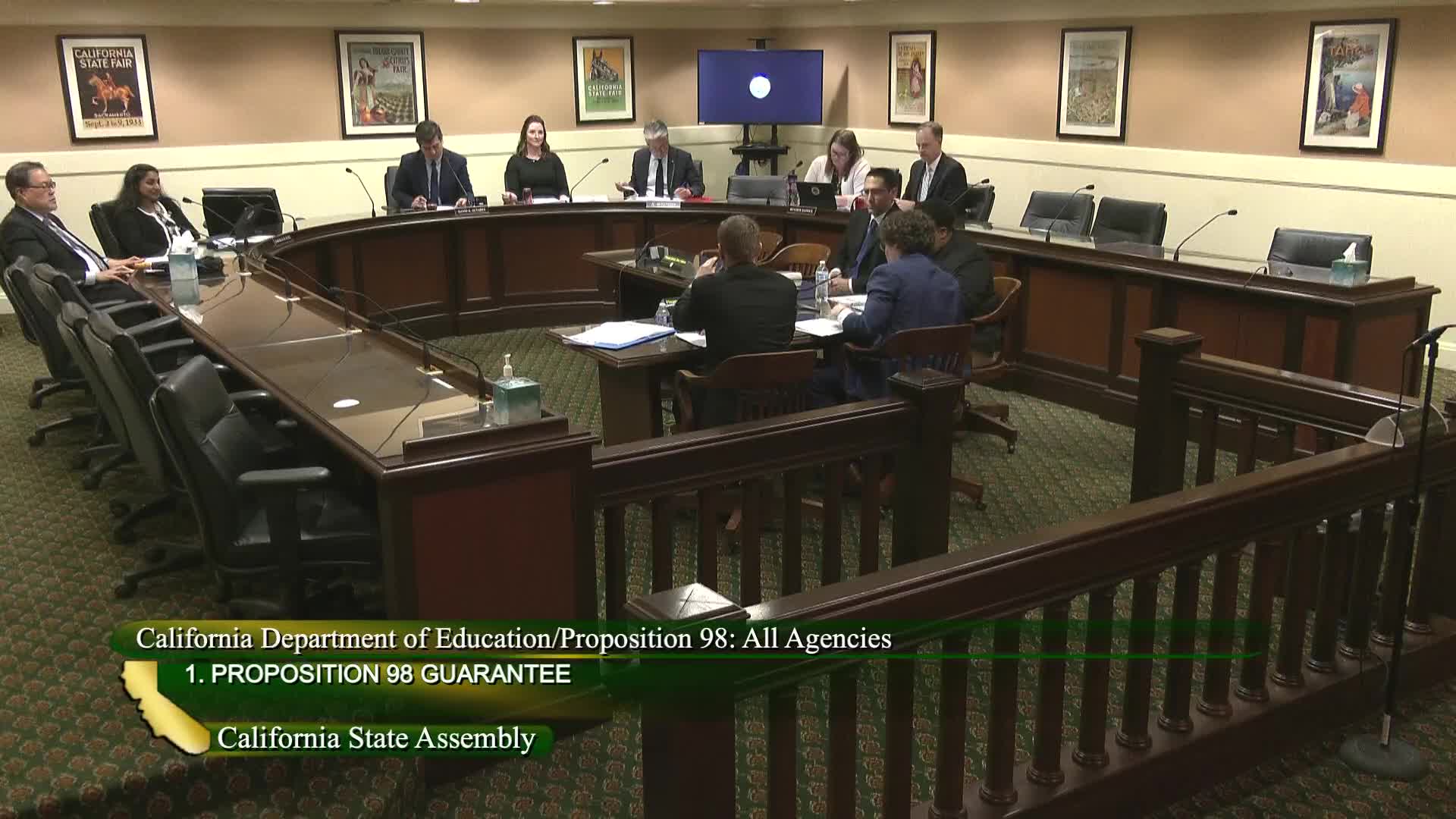
The Department of Finance and the Legislative Analyst’s Office told the Assembly Budget Subcommittee on Oct. 27, 2025, that the governor’s January budget projects higher Proposition 98 obligations but proposes delaying part of next year’s settlement payment to manage revenue volatility.
Alex Shope of the Department of Finance summarized the governor's estimates: the Proposition 98 guarantee for 2025–26 is projected at $118.9 billion, about $3.6 billion higher than the 2024 Budget Act. The administration projects a $7.5 billion increase across 2024–25 and 2025–26 relative to enacted levels, driven by higher general fund estimates, property tax growth and the TK rebenching. Shope described a proposed $1.6 billion "settle up" estimate the administration would delay into the next fiscal year as a hedging mechanism against revenue uncertainty.
Ken Capone from the Legislative Analyst’s Office warned the committee that the guarantee is unusually sensitive in 2024–25: "to the extent there are revenue changes in 24‑25, that falls almost entirely on schools," the LAO said, explaining the subsidy is roughly 95¢ of each dollar of revenue that ends up in Proposition 98 that year. The LAO identified three alternatives to the proposed delay: (1) deposit the $1.6 billion into the Proposition 98 Reserve (the school stabilization account); (2) appropriate the funds now but delay actual disbursement until final certification in June 2026 so the appropriation can be rescinded if revenues fall short; or (3) suspend the guarantee (requiring a two‑thirds legislative vote), creating maintenance factor instead of a settle‑up obligation.
The LAO recommended the reserve deposit as the most compelling option because it addresses volatility without increasing costs in 2026–27 or complicating district planning. Capone noted the administration’s rebenching of TK increases Proposition 98 and that by historical practice the increase has been split roughly 89% to K–12 and 11% to community colleges. The LAO also cautioned that the state’s revenue picture remains driven in part by capital gains and corporate and personal income tax collections, which are sensitive to stock market volatility.
Why it matters: The committee must weigh short‑term budget stability against timely funding for schools. Any change to timing or the size of settle‑up payments affects district budgets and program planning; the LAO warned that volatility in 2024–25 could fall disproportionately on schools.
What’s next: The committee will consider these tradeoffs as the May revision and final budget decisions approach.