Get Full Government Meeting Transcripts, Videos, & Alerts Forever!
Get email alerts on the Digital Equity Assessment topic
No spam. Unsubscribe anytime.
Travis County and City present 2023 Digital Equity Needs Assessment: cost, skills and mobile access top barriers
Summary
Travis County and City staff presented the recently published 2023 Digital Equity Needs Assessment, which found cost and affordability are the leading barriers to home internet access, mobile access is critical, and 59% of survey respondents said they'd be interested in basic digital skills training if free.
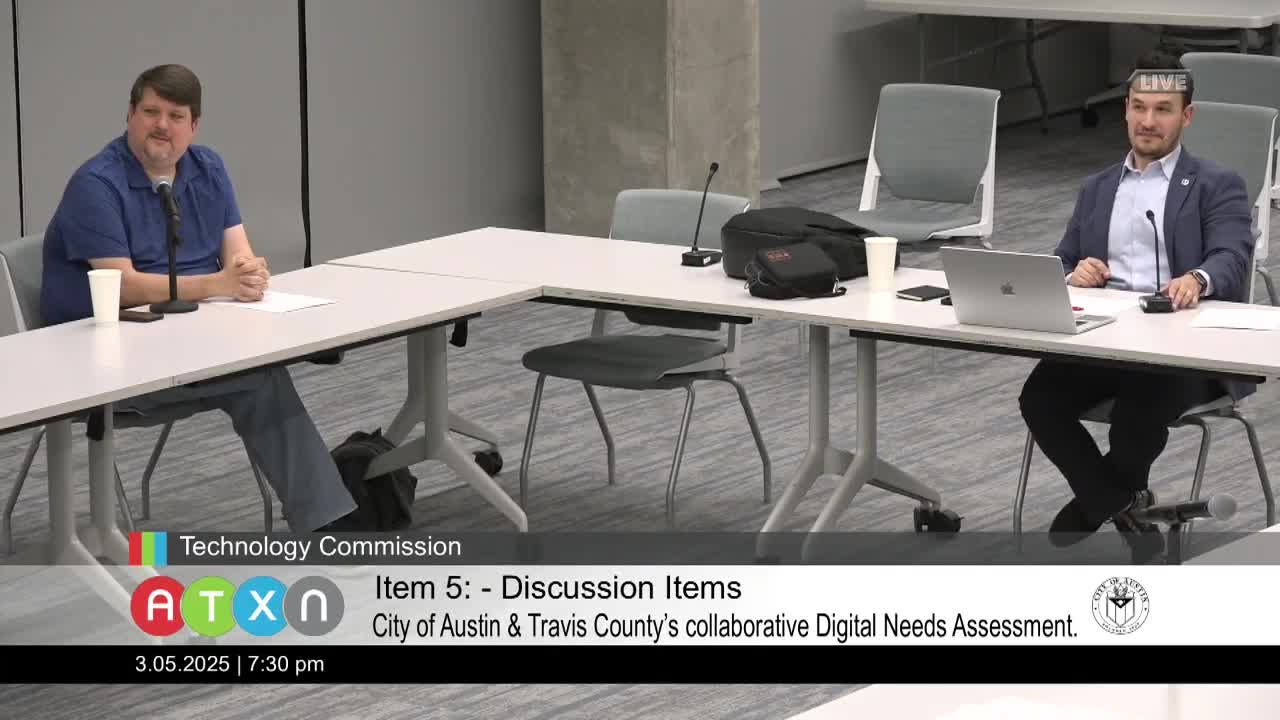
Travis County and City of Austin staff presented the 2023 Digital Equity Needs Assessment to the Technology Commission on March 5, describing methods, major findings and a set of policy and program recommendations to improve digital access, devices and skills for historically marginalized communities.
The study, funded in part by Saint David's Foundation, the City of Austin and Travis County, used a mixed methodology with an in‑person survey, community advisory workshops, nonprofit working groups and focus groups ("community circles"). Staff said they prioritized outreach in neighborhoods with higher rates of households without an internet subscription and provided resource packets to participants during data collection.
Key findings
- Cost and affordability: Across focus groups and the survey, cost was the top barrier. Among respondents who did not have home internet, 69% cited price as the primary reason.
- Digital skills demand: Of approximately 1,400 survey respondents, 59% said they would be interested in basic technology skills training for themselves or someone in their household; only seven of nearly 1,400 respondents indicated they would be willing to pay for such training. Among respondents with annual individual earnings under $25,000, 88% said they were interested in training but only if it were free.
- Mobile‑first reality and reliability problems: The study found that nearly all respondents who had home internet also used mobile data outside the home; most respondents without home internet relied on mobile data for outside‑home access. Focus groups revealed many users depend on mobile devices under constrained data caps, with frequent service quality issues and geographic gaps in mobile coverage.
- Public access and transportation: Focus group participants raised transportation burdens to reach public Internet locations, limited hours at libraries and community sites, blocked charging outlets, and paywalls (cafs or retail locations requiring purchase for Wi‑Fi access).
- Structural barriers and security concerns: Respondents described provider requirements such as documentation and credit history as barriers, along with experiences of fraud, identity theft, and fear about safety and security online. Language limitations and accessibility challenges (disability, translation) also restricted use of available tools.
Recommendations presented
The report offered a broad set of recommendations that the presenters grouped into buckets: improving affordable reliable internet access; expanding access to quality, low‑cost devices and repair services; increasing availability of free digital skills training and diversified delivery methods; supporting mobile connectivity; making public online services and government websites more accessible (mobile‑first design); supporting tenant decision‑making about bundled ISP options; and enhancing consumer protections and data‑ownership measures.
Specific program suggestions included targeted supports for populations with high barriers (immigrants and refugees, people with disabilities, older adults, justice‑impacted individuals, unhoused residents, low‑income households), more geographically dispersed public access points and charging stations, fix‑it clinics and repair programs, curricula aligned to community interest and schedules, and increased outreach and awareness about low‑cost plans.
Commissioners' response and next steps
Commissioners pressed staff on communications and outreach: staff said the report will be posted and publicized, a press release is planned with funders and the Digital Empowerment Community of Austin community of practice will be used to solicit further input. Staff also said the city will use the assessment to refresh the city's 2014 digital inclusion strategic plan and pursue recurring data collection roughly every three years, contingent on funding.
Staff noted immediate follow‑ups: inventory existing public access sites and hours, produce mapping aligned to the digital divide index, and return to commission with options and cost estimates so commissioners can advocate during the FY26 budget cycle.
Ending note
Presenters framed the assessment as a community‑driven, participatory effort and emphasized that findings should inform short‑term actions (public access, training pilots) and a medium‑term strategic plan refresh. The full report and data visualizations will be shared on the city's public sites.