Get Full Government Meeting Transcripts, Videos, & Alerts Forever!
Get email alerts on the Industry Impacts topic
No spam. Unsubscribe anytime.
Egg, poultry and dairy producers describe large losses, slow repopulation and ask for vaccines and movement limits
Summary
Industry witnesses told the Senate that large commercial losses and delays in restocking threaten California egg and dairy supplies. Producers urged continued funding for CDFA, stronger movement controls for dairy cattle, and support for vaccination research and repopulation assistance.
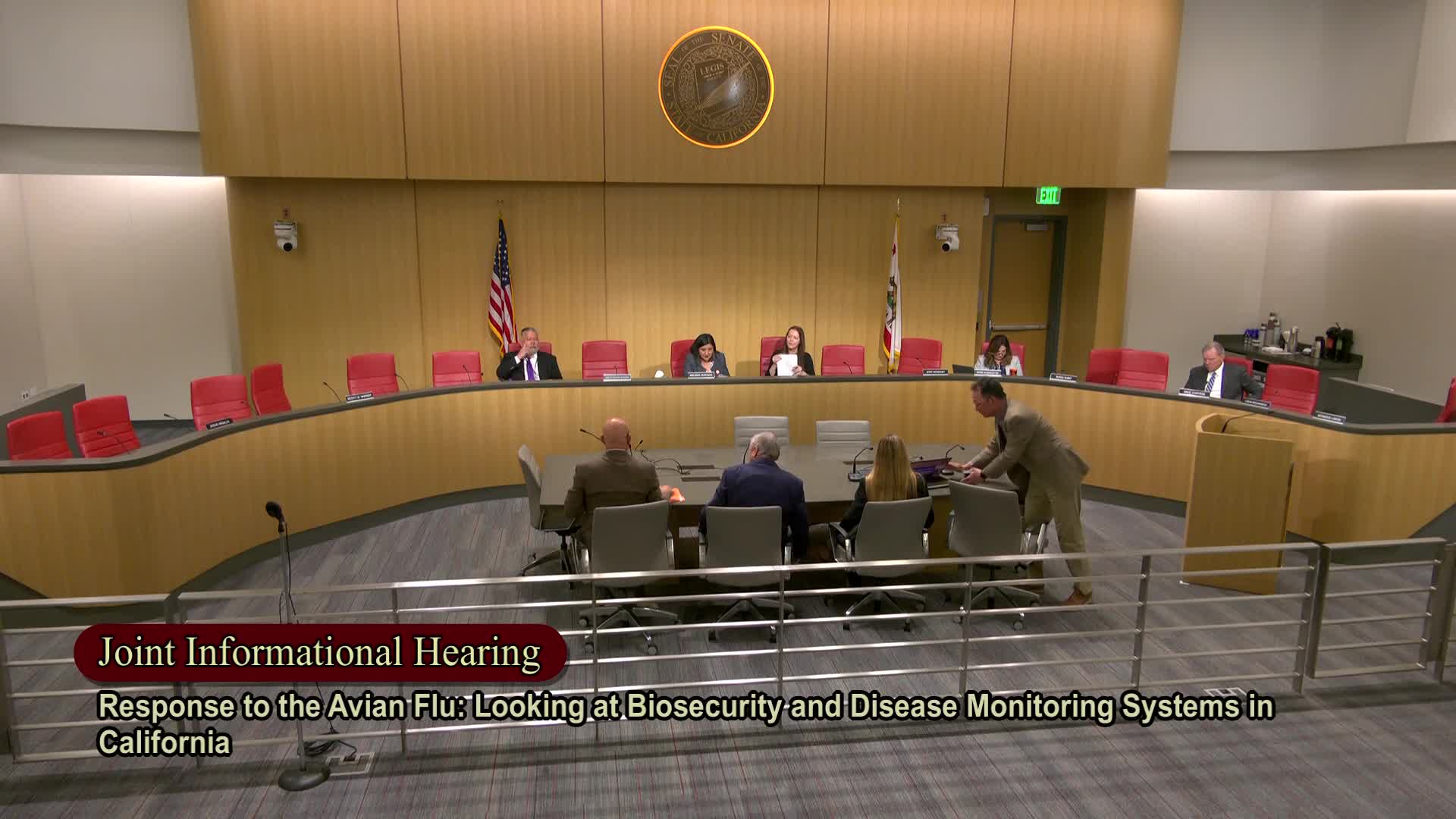
Leaders from California’s poultry and dairy industries told the joint Senate hearing that profound production losses, limited replacement birds and complex trade considerations are constraining recovery from the H5N1 outbreak.
"We take it very seriously," said Bill Matos, president of the California Poultry Federation, describing industry biosecurity steps and long experience responding to poultry diseases. Matos said modern poultry operations enforce strict disinfecting and access controls and credited state and federal laboratory systems for rapid testing capability.
David Will, vice president of sales for Chino Valley Ranchers, described the direct operational impact on one family‑owned organic farm that lost 180,000 laying hens in December despite following stringent biosecurity. Will requested stronger dairy movement restrictions and a national vaccination program to address the dairy as a viral harborage. "This dairy harborage of infection cannot be overlooked," he said, and he asked for epidemiologists to assist farms immediately after detection.
Doreen Dite, a field representative for California Dairies Inc., said the cooperative saw widespread drops in milk production, higher treatment costs, increased mortalities and breeding problems. She also described laboratory bottlenecks early in the outbreak, noting many bulk‑milk samples had to be sent to UC Davis and then out of state for confirmation, which slowed quarantines.
Numbers and operational realities: witnesses and earlier speakers offered several production figures during the hearing. In opening remarks Senator Hurtado said, "Statewide, that number is a 66,000,000 birds with 30,000,000 just since January" (opening remarks attributed to Senator Hurtado in the transcript). Industry witnesses described supply-chain impacts and long repopulation timelines for specialty flocks: one witness said replacing organic brown layers could take 12–18 months before full production resumes.
Industry requests to the Legislature included continued and prioritized funding for CDFA and local officials, faster on‑farm disinfect and depopulation support to shorten downtime, help with replacement‑bird supply and international trade‑aware vaccination strategies that would allow targeted use of vaccines without causing export bans.
What the committee heard: industry witnesses emphasized that, despite strong biosecurity, the combination of dairy infections and high local poultry density created conditions for unusual spread. They urged lawmakers to support coordinated state‑federal action on movement controls, vaccine research and repopulation assistance so producers can restore domestic supply more quickly.