Get Full Government Meeting Transcripts, Videos, & Alerts Forever!
Get email alerts on the Local Response Tulare topic
No spam. Unsubscribe anytime.
Tulare County details rapid local response after its first confirmed human H5N1 case
Summary
Tulare County public health officials said advance planning, a county operation center, local lab processing and community PPE distribution were central to their response after the county’s first confirmed human H5N1 case.
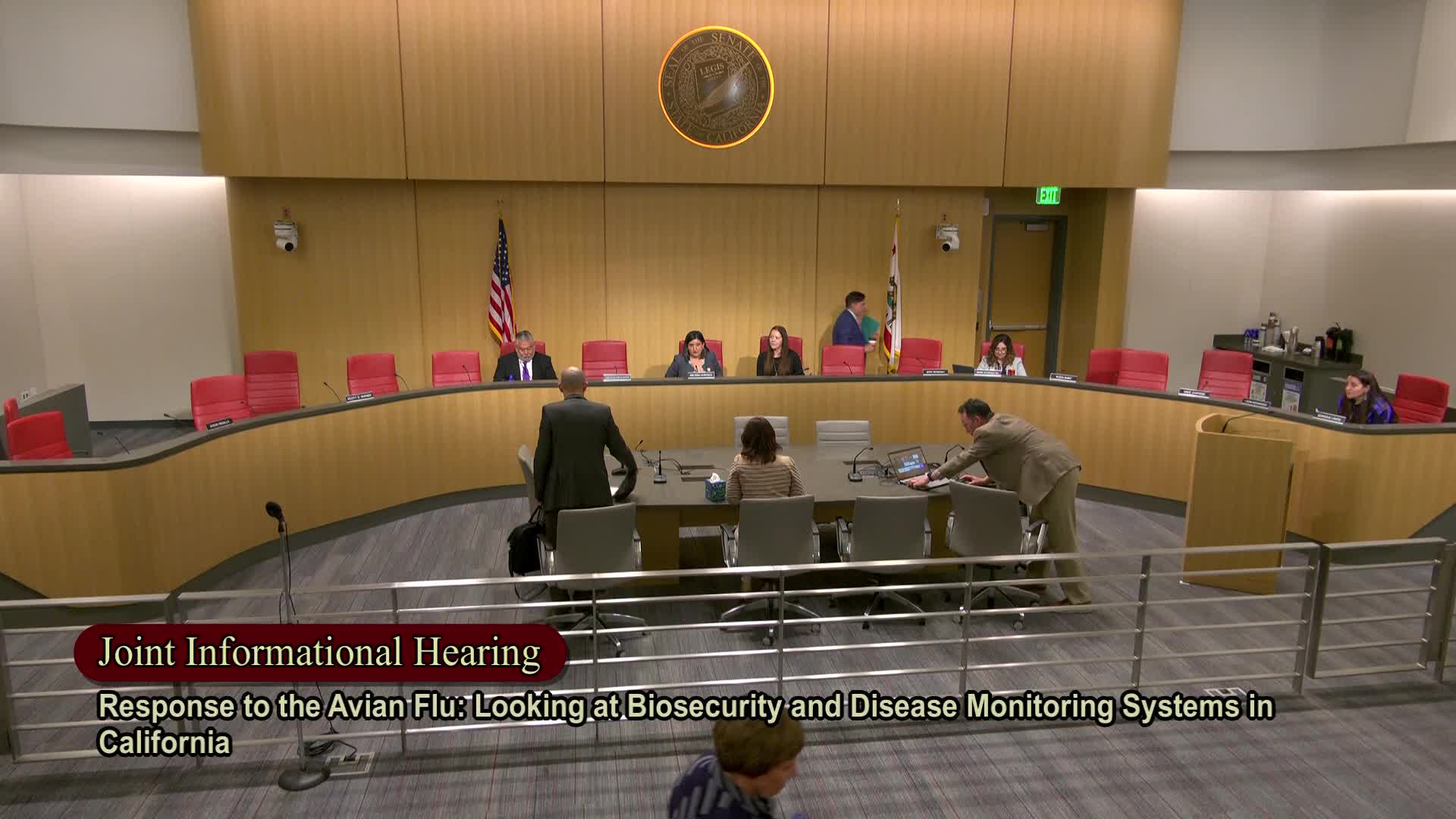
Tulare County public health officials told the Senate joint hearing that local planning and rapid activation of emergency operations limited harm after the county detected its first human H5N1 infection.
"It wasn't a question of if it would happen, but when," Tulare County Public Health Director Karen Elliott said. The county began preparing in March 2024, Elliott said, and held a large tabletop exercise in August 2024 that included more than 85 participants from dairy, state agencies, local health care and county partners.
Elliott described a multi-pronged local response after notification of the first human case on Oct. 3. Tulare activated a Department Operations Center (DOC) to coordinate case investigation, contact monitoring and resource distribution. "We organized PPE distribution events and outreach efforts to protect workers and prevent further spread," Elliott said, and she noted the county’s public-health lab typically provided same‑day processing for H5 testing of influenza-positive swabs.
The county emphasized partnerships: public health nursing staff monitored up to 2,000 exposed workers at once; environmental health dairy inspectors helped coordinate with dairy owners; and local community-based organizations joined PPE and outreach events. Elliott said the county used state technology systems — CalConnect, CalReady and MyCalVax — to facilitate monitoring and vaccine access.
Why it matters: Tulare County lies in California’s Central Valley, a high concentration area for dairies and a place where early introductions can quickly affect production and workers. Elliott said the county distributed a large share of state-supplied PPE, noting Tulare distributed more than 1.7 million pieces (the witness reported this was more than 10% of a national total referenced earlier in testimony).
What worked and what did not: Elliott credited the state’s "futures of public health" funding for building local capacity, and she said the longstanding local relationships between dairy inspectors, creameries and health departments accelerated outreach. She also said testing and surveillance were strengthened by having the Tulare public‑health lab rapidly screen local clinical specimens and support neighboring counties.
Elliott concluded that preparedness investments and community partnerships were decisive, and she urged continued funding for local public health capacity and for lab networks that can process surge testing quickly.