Get Full Government Meeting Transcripts, Videos, & Alerts Forever!
Get email alerts on the Avian Influenza Response topic
No spam. Unsubscribe anytime.
California officials describe integrated response, lab surge and federal funding to fight H5N1 outbreak
Summary
State and federal officials told a joint California Senate hearing that California has activated an integrated animal- and human-health response to H5N1, expanding testing and laboratory capacity, distributing PPE, and coordinating with USDA on federal funding and vaccine research.
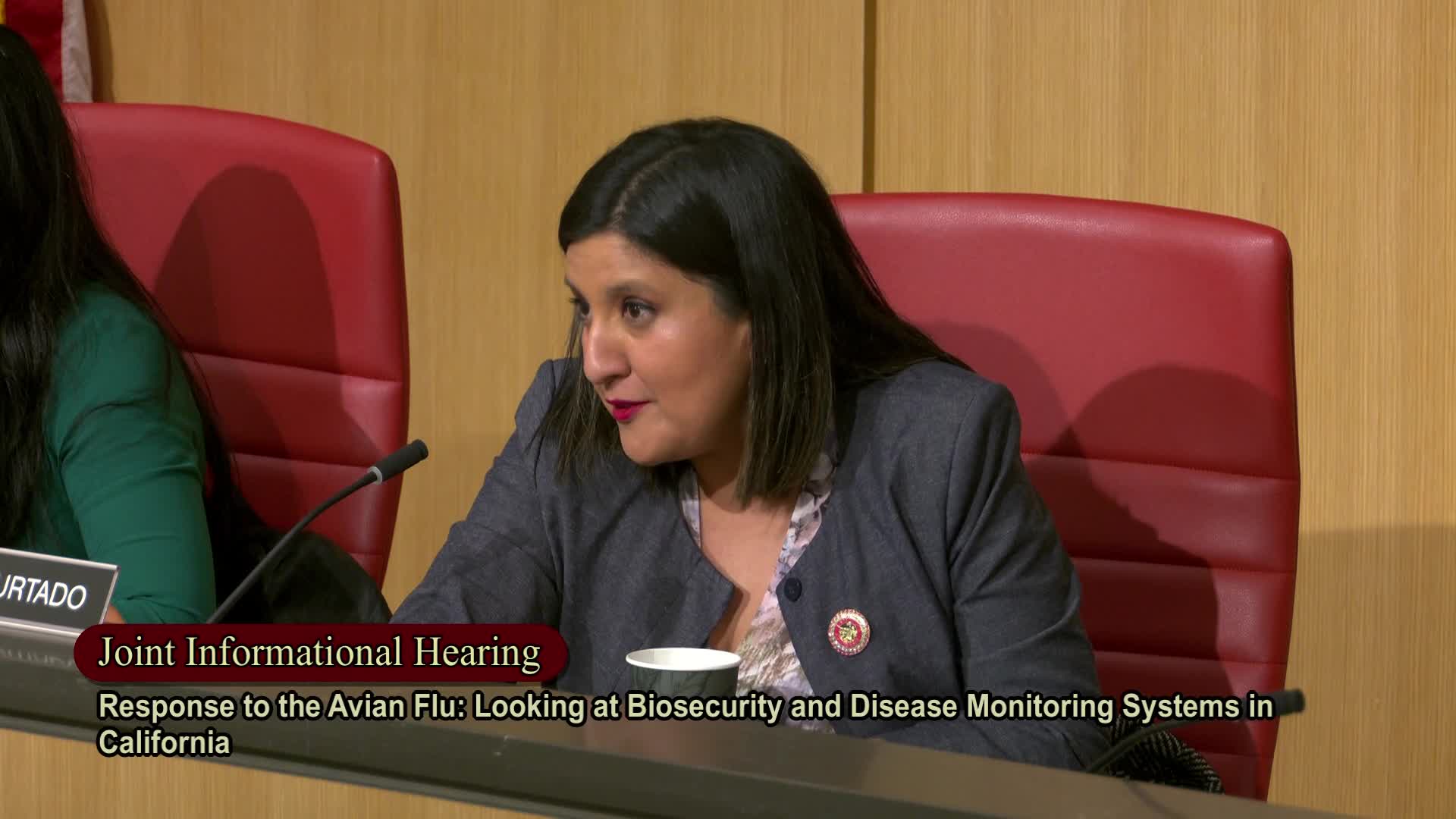
California officials told a joint Senate Health and Agriculture committee hearing that state and federal agencies have activated an integrated response, expanded testing and laboratory capacity, and secured federal funds to address the ongoing H5N1 avian influenza outbreak.
The testimony put a spotlight on three immediate priorities: strengthen farm-level biosecurity, scale and certify diagnostic testing, and support research into vaccines and therapeutics. "We have the expertise here," California Department of Food and Agriculture Secretary Karen Ross said, describing longstanding interagency relationships with state public health and federal partners. Ross highlighted partnerships with the UC Davis veterinary lab network and the use of the National Animal Health Laboratory Network to handle surges in samples.
Why it matters: witnesses said H5N1 has already disrupted poultry and dairy production and threatened food supply chains. Officials argued the state's historical investments in diagnostic laboratories, coordinated response plans and emergency contracting authority helped slow further harm after the governor declared an emergency in December.
State veterinarian Annette Jones described how the virus behaves differently by host and why that matters for policy. "It's not a may, it's a must," Jones said of the statutory duty that requires certain regulatory actions when specified livestock diseases are detected. Jones explained that the virus replicates readily in birds and that, in dairy cattle, the mammary gland is the easiest place to detect virus — which is why bulk-milk testing became a central surveillance tool.
Public health director Dr. Bridal Pan (California Department of Public Health) described the human‑health side of the response, including an incident management structure to monitor exposed workers and distribute personal protective equipment. "To date, we still have no reported human infections in poultry workers," Pan said, and she noted the department’s efforts to add H5 testing to routine influenza A diagnostics and to use wastewater surveillance as a complementary early‑warning tool.
From the federal side, USDA deputy administrator Dr. Rosemary Sifford told the committee the current outbreak is unusually persistent compared with prior HPAI episodes and emphasized expanded national surveillance for dairy and poultry. Sifford said USDA is putting new research and vaccine-development funding into play and coordinating vaccine‑ and biosecurity‑related requests for proposals.
Federal funding and lab capacity: witnesses described recent federal commitments that they said will be routed through multiple federal programs and state-federal partnerships — including about $1 billion in broadly-stated investments tied to biosecurity, roughly $400 million for financial assistance and surveillance programs, and $100 million targeted at accelerating vaccines and therapeutics, as described by Secretary Ross reporting USDA announcements. Witnesses also noted that some California lab capacity is still recovering from prior flood damage (a Tulare lab), while a new Turlock facility is expected online later this year.
What remains unresolved: officials said some risks persist because influenza viruses evolve; they emphasized the need for ongoing surveillance, calibrated use of any animal vaccine to avoid trade disruptions, and continued federal‑state coordination on surge personnel and diagnostics. Dr. Sifford cautioned that seasonal migration patterns of wild birds will influence future introductions and urged continued readiness.
Looking ahead, officials urged steady funding for laboratory networks and interagency response capacity, while noting that operational questions — such as when and how to deploy animal vaccines without harming export markets — will require careful scientific review and federal coordination.